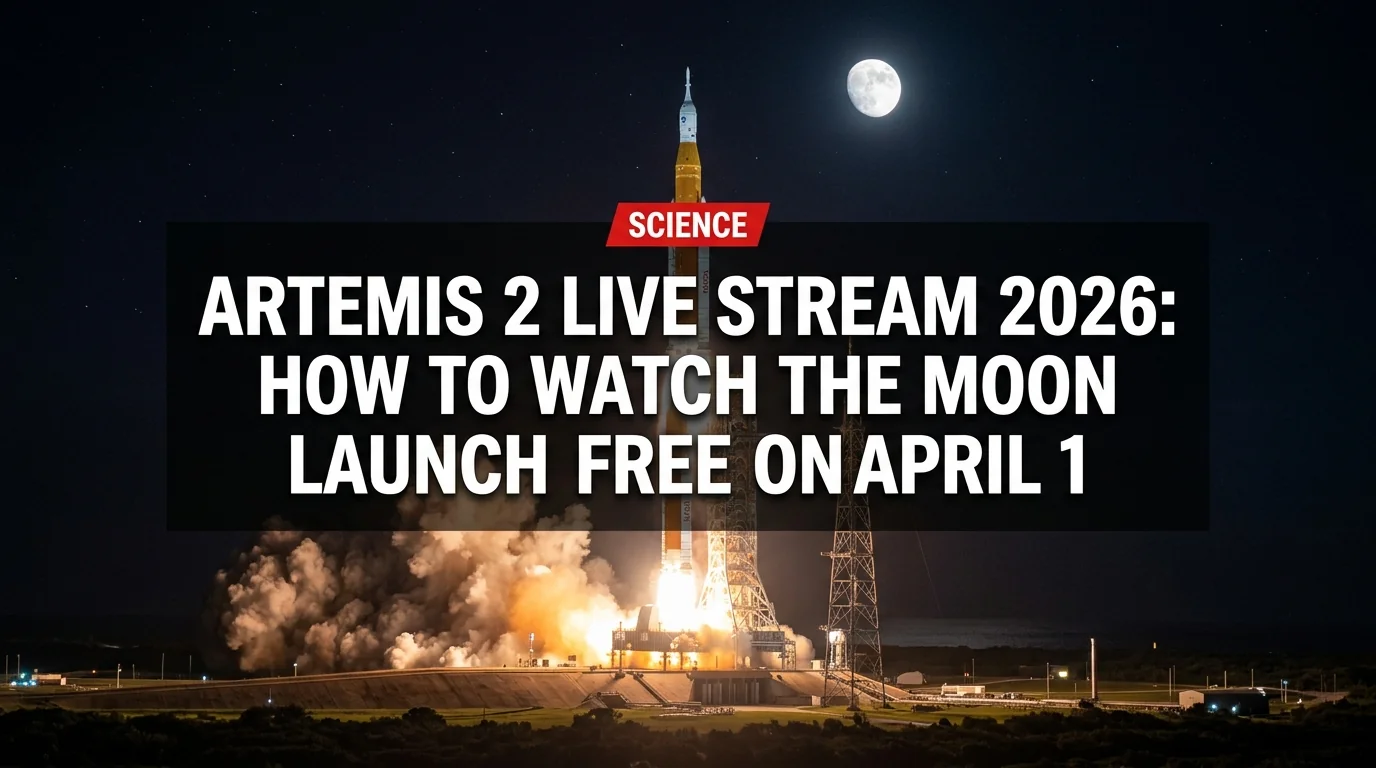
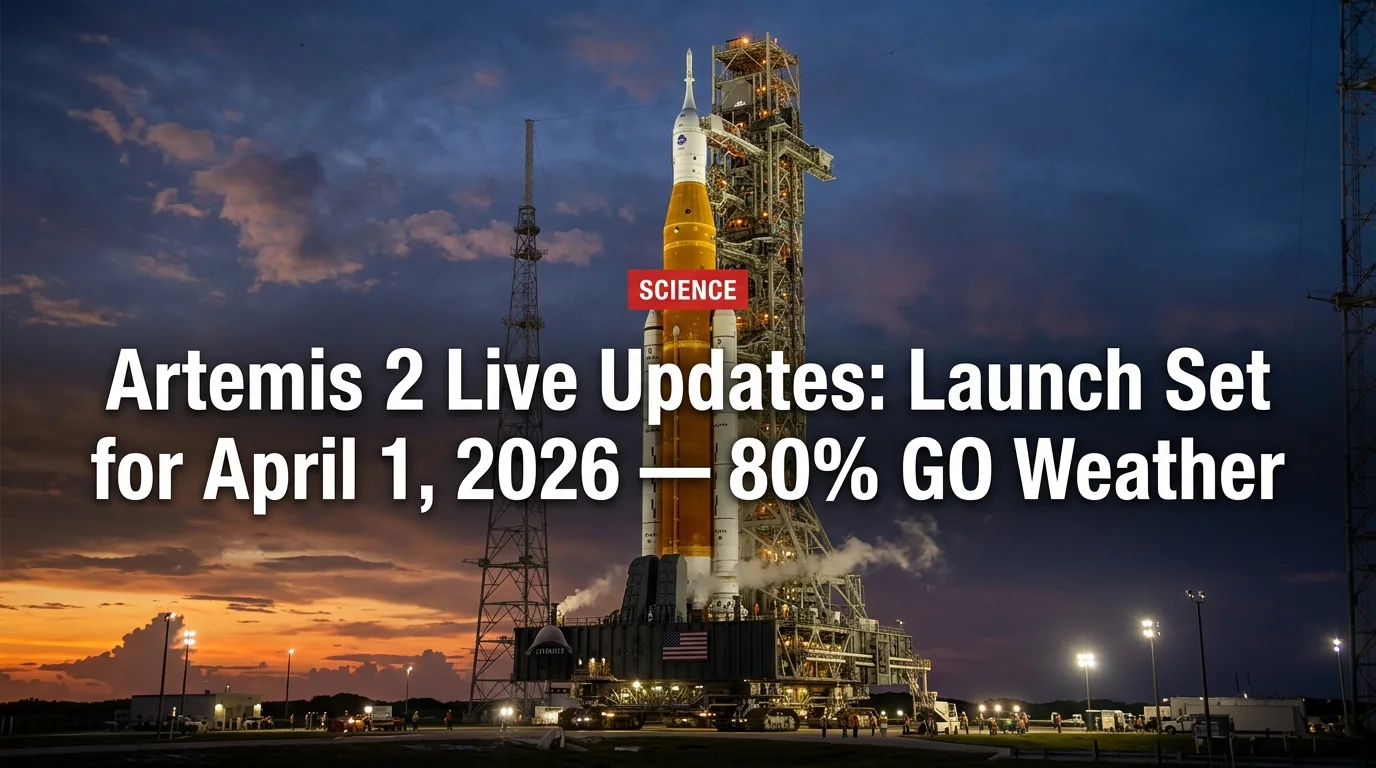
NASA's Artemis II mission — the first crewed flight to the Moon since 1972 — is on track for a historic launch on April 1, 2026, with the countdown officially underway and mission controllers reporting an 80% favorable weather forecast for liftoff.
The Artemis II crew — four astronauts aboard the Orion spacecraft atop NASA's Space Launch System (SLS) rocket — will fly a 10-day journey around the Moon and back in what NASA calls the proving flight before landing astronauts on the lunar surface with Artemis III.
The Crew Making History
Artemis II carries a crew of four, each with a historic distinction:
- Reid Wiseman (Commander, NASA) — veteran of ISS expeditions, selected as Artemis commander in 2023
- Victor Glover (Pilot, NASA) — will become the first person of color to travel around the Moon
- Christina Koch (Mission Specialist, NASA) — will become the first woman to fly around the Moon; holds the record for longest spaceflight by a woman
- Jeremy Hansen (Mission Specialist, Canadian Space Agency) — will become the first non-American to travel around the Moon
- First crewed Moon mission since Apollo 17 in December 1972 — a 53-year gap
- SLS is the most powerful rocket NASA has ever launched
- Orion capsule will reach ~370,000 km from Earth — farther than any crewed spacecraft since Apollo
- The crew entered quarantine in Houston on March 18, 2026
- Rocket rolled to Pad 39B on March 19 after earlier rollback for troubleshooting in February
Countdown Status: T-Minus and Counting
The official countdown began March 30, 2026 at 4:44 PM EDT, with launch teams at their consoles conducting final checks. Here is where things stand:
Weather Forecast: 80% Favorable
The 45th Weather Squadron at Cape Canaveral reports an 80% chance of favorable conditions for the April 1 launch window. Primary concerns being monitored:
- Cumulus cloud rule — prohibits launch through certain cloud layers that could trigger lightning on the rocket
- High ground winds — SLS stands 98 meters tall and is sensitive to crosswinds at the pad
- Thick cloud rule — if cloud layers exceed certain density thresholds, launch must wait
Forecasters note that afternoon conditions at the Florida coast in early April are historically cooperative. If scrubbed April 1, the next available window would be April 2 with similar weather prospects.
What Artemis II Will Actually Do
Unlike Apollo missions that landed on the Moon, Artemis II is a free-return trajectory flight — a figure-8 path using lunar gravity. The spacecraft will:
- Launch from Kennedy Space Center aboard SLS
- Enter a high Earth orbit, then perform a trans-lunar injection burn
- Swing around the far side of the Moon using lunar gravity
- Return on a free-return trajectory without entering lunar orbit
- Re-enter Earth's atmosphere at 40,000 km/h and splashdown in the Pacific
This is deliberate — the goal is to stress-test Orion's life support, navigation, and communications systems with a real crew aboard before committing to a lunar landing attempt. Think of it as a full dress rehearsal at maximum difficulty.
How to Watch Artemis 2 Launch Live
NASA is providing extensive free coverage across multiple platforms:
- NASA TV (free): nasa.gov/live, YouTube (@NASA), Peacock
- Crew walkout begins approximately 3 hours before launch (~3:30 PM EDT)
- Launch commentary begins 2 hours before liftoff (~4:30 PM EDT)
- Mobile apps: NASA app (iOS/Android) with push notifications for countdown updates
Why This Launch Matters
NASA has faced intense pressure on the Artemis program. The program has already cost over $93 billion since its inception, with multiple delays pushing back what was originally a 2024 Moon landing target. Artemis II was itself delayed from November 2024, then from September 2025, before the current April 1, 2026 target was set.
A successful Artemis II flight — even without landing — would validate SLS and Orion for crewed deep-space operations, clear the path for Artemis III (the Moon landing), and maintain US leadership in lunar exploration ahead of China's planned crewed lunar mission in the late 2020s.
The global audience is expected to be enormous. NASA estimates over 10 million viewers for the launch broadcast — rivaling Apollo-era numbers.
What Comes Next: Artemis III
If Artemis II succeeds, Artemis III — the actual Moon landing — is currently targeted for no earlier than 2027. That mission will use SpaceX's Starship Human Landing System (HLS) to ferry two astronauts from Orion to the lunar surface near the south pole, where water ice deposits have been confirmed.
The stakes on April 1 are high. Every second of Artemis II is data that feeds into whether humans set foot on the Moon again within this decade.
Follow linos.ai for live updates as the April 1 launch window approaches.