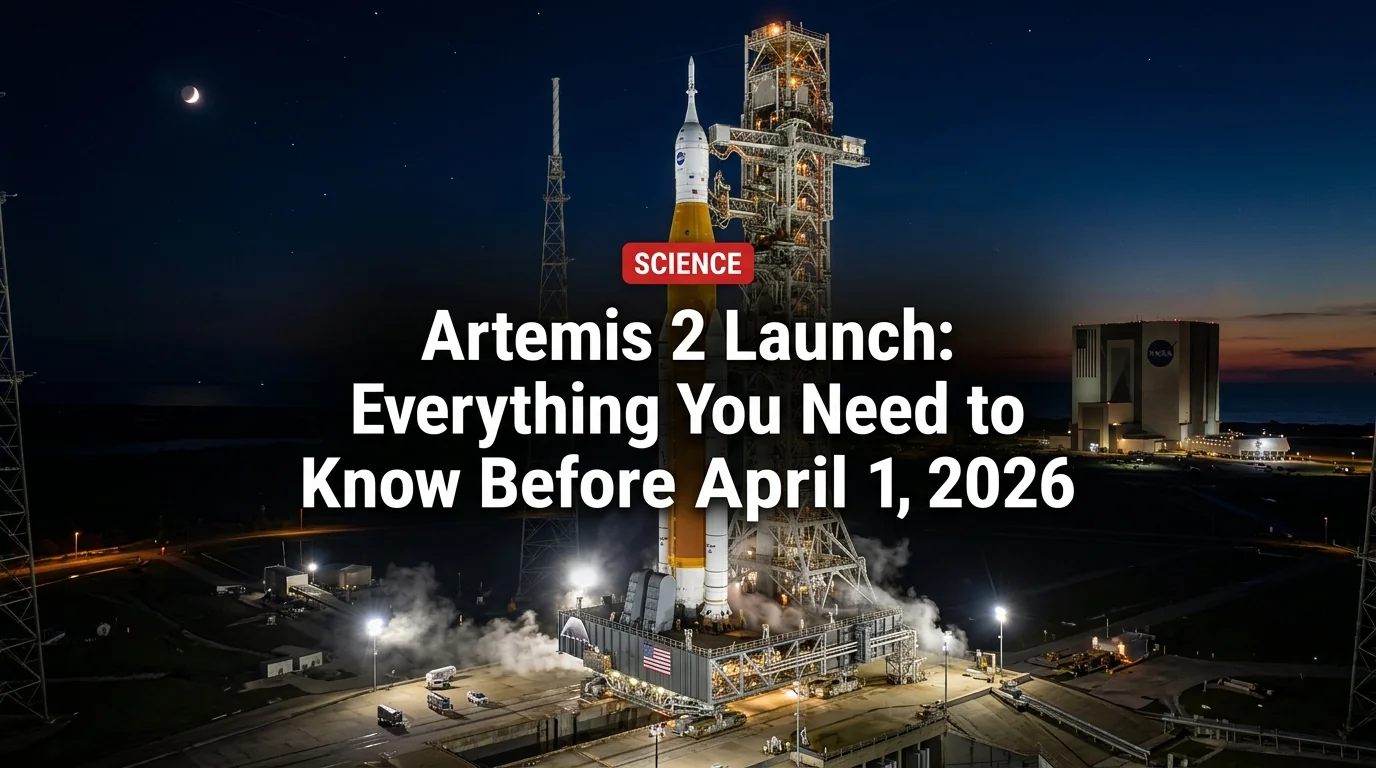
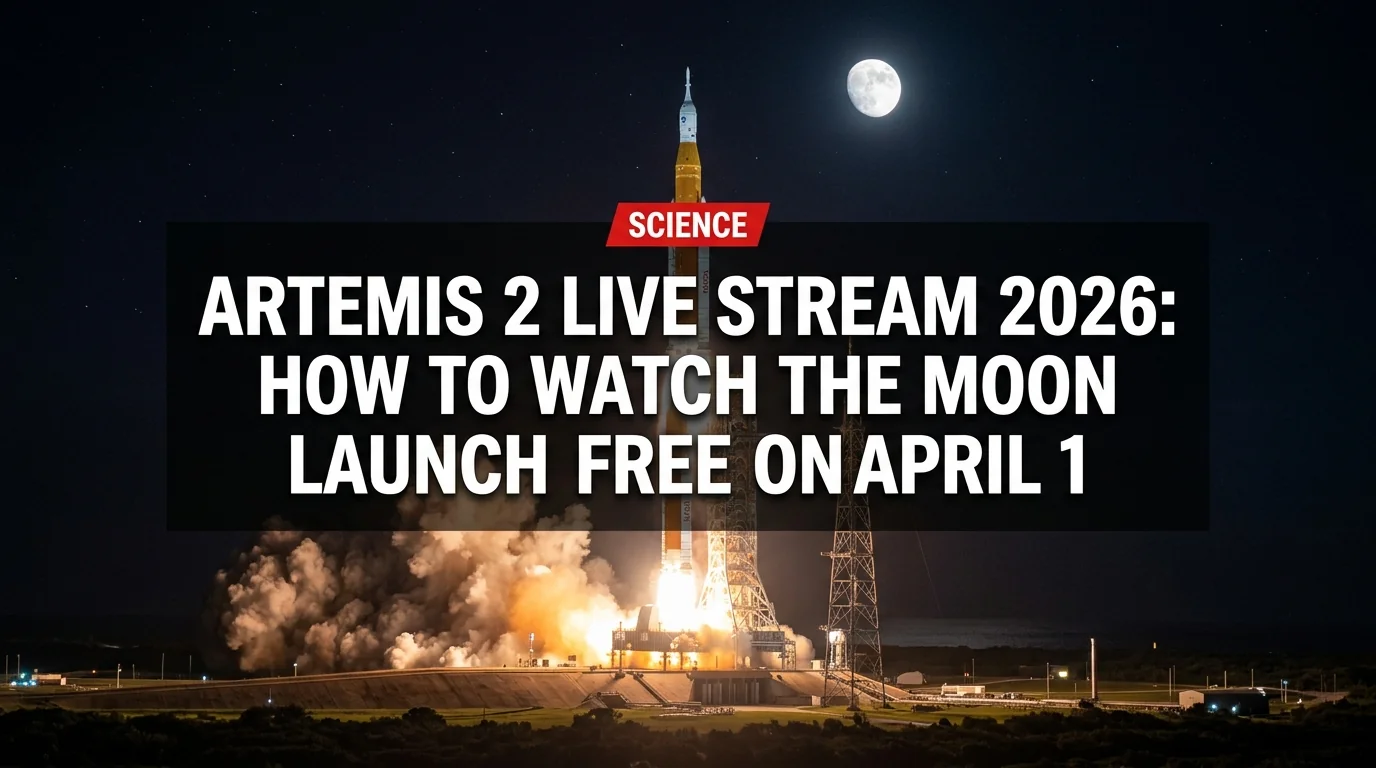
After more than 50 years since Apollo 17, humanity is going back to the Moon — with people aboard. NASA's Artemis II mission lifts off from Kennedy Space Center on Wednesday, April 1, 2026, at 6:24 PM EDT (22:24 UTC), sending four astronauts on a 10-day journey around the Moon. This is the moment the space program has been building toward for years, and you can watch every second of it for free. Here is exactly how.
The Mission at a Glance
Artemis II is the first crewed flight of NASA's Space Launch System (SLS) rocket and the Orion spacecraft. The crew will loop around the Moon without landing — a critical rehearsal before Artemis III puts boots on the lunar surface.
- Launch date: Wednesday, April 1, 2026
- Launch time: 6:24 PM EDT (22:24 UTC / 11:24 PM BST)
- Launch site: Pad 39B, Kennedy Space Center, Florida
- Launch window: 2 hours (closes at 8:24 PM EDT)
- Backup dates: April 2–6, 2026, plus April 30 if needed
- Mission duration: ~10 days around the Moon
The Crew: Meet the Four Astronauts
This crew is historic on multiple levels. Victor Glover becomes the first Black astronaut to travel to the Moon. Jeremy Hansen becomes the first Canadian. Christina Koch brings a depth of long-duration spaceflight experience matched by few people alive. Commander Wiseman has led the crew through years of training at NASA's Johnson Space Center.
How to Watch Artemis II Live — Every Free Option
1. NASA+ (Best Option — Completely Free, No Ads)
NASA+ is NASA's own streaming platform and the gold standard for launch coverage. It is completely free, runs no advertisements, and provides the most comprehensive pre-launch and post-launch commentary of any platform.
- Where: plus.nasa.gov or the NASA app (iOS, Android)
- Coverage starts: Approximately 6 hours before liftoff — around 12:24 PM EDT
- What you get: Mission commentary, launch control audio, expert interviews, post-launch trajectory updates
- Geo-restrictions: None — available worldwide
2. NASA YouTube Channel (Free, No Account Needed)
NASA's YouTube channel provides the same live feed as NASA+, with the added benefit of a massive live chat where space fans around the world react in real time. No sign-in required.
- Where: youtube.com/NASA
- Coverage: Same as NASA+ — full pre-launch through orbit insertion
- Archive: The full stream will remain available for replay after the launch
3. Netflix (Yes, Really — Free Through NASA)
In a surprise partnership announced in early 2026, NASA's live feeds are embedded directly within Netflix's interface. If you have a Netflix subscription, you will see the Artemis II launch stream as a featured live event. This is the same NASA+ feed, just surfaced inside the Netflix UI — no extra cost.
4. Broadcast TV (ABC, NBC, CBS, CNN, Fox News)
All major US broadcast and cable news networks are expected to carry live coverage, particularly around the launch window and immediately after liftoff. CNN and Fox News are likely to provide the most sustained continuous coverage. ABC, NBC, and CBS will carry special segments but may cut away to regular programming during the quieter orbital phases.
5. International Streaming Options
United Kingdom:
- BBC News Channel and BBC iPlayer will carry live coverage (no VPN needed)
- Coverage expected to begin around the 1-hour pre-launch mark
Europe:
- Euronews, France 24 (English), ARD (Germany), ZDF (Germany)
- All NASA streams (NASA+, YouTube) are globally accessible without geo-restrictions
Australia/New Zealand: Launch time converts to 8:24 AM AEST on April 2 — a civilized breakfast time. NASA+ and YouTube are your best options.
India: Launch is 3:54 AM IST on April 2. NASA+ and YouTube are the go-to sources.
What to Watch For During the Launch
The launch sequence itself runs approximately 8 minutes from ignition to the point where Orion reaches orbit. After that, there is a critical burn called the Trans-Lunar Injection (TLI) that will send the crew toward the Moon — this happens roughly 90 minutes after launch and is the moment the mission truly begins.
What If the Launch Gets Scrubbed?
Scrubs happen — weather, technical issues, range conflicts. NASA has backup windows April 2 through April 6 and a reserve window on April 30. If April 1 is scrubbed, NASA typically announces the new target within 24 hours. Follow nasa.gov or the NASA app for real-time status updates.
- 2-hour launch window gives some flexibility
- Favorable April weather at KSC historically
- SLS has been validated by Artemis I in 2022
- Multiple backup dates available
- Florida spring storms can cause last-minute scrubs
- High upper-level winds are a common constraint
- Any technical anomaly triggers automatic hold
Watch the Pad Live Right Now
NASA is running a 24/7 livestream from Pad 39B during the final pre-launch preparations. You can watch the SLS rocket sitting on the pad in real time at youtube.com/NASA. It is oddly compelling — thousands of people are watching a rocket do nothing, and loving every second of it.
Why This Matters
Artemis II is not just a mission. It is the first time in 54 years that human beings have traveled to the Moon. The last time was Apollo 17 in December 1972. Everyone alive today who watches this launch is witnessing something their parents' generation thought might never happen again.
The crew will not land — that is Artemis III — but the Orion capsule will come closer to the lunar surface than any crewed spacecraft has since Gene Cernan climbed into the Apollo 17 ascent stage. For a few hours, four human beings will see the Moon the way only 24 people in all of history have ever seen it.
Set your alarm. This one is worth staying up for.