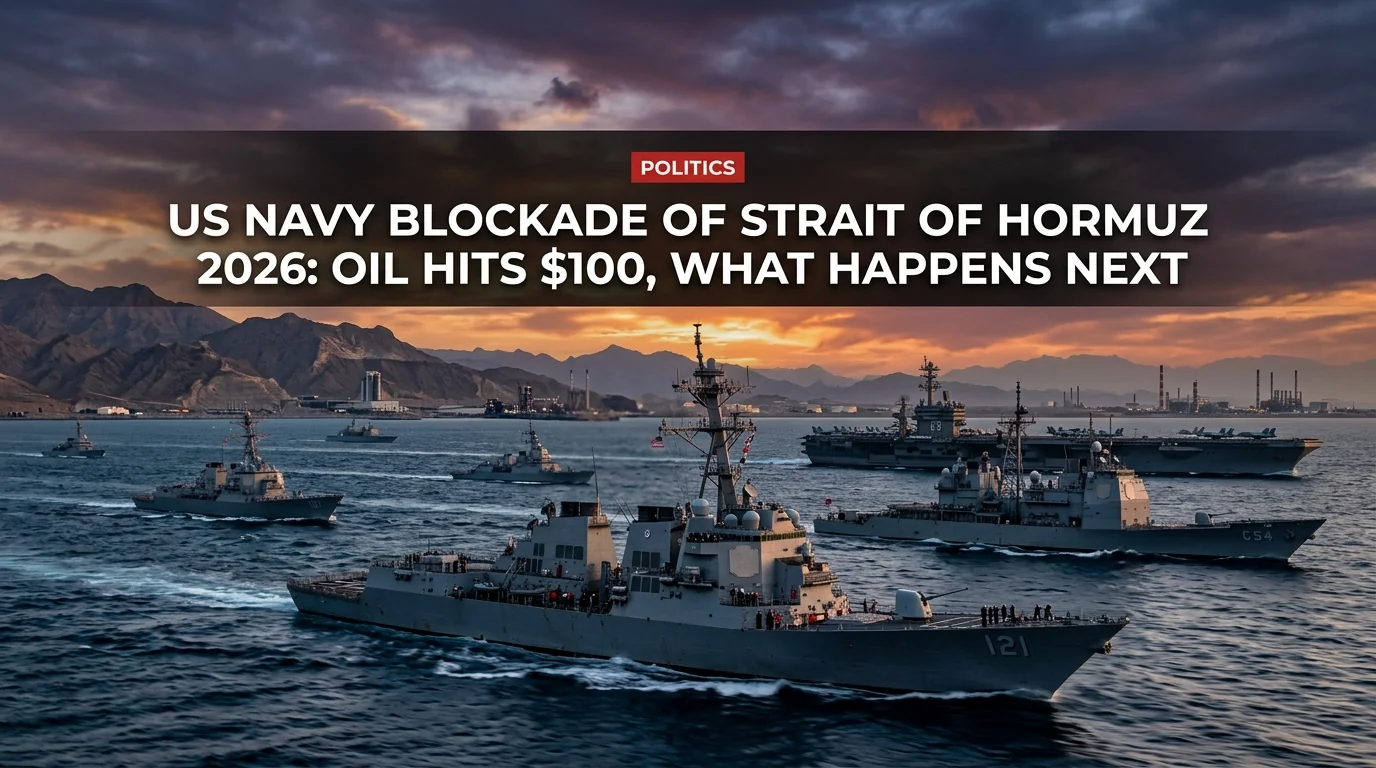
The United States Navy has begun enforcing a blockade of Iranian ports in the Strait of Hormuz today, April 13, 2026 — a dramatic escalation following the collapse of peace negotiations in Pakistan. The move is sending shockwaves through global energy markets, with Brent and WTI crude both surpassing $100 per barrel for the first time in years, and triggering sharp selloffs across Asian and Australian stock exchanges.
What Is the Strait of Hormuz and Why Does It Matter?
The Strait of Hormuz is a 21-mile-wide waterway between Iran and Oman connecting the Persian Gulf to the Gulf of Oman. It is the single most important oil chokepoint in the world. Nearly a fifth of all petroleum traded globally passes through it, including massive volumes from Saudi Arabia, Iraq, Kuwait, the UAE, and Qatar.
Any sustained disruption — even the threat of one — triggers immediate price spikes in energy markets. Iran has repeatedly threatened to close the strait during past standoffs with the West; the U.S. has always maintained a significant naval presence in the region specifically to deter that scenario. Today, the dynamic has inverted: it is the U.S. imposing the closure, targeting Iranian port access.
What Happened: Collapse of Pakistan Peace Talks
U.S.-Iran diplomatic efforts, mediated in part through backchannel discussions in Islamabad, broke down over the weekend. Sources familiar with the negotiations cited Iranian refusal to accept limits on its enrichment program and continued disputes over sanctions relief timelines. The Trump administration responded by authorizing the naval blockade, framing it as a pressure measure rather than an act of war.
The blockade targets Iranian-flagged vessels and ships bound for Iranian ports, with the U.S. Navy's Fifth Fleet positioned to intercept and turn back commercial traffic. Iran has called the action an "act of piracy" and vowed "asymmetric retaliation."
Market Reaction: Oil Above $100, Asia Stocks Plunge
The response from financial markets was swift and severe.
The oil price surge has immediate downstream consequences. Gasoline futures in the United States jumped nearly 12 cents per gallon in morning trading. Airlines including Delta and United issued statements warning of potential fuel surcharges. Heating oil, jet fuel, and petrochemical feedstocks are all moving sharply higher.
Gulf state economies face a paradox: higher oil prices benefit their sovereign revenues, but regional instability threatens trade, tourism, and investment. Dubai's luxury retail sector — heavily dependent on Iranian and regional high-net-worth travelers — has already seen reported revenue drops of 30 to 50 percent at major malls as wealthy visitors cancel trips.
Geopolitical Ripple Effects
The blockade is not unfolding in isolation. Several other flashpoints are converging simultaneously.
- Israel reported to have rammed UNIFIL peacekeeping vehicles with Merkava tanks in South Lebanon earlier today
- Viktor Orbán conceded defeat in Hungarian elections; opposition Tisza party claims a landslide win
- Pope Leo — the first American-born Pope — issued a public anti-war statement; President Trump called him "weak" and "terrible"
- China's clean technology firms are rallying on the energy shock, with analysts flagging them as primary beneficiaries of the oil supply squeeze
The cumulative weight of these events — a Middle East military escalation, a pivotal European election outcome, and a public rupture between the White House and the Vatican — has created an unusually volatile backdrop for markets and diplomacy alike.
What Happens If the Strait Stays Closed?
Economists and energy analysts are already running scenarios.
A prolonged closure lasting more than 30 days would be historically unprecedented and is widely viewed as unsustainable — both economically and militarily. However, even a two-to-three-week disruption could ripple through global supply chains in ways that take months to resolve.
What to Watch Next
- OPEC+ emergency meeting: Saudi Arabia and the UAE are expected to discuss increasing output to partially offset supply fears
- UN Security Council session: France and the UK have called for an emergency session; Russia and China expected to oppose any resolution endorsing the blockade
- Iran's response: Tehran has convened its Supreme National Security Council; options reportedly include closing Iranian airspace to foreign carriers
- U.S. domestic politics: Congressional leaders demanding briefings; formal authorization of military force debate may be unavoidable
The Bottom Line
The U.S. Navy blockade of Iranian ports in the Strait of Hormuz is the most consequential unilateral military-economic action in years. Oil above $100/barrel is no longer a tail risk — it is today's reality. The question is whether diplomacy can reassert itself before an already volatile global situation becomes something far harder to contain.