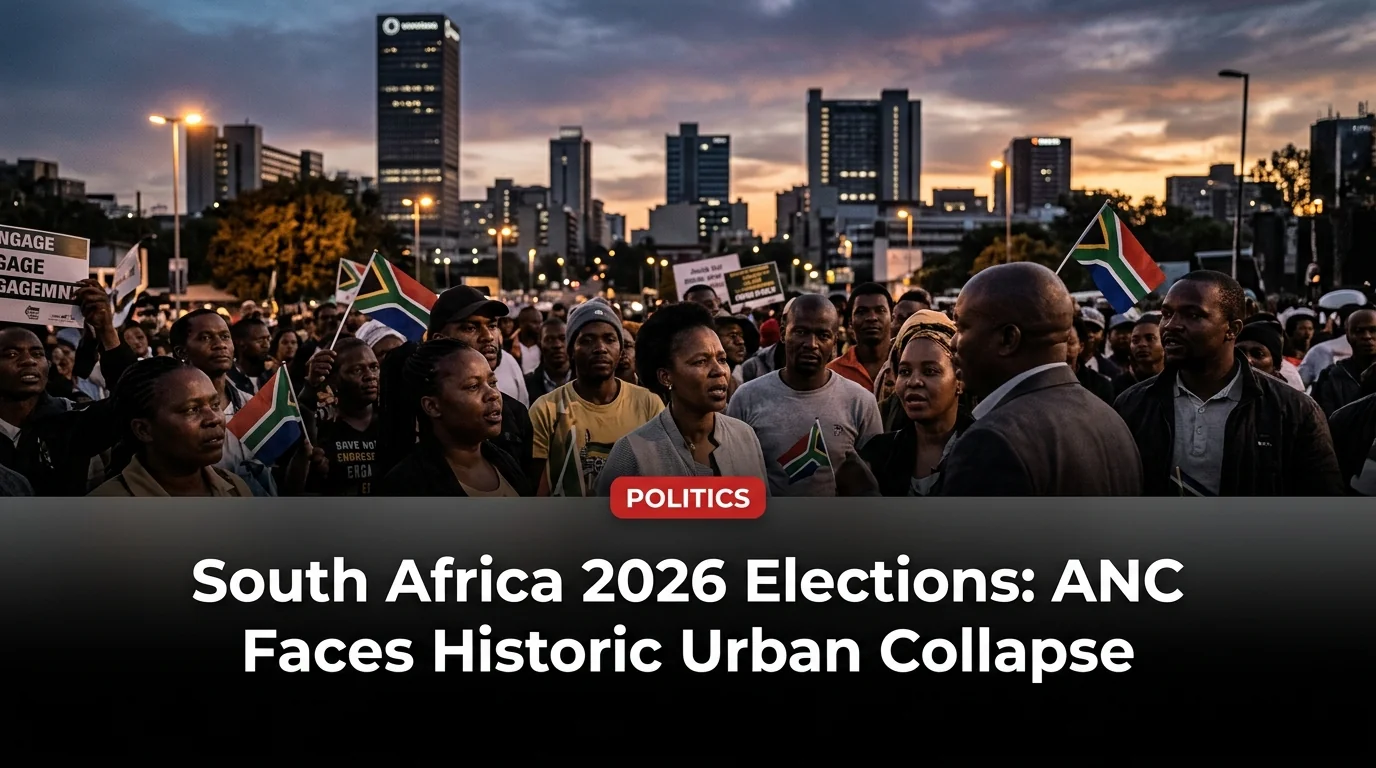
South Africa's ruling African National Congress is heading into its most consequential municipal election in three decades — and the numbers suggest it may not survive the ballot box intact. With voter registration at historic lows, internal party chaos in Johannesburg, and opposition coalitions circling every major metro, the 2026 Local Government Elections could mark the end of ANC dominance in urban South Africa.
The Stakes: 4,488 Wards, 257 Municipalities, One Verdict
Scheduled between November 2, 2026, and January 31, 2027, these elections will be the first municipal polls since the ANC lost its national majority in the 2024 general election. That seismic shift forced the creation of a Government of National Unity (GNU) — and now voters get to deliver their verdict on whether coalition politics actually works.
- 27.67 million registered voters — but nearly 50% of eligible citizens remain unregistered
- 4,488 wards across 257 municipalities up for contest
- 508 political parties registered, including 62 new entrants
- R2.6 billion ($142M) election budget — up from initial R2.1 billion
- 8 metropolitan municipalities at stake, 5 currently governed by unstable coalitions
The Democracy Crisis Nobody's Talking About
A Human Sciences Research Council survey released March 24, 2026, dropped a bombshell: only 17% of South Africans say they intend to vote in the upcoming elections. That's not a typo.
The numbers paint a picture of a democracy in crisis:
Dr. Ben Roberts of the HSRC put it bluntly: "There is a very large gap between the importance attached to politicians listening to citizens and the evaluation of politicians' ability to do this."
Gauteng province — home to Johannesburg, Pretoria, and the economic heartland — recorded the lowest belief that voting is a civic duty at just 47%, the worst of any province.
The Battle for Johannesburg
Nowhere is the ANC's crisis more visible than in Johannesburg, where the party is simultaneously fighting the opposition and itself.
The ANC's internal fracture is extraordinary. Its own Johannesburg Regional Executive Committee tried to recall Mayor Dada Morero — only to be overruled by the national leadership. Political analyst Hlumelo Xaba called it a "fractured political system that makes stable leadership almost impossible."
The Contenders: Who Wants Johannesburg?
The race for South Africa's economic capital has become a three-way brawl:
- Veteran administrator, former Cape Town mayor
- Running on governance track record
- DA polling strongest in Gauteng suburbs
- Coalition-tested from GNU partnership
- Incumbent mayor fighting recall from own party
- Hamstrung by ANC internal divisions
- Party polling below 30% in Gauteng metros
- Service delivery record under fire
Analysts predict the ANC could drop below 30% in Gauteng's metros — a collapse from the party that once commanded 60%+ across the board.
The Wild Cards
Two forces could reshape the entire contest:
The MK Party's First Municipal Test. Jacob Zuma's uMkhonto weSizwe Party, which stunned analysts by winning 14.6% nationally in 2024, faces its first-ever local elections. A massive leadership reshuffle in March 2026 saw Sibonelo Nomvalo appointed Secretary-General. The party's strength in KwaZulu-Natal could tip coalition arithmetic in multiple metros.
The SACP Goes Solo. For the first time in its history, the South African Communist Party has registered to contest elections independently of the ANC — a divorce that could split the left vote and accelerate the ANC's decline in working-class wards.
What's Being Done About Coalition Chaos
The Government of National Unity is pushing the Municipal Structures Amendment Bill — colloquially known as the "Coalition Bill" — to create a legal framework for coalition governance. The bill aims to:
- Regulate how coalition agreements are formed and enforced
- Strengthen accountability for coalition partners
- Prevent the "floor-crossing" and vote-buying that destabilized councils after 2021
Whether it passes before the election remains uncertain.
The Road Ahead
- June 20-21, 2026 — First national voter registration weekend
- August 2026 — Second registration weekend
- After June — Minister Hlabisa expected to announce exact election date
- November 2026–January 2027 — Election window
The next critical milestone is the June registration weekend. If the HSRC survey's dire turnout predictions hold, South Africa could see its lowest municipal election participation since democracy began in 1994.
For the ANC, the question is no longer whether it will lose ground — but how much. For South African democracy, the question is whether voters still believe it's worth showing up at all.