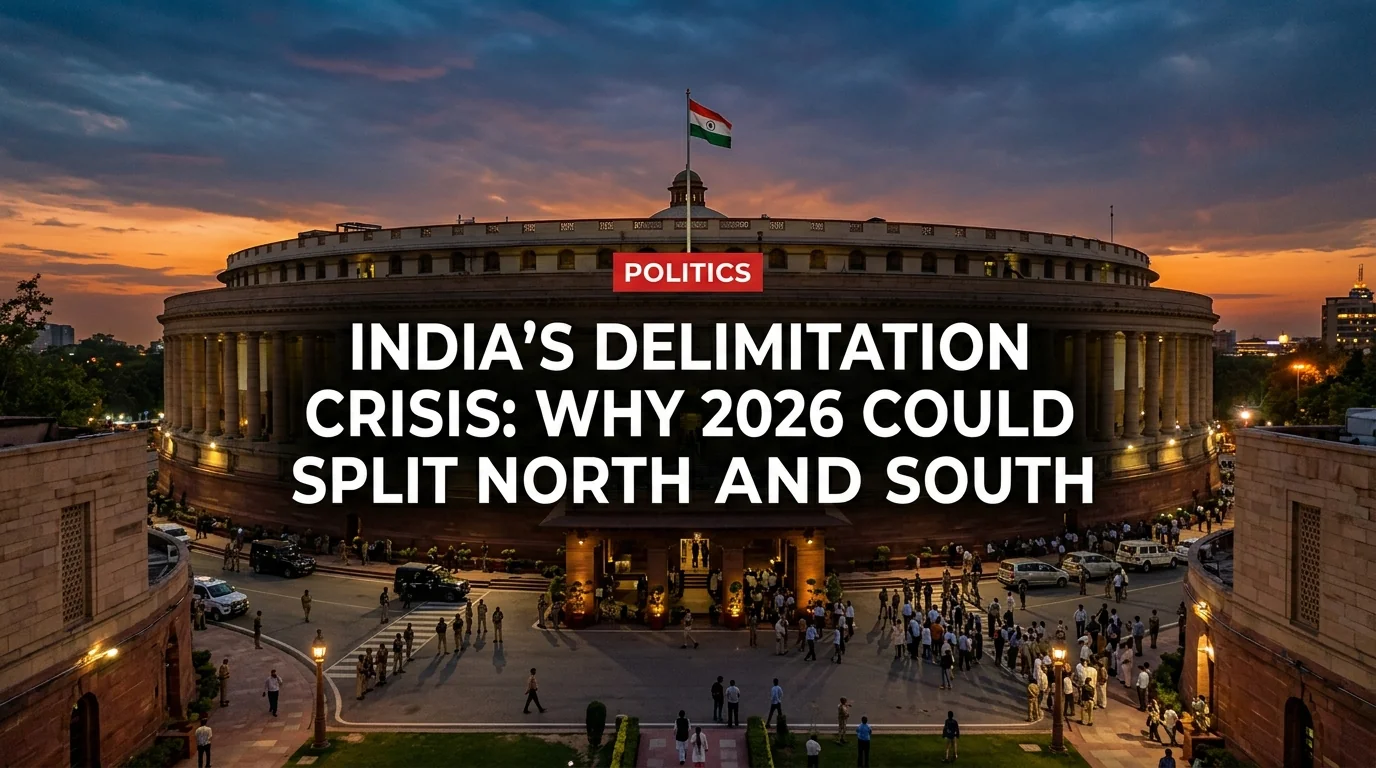
India is staring down its most consequential constitutional crisis in decades. The 50-year freeze on parliamentary seat allocation — designed to shield states from being penalized for population control — expires this year, and the math is brutal.
Southern states that successfully curbed population growth now face losing political power to northern states that didn't. It's a collision between democracy's core principle of equal representation and the federal promise that good governance won't be punished.
What's Actually Happening
India's Lok Sabha (lower house of Parliament) currently has 543 seats, distributed based on the 1971 Census — when the country had 548 million people. India now has over 1.4 billion. The 84th Constitutional Amendment (2001) froze seat allocations until the first census after 2026 to give slower-growing states time to catch up.
That time is up.
The new Parliament building, inaugurated in 2023, was built with 888 seats in the Lok Sabha chamber — a clear signal that a massive expansion is coming.
The Numbers That Tell the Story
If seats are redrawn purely on population, the redistribution is dramatic:
| State | Current Seats | Projected Seats | Change | Population per MP |
|---|---|---|---|---|
| Uttar Pradesh | 80 | 128–143 | +48 to +63 | ~2.5M |
| Bihar | 40 | 70–79 | +30 to +39 | ~2.6M |
| Rajasthan | 25 | 44 | +19 | ~2.7M |
| Tamil Nadu | 39 | 41–49 | +2 to +10 | ~1.8M |
| Kerala | 20 | 19 | −1 | ~1.7M |
The raw numbers obscure the real damage. Even where southern states don't lose seats in absolute terms, their proportional share of Parliament collapses. Tamil Nadu currently holds 7.2% of Lok Sabha seats. Under an expanded 848-seat house, it could hold as little as 4.8%.
The Core Tension: Democracy vs. Federalism
- One MP in UP represents 2.5 million people
- One MP in Kerala represents 1.7 million
- Current system violates democratic equality
- Population-based allocation is constitutionally mandated
- Southern states implemented family planning successfully
- They contribute 31% of India's GDP
- Maharashtra + Karnataka pay 50%+ of direct taxes
- Losing seats means losing control over how their taxes are spent
Tamil Nadu Chief Minister M.K. Stalin has called delimitation a "Sword of Damocles" hanging over southern states. In March 2025, he hosted the first meeting of the Fair Delimitation Joint Action Committee (JAC) — a coalition of southern and opposition-led states from Tamil Nadu, Kerala, Telangana, Karnataka, and Punjab — to build a united front.
Union Home Minister Amit Shah has assured that no southern state will "lose a single seat." But critics note that in an expanded house, holding 20 seats while others gain 60 is a loss by any meaningful measure.
The Timeline Ahead
The Money Problem
This isn't just about seats — it's about money. India's tax revenue flows upward to the central government and is then redistributed to states through the Finance Commission. Southern states already feel they send more to Delhi than they get back.
- Maharashtra and Karnataka alone contribute **over 50%** of India's direct tax revenue
- Southern states produce roughly **31% of India's GDP** with about 20% of the population
- The 16th Finance Commission increased southern states' allocation by **₹18,330 crore** to ease tensions
- A new **10% weight for "contribution to GDP"** was added to the devolution formula
The fear is straightforward: if northern MPs dominate the Lok Sabha, they'll control the budget. States that generate the wealth will have less say in how it's spent.
What Are the Options?
Delimitation isn't inevitable in its most disruptive form. Several alternatives are being debated:
- **Extend the freeze** another 25 years — buys time but kicks the can down the road
- **Expand the house** to 848+ seats so no state loses current seats — logistically complex but politically palatable
- **Weighted formula** using development indicators (literacy, health, TFR) alongside population — fairer but constitutionally untested
- **Strengthen the Rajya Sabha** to counterbalance Lok Sabha shifts — preserves bicameral checks
- Every delay deepens the democratic deficit for underrepresented northern voters
- Expansion without reform still dilutes southern proportional power
- Any formula beyond population faces legal challenges
- Rajya Sabha reform alone doesn't address Lok Sabha voting power
Former Chief Election Commissioner S.Y. Quraishi has argued that "population should not be the sole criterion," advocating for a hybrid approach. But any formula that deviates from pure population will face constitutional scrutiny — and accusations of rigging from both sides.
Why This Matters Beyond India
India's delimitation debate echoes a universal democratic tension: how do you balance equal representation with protecting minorities from permanent marginalization? The United States wrestles with similar questions in Senate representation. The European Union faces it in Parliament seat allocation.
The stakes are existential for Indian federalism. Get it wrong, and the country risks a permanent north-south political fracture. Get it right, and India could become a model for how diverse democracies evolve.
The census begins next month. The clock is ticking.
The Delimitation Commission's orders have the force of law and cannot be challenged in any court. Whatever formula India chooses will reshape its democracy for decades.