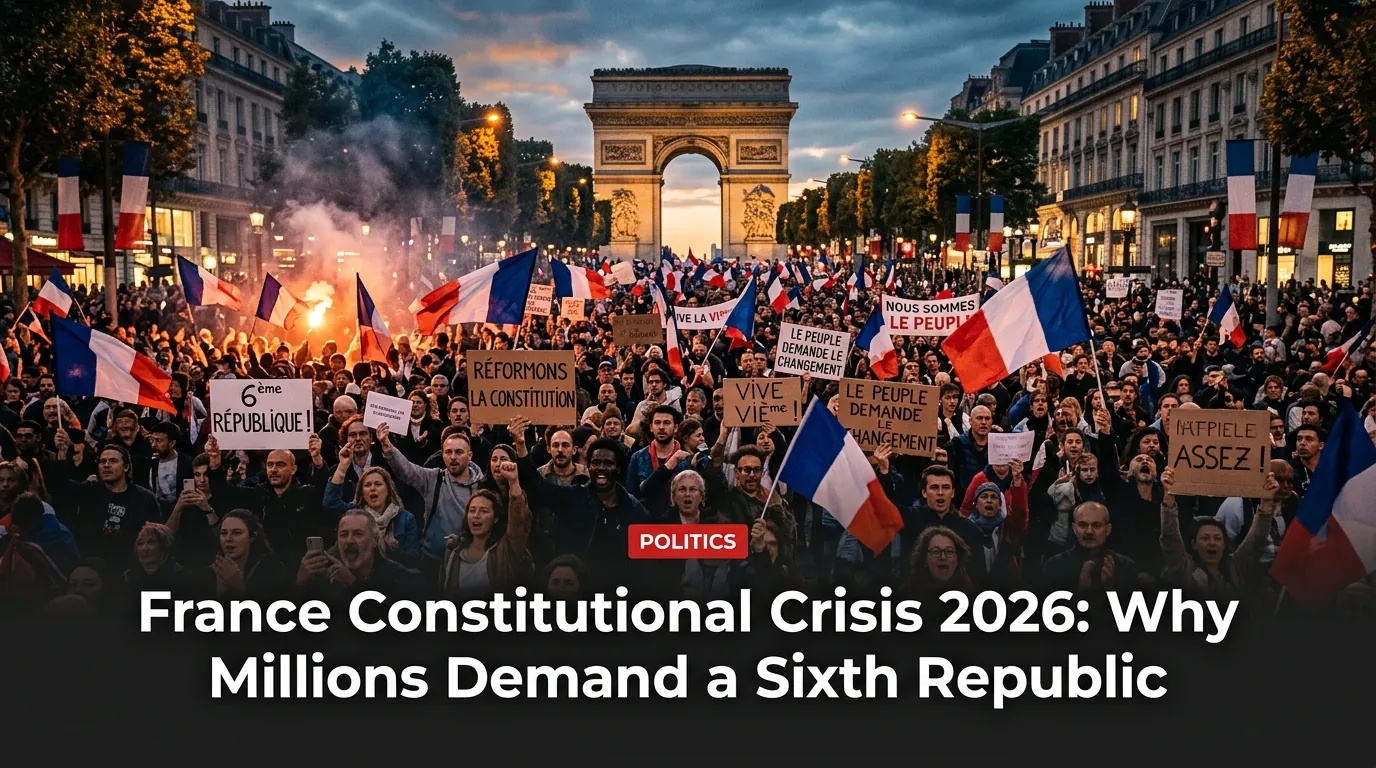
France is experiencing its most severe institutional crisis since the founding of the Fifth Republic in 1958. After cycling through five prime ministers in under two years, forcing the national budget through parliament without a vote, and facing nationwide strikes that have paralyzed Paris and major cities, the country now confronts a fundamental question: is the Fifth Republic broken beyond repair?
The answer, according to millions of French citizens marching in the streets, is yes.
How France Got Here: A Timeline of Collapse
The crisis traces back to June 2024, when President Emmanuel Macron made a fateful gamble. After his party's crushing defeat in European Parliament elections, he dissolved the National Assembly and called snap legislative elections. The result was catastrophic — not for one party, but for governance itself.
The Numbers Behind the Crisis
What Is Article 49.3 and Why Does It Matter?
At the heart of the crisis lies Article 49.3 of the French Constitution — a mechanism that allows the government to adopt legislation without a parliamentary vote. The prime minister essentially stakes the government's survival on the bill: parliament can either accept it silently or bring down the government entirely through a no-confidence vote.
PM Lecornu has invoked 49.3 multiple times since January 2026 to pass the budget. He himself called it a "partial failure" but argued it was necessary to avoid a "budgetary Chernobyl." Critics call it governance by decree.
The Key Players
- Emmanuel Macron — President until 2027. Called the dissolution that started the crisis. Now widely seen as a "lame duck" with severely curtailed power.
- Sébastien Lecornu — Current Prime Minister (since October 2025). Leads a minority government surviving on case-by-case deals.
- Marine Le Pen — Leader of National Rally (RN), the largest single party in parliament. Has called current governance a "farce" and demanded Macron's resignation.
- Jean-Luc Mélenchon — Leader of La France Insoumise (LFI). Explicitly calls for a Sixth Republic with a new constitution.
- Édouard Philippe — Former PM, now the leading centrist contender for 2027. Emerged strengthened from local elections.
The Protests: Biggest Since 1968
March 2026 has seen waves of demonstrations across France, each targeting a different symptom of the same disease:
Anti-austerity marches drew hundreds of thousands to protest the €44 billion in budget cuts, which include public sector hiring freezes and cuts to social welfare programs. Trade unions argue the government is "balancing the books on the backs of workers."
Anti-racism and anti-fascism rallies brought thousands to the streets ahead of local elections, driven by fears of the National Rally's growing influence in smaller cities.
Education strikes — a mass walkout by teachers planned for March 31 — target job cuts in public schools, with unions warning of a "generational catastrophe" in education funding.
The common thread uniting these movements: a growing consensus that the Fifth Republic's institutions can no longer function in a fragmented political landscape.
Fifth Republic vs. Sixth Republic: What Would Change?
| Fifth Republic (Current) | Proposed Sixth Republic | |
|---|---|---|
| President | Dominant executive power, can dissolve parliament | Ceremonial or reduced role |
| Parliament | Weak, can be bypassed via 49.3 | Sovereign, proportional representation |
| Government formation | President appoints PM | Parliamentary coalition required |
| Budget | Can pass without vote (49.3) | Must win majority approval |
| Design | Built for strong single-party rule | Built for coalition governance |
| Origin | De Gaulle, 1958 | Proposed by left-wing parties, 2026 |
Historian Pierre Purseigle argues the crisis is a "crise de régime," noting that the Fifth Republic's "quasi-monarchic presidential ascendancy" simply doesn't work when no party commands a majority. The system was designed for a France where the president's party controlled parliament. That France no longer exists.
Financial Fallout
Markets have not been kind. The CAC 40, France's benchmark stock index, dropped 3.3% in a single week following the September 2025 government collapse. The spread between French and German 10-year bonds widened to 77 basis points — a level that signals significant sovereign risk.
Analysts at XTB France noted the CAC 40 dipped toward 7,700 as domestic political risk weighed on investor sentiment. France's sovereign debt, already at €3.2 trillion, makes the country uniquely vulnerable to political paralysis — every month of delayed reform costs billions in elevated borrowing costs.
What Happens Next
The Lecornu government is expected to limp along until autumn 2026, when the next budget battle begins. But the real event on the horizon is the 2027 presidential election.
The March 2026 local elections served as an unofficial primary:
- Édouard Philippe emerged as the strongest centrist candidate, with his allies performing well nationally.
- The National Rally dominated smaller cities but failed to capture major urban centers like Paris, Marseille, or Lyon — winning the countryside but losing the cities.
- The Left took back Paris with Socialist Emmanuel Grégoire as the new mayor, energizing the coalition.
- Macron's party essentially collapsed as an independent political force.
Whether France actually transitions to a Sixth Republic remains an open question. What's clear is that the current system — designed by Charles de Gaulle for a different era — is creaking under pressures it was never built to handle. The protests in the streets are not just about budgets or austerity. They're about whether a 68-year-old constitution can survive a political landscape that has fundamentally changed.
For now, France governs by decree, protests by tradition, and waits — impatiently — for 2027.