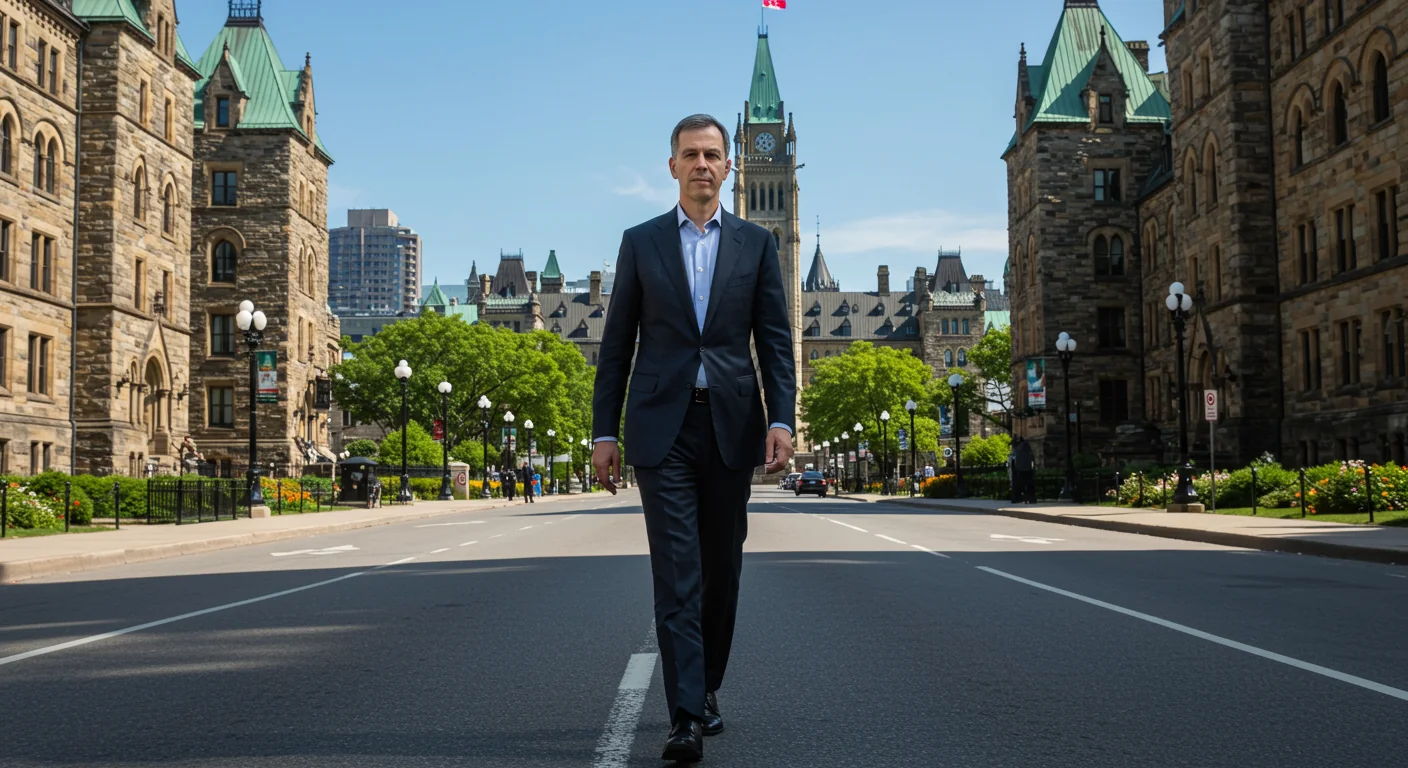
Canada's political landscape is heading toward a decisive moment. Prime Minister Mark Carney's Liberal government — built on a fragile minority mandate — is engineering what critics call a "manufactured majority" through unprecedented floor-crossings and three pivotal byelections set for April 13, 2026.
The stakes are binary: win the seats and govern with a free hand, or lose them and face a potential snap election by summer.
- **170 seats** — Current Liberal count (2 short of 172 majority)
- **4 MPs** crossed the floor to join the Liberals since November 2025
- **April 13, 2026** — Three federal byelections that could clinch a majority
- **$502.8 billion** — Total 2026-27 budgetary spending tabled March 19
- **6.7%** — Canada's unemployment rate as of February 2026
How Carney Got Here
Mark Carney — the former Governor of both the Bank of Canada and the Bank of England — became Prime Minister on March 14, 2025, after winning the Liberal leadership following Justin Trudeau's resignation. The April 2025 federal election delivered a minority: 169 seats, three short of the 172 needed.
What followed was a systematic campaign to close that gap without calling a general election.
The Floor-Crossing Controversy
Four opposition MPs have defected to the Liberal caucus in just five months — three Conservatives and one New Democrat. While floor-crossing is permitted under Canada's parliamentary system, the pace and coordination of these moves has drawn sharp criticism.
Conservative Leader Pierre Poilievre has been unsparing. "Mark Carney is using backroom deals to seize a costly majority that voters rejected," he said on March 11, the day Lori Idlout — the NDP's MP for Nunavut — crossed the floor.
Interim NDP Leader Don Davies echoed the concern: "I am increasingly concerned by the way Mr. Carney is trying to stitch together a majority government in this country."
Political analysts describe Carney as a "CEO-style leader" who has pivoted the Liberal party from Trudeau-era social equity messaging toward an "energy superpower" economic agenda. The floor-crossings, they argue, reflect a gravitational pull toward power rather than ideological conversion.
The Three Byelections That Decide Everything
On April 13, voters in three ridings will go to the polls. The outcome will determine whether Carney governs with authority or faces a parliamentary knife fight over every budget vote.
| Riding | Province | Vacated By | Liberal Outlook | Key Opponent |
|---|---|---|---|---|
| Scarborough Southwest | Ontario | Bill Blair (Liberal) | Strong favorite | Conservative candidate |
| University—Rosedale | Ontario | Chrystia Freeland (Liberal) | Strong favorite | NDP candidate |
| Terrebonne | Quebec | Court-annulled result | Toss-up | Bloc Québécois (Sinclair-Desgagné) |
Scarborough Southwest and University—Rosedale are Liberal strongholds vacated by former cabinet heavyweights. Terrebonne is the wildcard — the Supreme Court annulled the 2025 result on February 13, 2026, after Elections Canada admitted a mailing error that affected ballot distribution. The Bloc Québécois' Nathalie Sinclair-Desgagné brought the successful legal challenge and is running again against Liberal Tatiana Auguste in a rematch.
The Budget Gamble
Finance Minister François-Philippe Champagne tabled the 2026-27 Main Estimates on March 19 — and the numbers tell a story of a government preparing for economic headwinds.
Total budgetary spending stands at $502.8 billion, but the distribution reveals stark priorities:
Figures in billions of Canadian dollars. Negative values represent spending reductions.
The $31 billion in cuts across 85 departments — paired with a $5.3 billion defence boost — signal Carney's response to U.S. President Donald Trump's pressure on NATO spending and trade disputes. Immigration spending faces a 26% reduction, while border services takes a 41% cut.
Meanwhile, the Bank of Canada held interest rates at 2.25% in March, citing "downside risks" to growth and spiking gasoline prices driven by Middle East volatility. February headline inflation came in at 1.8%, but March gasoline prices surged 20%.
What Happens Next
The scenarios are straightforward:
- **Liberals win 2+ seats (majority):** Carney governs without needing opposition support. Committee control. Budget passes cleanly. Stability through 2029.
- **Liberals win all 3 (working majority at 173):** Full parliamentary control including committee chairs. No reliance on Speaker's tie-breaking vote.
- **Liberals win 0-1 seats:** Majority bid fails. Opposition could unite against the 2026 Budget. Snap election possible by summer 2026.
- **Conservative momentum builds:** Poilievre's affordability message gains traction with 6.7% unemployment and rising gas prices.
Polling from Angus Reid and Nanos Research shows Liberals leading nationally at 44-47% support, but the cost-of-living squeeze — unemployment at 6.7%, gasoline spiking — gives Poilievre's Conservatives a potent issue to run on.
The Bigger Picture
This marks Canada's third consecutive Liberal minority government since 2019. Historically, Canadian minority governments last an average of one year and 140 days. Carney's attempt to manufacture a majority through floor-crossings rather than elections is unprecedented in modern Canadian politics.
The April 13 byelections aren't just about three ridings. They're a referendum on whether Canadians accept a Prime Minister who never won a majority assembling one seat by seat — or whether they demand a fresh mandate at the ballot box.