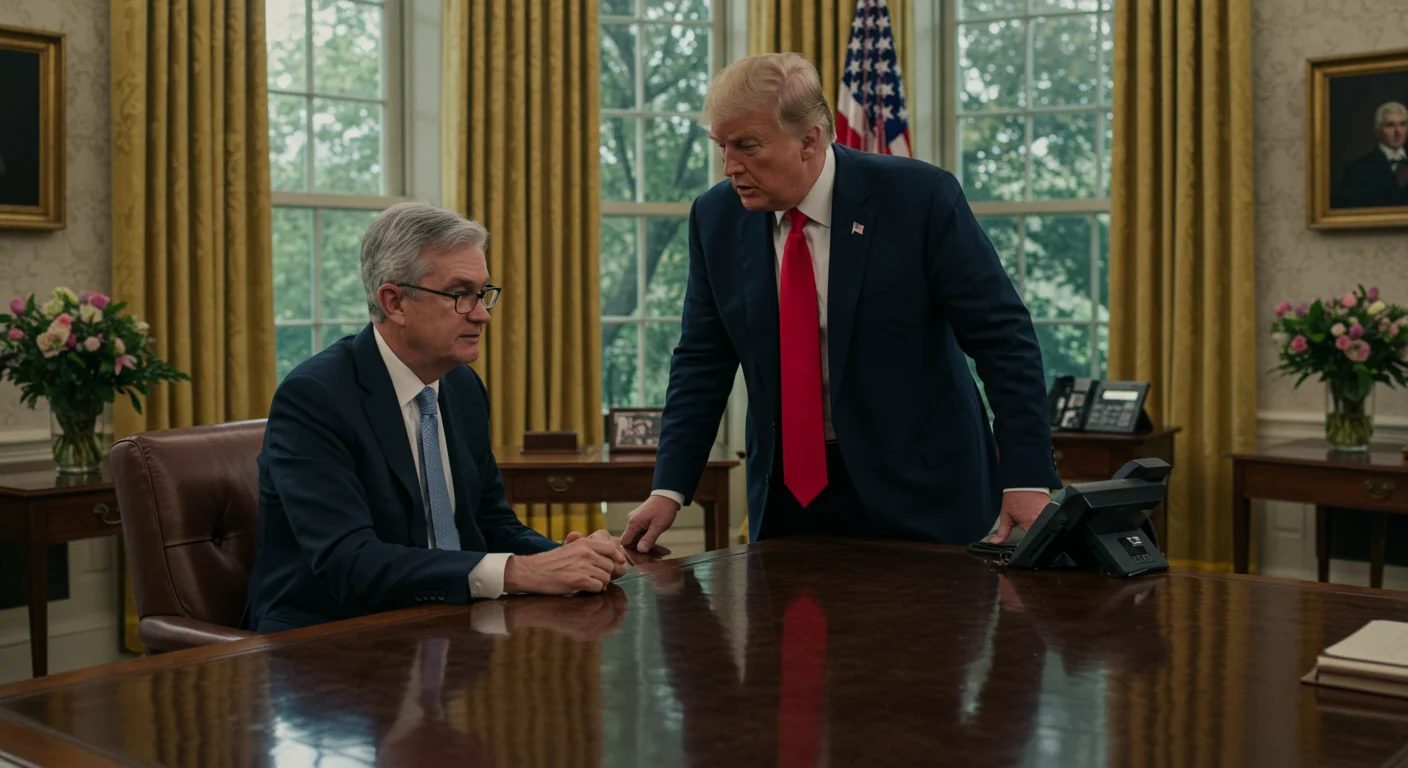
President Donald Trump has made no secret of his frustration with Federal Reserve Chair Jerome Powell. From social media attacks to public demands that the Fed cut interest rates, the tension between the White House and the central bank has reached a boiling point in April 2026. But the question on Wall Street, in legal circles, and in search engines is simple: Can Trump actually fire Jerome Powell?
The short answer is: not easily — and possibly not at all.
Who Is Jerome Powell?
Jerome "Jay" Powell, 73, has served as Chair of the Federal Reserve since February 2018. He was originally appointed by Donald Trump himself during his first term, then reappointed by President Biden in 2022. Powell's current term as Chair runs through May 15, 2026, and his term as a Fed Governor extends through January 2028.
Powell is a Republican — a rare instance of bipartisan alignment on central banking. Before leading the Fed, he spent years in investment banking and private equity, including a stint as a partner at The Carlyle Group. He is widely respected in global financial markets as a steady, data-driven leader.
- Jerome Powell has been Fed Chair since February 5, 2018
- Originally appointed by Trump; reappointed by Biden in 2022
- His Chair term expires May 15, 2026
- His Governor term runs through January 2028
- Powell is a Republican and attorney with an Ivy League background
The Law: What Does the Federal Reserve Act Say?
The Federal Reserve Act of 1913 — the law that created the central bank — states that members of the Board of Governors (including the Chair) can only be removed "for cause." That phrase carries enormous legal weight. It means the President cannot fire Powell simply because he dislikes his monetary policy decisions.
"For cause" removal has historically meant proven misconduct, negligence, or dereliction of duty — not policy disagreements. This protection was designed deliberately to insulate the Fed from political interference, preserving the independence that makes U.S. monetary policy credible to global markets.
The Supreme Court Precedent: Humphrey's Executor
The key legal precedent here is Humphrey's Executor v. United States (1935), a Supreme Court ruling that sharply limited the President's power to fire independent agency officials. The Court held that Congress can create agencies with independence from the executive branch, and that officers leading such agencies can only be removed for cause.
For decades, Humphrey's Executor has been the legal shield protecting the Fed Chair's independence. Trump's legal team has long argued this precedent should be narrowed or overturned — and the current Supreme Court has shown some openness to rethinking the boundaries of executive power under the "unitary executive" theory.
In 2020, the Supreme Court's ruling in Seila Law v. CFPB did chip away at Humphrey's Executor, allowing the President to fire the CFPB director at will. But the Court explicitly did NOT overturn the broader precedent as it applies to multi-member independent commissions — a category that includes the Federal Reserve Board of Governors.
What Has Trump Actually Said?
Throughout early 2026, Trump has publicly called Powell "too slow," "a disaster," and blamed him for not cutting rates fast enough to cushion the economy from tariff impacts. Reports indicate Trump has explored whether legal mechanisms exist to remove Powell. Congressional allies have also floated subpoenas targeting Fed communications.
The market reaction to these threats has been swift and negative — each escalation has triggered volatility in U.S. Treasury yields and the dollar, as investors price in the risk of a politically captured central bank.
Can Trump Demote Powell Instead?
One theory circulating in legal and political circles: Trump cannot fire Powell as a Governor, but could he strip him of the Chair title and demote him to an ordinary Board member?
The legal answer is murky. The Federal Reserve Act gives the President the power to designate the Chair from existing Board members — but legal scholars disagree sharply on whether that implies a power to un-designate, or demote, a sitting Chair. Powell himself has stated he would not resign if asked. The White House has not yet tested this theory in court.
If Trump tried this maneuver, expect immediate legal challenges and a Supreme Court case that could redefine the boundaries of central bank independence forever.
What Would Happen If Powell Were Fired?
The economic and market fallout would likely be severe and immediate:
- Would allow faster rate cuts
- Could reduce borrowing costs for consumers
- Aligns monetary policy with fiscal stimulus
- Immediate dollar collapse risk
- Bond market selloff (higher long-term rates)
- Loss of Fed credibility globally
- Inflation expectations could spike
- Potential capital flight from U.S. assets
Many economists compare the scenario to Turkey in 2019-2021, where President Erdogan repeatedly fired central bank governors who refused to cut rates. The result: Turkey's lira lost over 50% of its value and inflation soared to 85%.
When Does Powell's Term Actually End?
Here's the detail that makes all of this somewhat moot in the short term: Powell's term as Fed Chair expires May 15, 2026 — just weeks away. Trump will be able to simply not reappoint him, allowing Powell to step down from the Chair role without a single legal battle.
Powell could then continue as an ordinary Board Governor until January 2028, if he chooses. Trump would nominate a new Chair who would still need Senate confirmation — a process that could take months, creating its own uncertainty.
The Bottom Line
Can Trump fire Jerome Powell? Legally, almost certainly not without triggering a landmark Supreme Court battle over the Federal Reserve's independence. Practically, Trump doesn't need to — Powell's Chairmanship ends in May 2026 on its own.
The real questions for markets are: Who replaces Powell? Will the next Fed Chair be as independent? And what signal does the selection send about the future of U.S. monetary policy credibility?
For investors, the Powell saga is a reminder that central bank independence isn't just an academic concept — it's the foundation of global confidence in U.S. dollar assets. Whatever happens next, markets are watching closely.