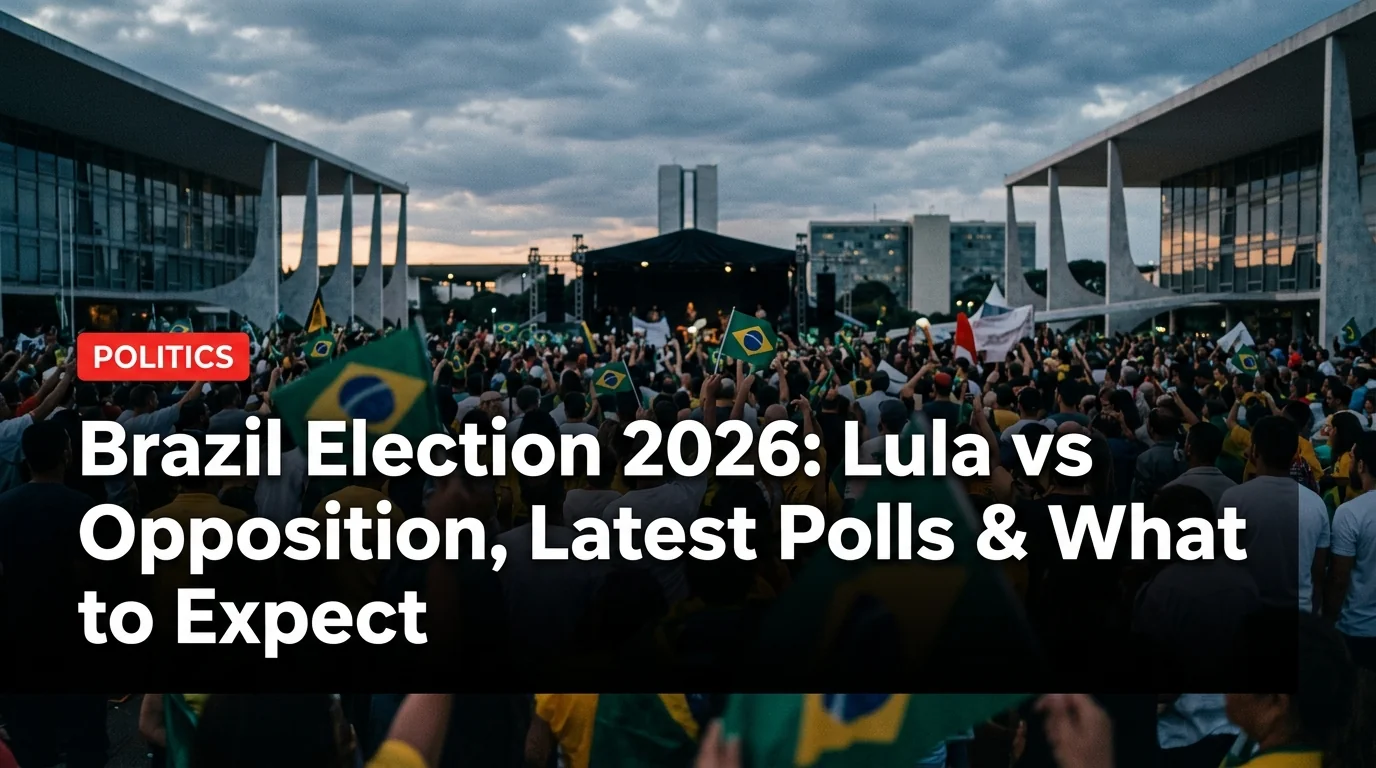
Brazil heads to the polls on October 4, 2026 for its next presidential election — and the race is more competitive than many expected when Luiz Inácio Lula da Silva won back the presidency in 2022. With the economy a central issue, a resurgent right, and markets watching closely for signals on fiscal policy, here is everything you need to know about the 2026 Brazilian election.
The Setup: A Rematch on the Horizon?
President Lula, now 80 and in his third term, has not formally declared re-election candidacy but remains the left's presumptive standard-bearer. His Partido dos Trabalhadores (PT) is organizing around a Lula-led ticket, though internal discussions about a potential successor have surfaced given his age and health considerations.
On the right, the landscape that defined Jair Bolsonaro's rise has reorganized. Bolsonaro himself is barred from running for office until 2030 following his conviction on electoral crimes, but his influence over Brazil's conservative electorate remains substantial. His party, Partido Liberal (PL), is fielding alternative candidates while Bolsonaro's coalition looks for a credible proxy.
Current Polling Landscape
Polling in Brazil's 2026 race shows a fragmented field, with no candidate commanding the dominant support Lula enjoyed in the final 2022 runoff against Bolsonaro.
Lula's approval ratings have tracked the economy closely. His administration's social spending programs — including the expanded Bolsa Família — have maintained a loyal base among lower-income voters. But inflation concerns, slow GDP growth in late 2025, and frustration over fiscal deficits have eroded support among the middle class.
Key opposition figures polling competitively include Governor Tarcísio de Freitas of São Paulo (PL), widely seen as Bolsonaro's chosen heir, and Senator Sergio Moro (União Brasil), the former anti-corruption judge whose legal battles with Lula have made him a polarizing but recognizable figure nationally.
Key Issues Driving the Race
The Economy Brazil's economy is the defining issue. Lula's government has been caught between maintaining popular spending programs and reassuring bond markets about fiscal sustainability. The real's performance against the dollar has been a flashpoint — any sustained depreciation intensifies inflation fears and fuels opposition attacks.
Crime and Public Security Urban crime, organized trafficking networks in major cities, and rural land conflicts remain persistent issues. The opposition consistently polls higher on security questions, and the Lula government's approach — which has emphasized social investment over hard-line enforcement — remains contested.
Amazon and Environmental Policy Lula's return to power was globally celebrated for reversing Bolsonaro-era deforestation rollbacks. Amazon deforestation has declined sharply since 2023, but environmentalists have raised concerns about exceptions carved out for agribusiness interests. This remains a wedge issue between Lula's base and centrist business communities.
Social Polarization Brazilian society remains deeply divided along the fault lines exposed in the 2022 election. The January 8, 2023 attacks on government buildings in Brasília — Brazil's equivalent of a democratic crisis moment — have shaped narratives on both sides, with Lula's allies framing the election as a defense of democracy and the opposition arguing the subsequent prosecutions represent political persecution.
- Lula (PT) — incumbent, socialist-left, anchored by social program base, constrained by fiscal markets
- Tarcísio de Freitas (PL) — São Paulo governor, Bolsonaro-aligned, strong economic manager image
- Sergio Moro (União Brasil) — former judge, anti-corruption brand, center-right lane
- Simone Tebet (MDB) — centrist senator, 2022 third-place finisher, potential kingmaker
- Geraldo Alckmin — current Lula VP, centrist bridge, could factor in successor scenarios
What Markets Are Watching
Brazil's financial markets have shown elevated sensitivity to polling shifts. Key indicators traders and analysts are monitoring include:
Fiscal Framework Credibility: Lula's government passed a new fiscal framework in 2023 to replace the spending cap, but markets want evidence of compliance heading into an election year. Campaign promises from any candidate that imply large spending increases will move the real and Bovespa meaningfully.
Central Bank Independence: Brazil's central bank operates independently, but appointments and public pressure from the executive have historically tested that independence. Any candidate whose platform questions the central bank's autonomy will trigger bond market reactions.
Agricultural and Export Policy: Brazil is the world's largest exporter of soybeans, beef, and sugar. US tariff disputes and China demand dynamics directly affect agricultural state voters who form a critical constituency for right and center-right candidates.
The Bolsonaro Factor
Despite being legally barred from the ballot, Jair Bolsonaro's influence on the 2026 race is hard to overstate. His social media following, evangelical church networks, and rural base remain highly mobilized. His endorsement — whenever it comes — will be the decisive moment in consolidating the right's vote.
The critical question is whether his preferred candidate (most likely Tarcísio de Freitas, who has not yet formally declared) can consolidate right-wing voters without activating the anti-Bolsonaro backlash that cost the former president in 2022.
- Incumbency advantage and existing government platform
- Loyal low-income voter base via Bolsa Família
- International credibility and diplomatic relationships
- Democratic legitimacy narrative post-January 8
- Economy and security messaging resonates with middle class
- Bolsonaro's base without Bolsonaro's personal baggage
- São Paulo's economic management record as credibility base
- Youth and social media mobilization infrastructure
Timeline to Watch
What 2026 Means Beyond Brazil
Brazil is the largest democracy in the Western Hemisphere outside the United States and the world's largest Portuguese-speaking country. The 2026 result will shape:
- South American geopolitics — Whether BRICS, regional trade agreements, and relations with China and the US tilt left or right
- Amazon policy — Potentially the most consequential single country-level climate policy question globally
- EM investment flows — Brazil remains the largest economy in Latin America; political risk premiums move capital throughout the region
For the first time in recent memory, the Brazilian election result is genuinely uncertain. Neither the incumbent nor the opposition can take the outcome for granted, making 2026 a race worth following closely from now until October.
Watch this space — linos.ai will track Brazilian election polls and developments through the October 2026 vote.