
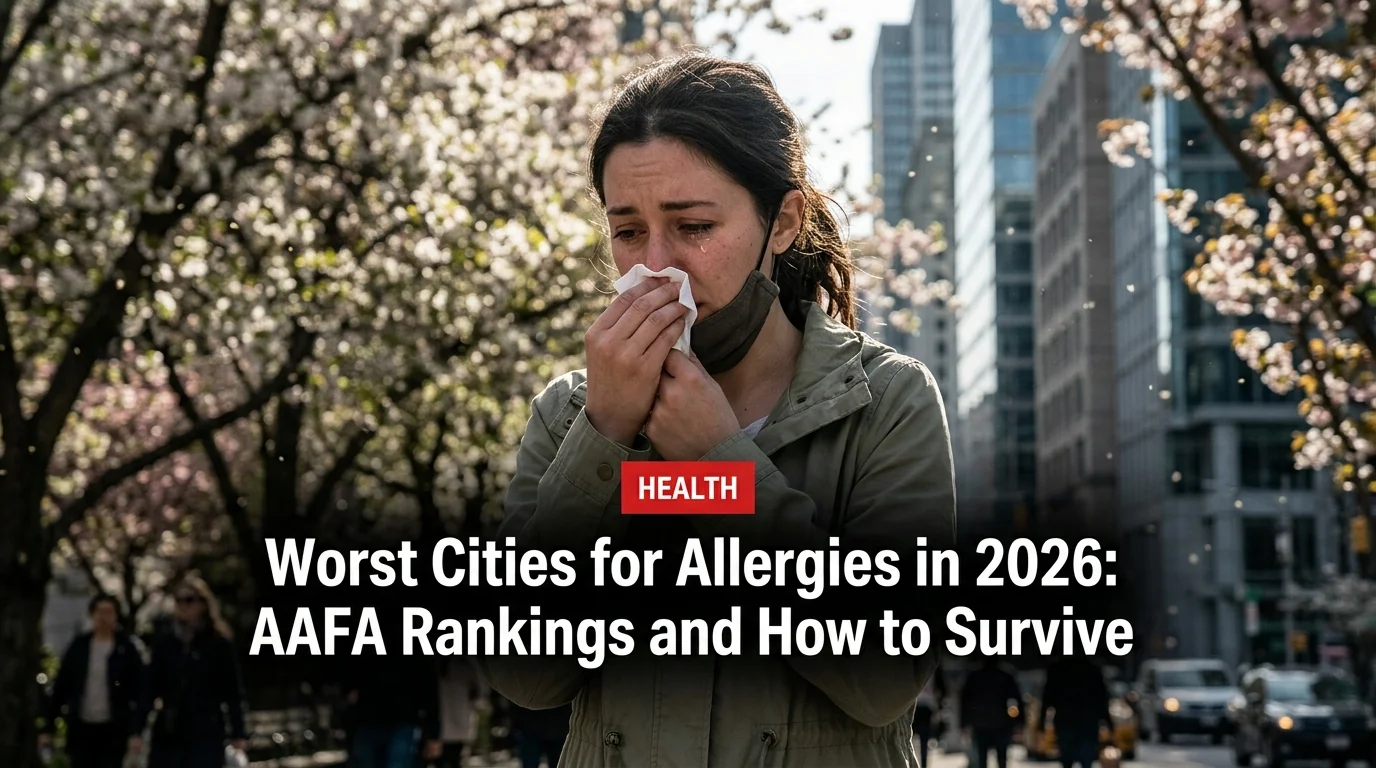
If you've been sneezing more than usual this spring, it's not your imagination. The Asthma and Allergy Foundation of America just released its 2026 Allergy Capitals report, and the results show pollen seasons are getting longer, more intense, and hitting cities that never used to make the list.
Boise, Idaho, now ranks as the worst city in America for allergy sufferers — a first for the Western city. Here's the full breakdown of which cities are hardest hit, why it's getting worse, and what actually works to manage symptoms.
2026 Allergy Capitals: Top 20 Worst Cities
The AAFA ranks the 100 most-populated metro areas based on three factors: pollen counts (tree, grass, and weed), over-the-counter allergy medication sales, and availability of board-certified allergists.
::stats
- 106 million Americans experience allergies annually
- 82 million suffer from seasonal hay fever specifically
- The U.S. growing season has expanded by 16 days since 1970
- Allergy-related costs hit $115 billion per year in the U.S. ::/stats
| Rank | City | State | Notable Factor |
|---|---|---|---|
| 1 | Boise | Idaho | First time at #1; high pollen, few specialists |
| 2 | San Diego | California | Atmospheric rivers fueling plant growth |
| 3 | Tulsa | Oklahoma | Consistently high tree and grass pollen |
| 4 | Provo | Utah | Mountain valleys trap pollen |
| 5 | Rochester | New York | Rising pollen counts, limited specialists |
| 6 | Wichita | Kansas | Historic allergy capital, still severe |
| 7 | Raleigh | North Carolina | Early tree pollen bloom |
| 8 | Ogden | Utah | Third Utah city in top 15 |
| 9 | Spokane | Washington | Western shift in allergy hotspots |
| 10 | Greenville | South Carolina | Southern pollen corridor |
| 11 | San Francisco | California | Second California city in top 20 |
| 12 | Minneapolis | Minnesota | Warming winters extending season |
| 13 | Salt Lake City | Utah | Valley inversion traps allergens |
| 14 | Richmond | Virginia | East Coast pollen belt |
| 15 | Colorado Springs | Colorado | High altitude doesn't help anymore |
| 16 | Little Rock | Arkansas | Traditional Southern allergy zone |
| 17 | Toledo | Ohio | Midwest pollen surge |
| 18 | New Orleans | Louisiana | Year-round pollen emerging |
| 19 | Winston-Salem | North Carolina | Two NC cities in top 20 |
| 20 | Lakeland | Florida | Subtropical pollen overlap |
Why Allergies Are Getting Worse in 2026
::keyfacts
- Climate shift: The contiguous U.S. has warmed roughly 0.5°F per decade over 70 years, directly extending pollen production windows
- Atmospheric rivers: Heavy moisture events in the West followed by warmth are fueling explosive plant growth in cities like Boise and San Diego
- Western migration: Allergy hotspots historically clustered in the South and Northeast — 2026 marks a dramatic shift toward Western cities
- Year-round pollen: Experts expect "year-round" pollen in the South to spread northward as winters continue to mellow ::/keyfacts
"We are experiencing a widening health threat fueled by climate change," said AAFA President Kenneth Mendez. "We need climate solutions, and we need them now."
The growing season has expanded by an average of 16 days nationally since 1970, with some regions seeing increases of over four weeks. Record-breaking warm temperatures in February 2026 triggered early tree pollen blooms across the South and West, catching many off guard.
::timeline
- 1970–Present — U.S. growing season expands by 16+ days on average
- February 2026 — Record warmth triggers early tree pollen blooms in South and West
- March 4, 2026 — AccuWeather warns of "sharp swings" in pollen levels
- March 10, 2026 — AAFA releases 2026 Allergy Capitals report
- April–May 2026 — Peak grass pollen season expected nationwide ::/timeline
Can You Move to Escape Allergies?
Short answer: probably not. Board-certified allergist Dr. Neeta Ogden, a medical spokesperson for AAFA, says relocation rarely solves the problem because "pollen is sort of ubiquitous at this point."
Even cities not in the top 20 are seeing rising pollen counts. The better strategy is managing symptoms effectively rather than chasing low-pollen zip codes.
Zyrtec vs Claritin vs Allegra: Which Antihistamine Works Best?
All three are second-generation antihistamines — meaning they last longer and cause less drowsiness than older options like Benadryl. But they're not interchangeable.
::versus Zyrtec (Cetirizine) vs Allegra (Fexofenadine)
- Strength: Strongest relief, fastest onset (20-60 min) | Truly non-sedating, even at higher doses
- Drowsiness: ~14% report mild drowsiness | Virtually zero sedation
- Best for: Severe symptoms, hives, fast relief needed | Active lifestyles, driving, students/professionals
- Watch out: Withdrawal itching reported after long-term use | Must take on empty stomach (food reduces absorption 40%)
- Onset: 20-60 minutes | 1-2 hours ::/versus
| Feature | Zyrtec | Claritin | Allegra |
|---|---|---|---|
| Active ingredient | Cetirizine | Loratadine | Fexofenadine |
| Onset time | 20–60 min | 1–3 hours | 1–2 hours |
| Duration | 24 hours | 24 hours | 12–24 hours |
| Drowsiness risk | Moderate (~14%) | Very low | Virtually none |
| Take with food? | Yes | Yes | No (empty stomach) |
| Best for hives? | Yes (strongest) | Moderate | Moderate |
| Generic price/month | ~$8–12 | ~$8–12 | ~$10–15 |
::proscons Quick Medication Picks
- pros: Zyrtec if you need the strongest relief and don't mind mild drowsiness
- pros: Claritin if you want the gentlest option with fewest side effects
- pros: Allegra if staying alert is non-negotiable (driving, working, studying)
- pros: Add a nasal spray (Flonase/Nasacort) for congestion — pills alone won't cut it
- cons: No single antihistamine eliminates all symptoms — nasal congestion especially needs a separate approach
- cons: "D" versions (Zyrtec-D, Claritin-D) add pseudoephedrine with extra side effects
- cons: Starting meds after symptoms hit means you're already behind — begin 2 weeks before your local season ::/proscons
How to Survive Allergy Season 2026
Allergists recommend a multi-layer approach, not just popping a pill:
::alert info Start medications early. Begin your antihistamine regimen two weeks before your local pollen season begins. By the time you're sneezing, inflammation has already built up. ::/alert
- Track pollen daily. Use apps like Pollen Sense or check AAFA's local pollen forecasts before planning outdoor time
- Time your outdoor activity. Pollen counts peak in early morning and late afternoon — schedule runs, walks, and yard work for midday when possible
- Shower at night. Pollen clings to hair and clothing all day — washing before bed keeps it out of your pillow
- Keep windows closed. Even on beautiful days, open windows during high-pollen periods undo everything else you're doing
- Consider immunotherapy. Allergy shots can desensitize your immune system over time — talk to a board-certified allergist if OTC medications aren't enough
::alert warning Don't ignore worsening symptoms. Uncontrolled allergies can trigger asthma, sinus infections, and sleep disruption. If OTC options aren't working after two weeks, see a specialist. ::/alert
The Bottom Line
The 2026 allergy season is shaping up to be one of the worst on record, driven by climate change extending pollen windows and atmospheric rivers fueling plant growth in the West. Whether you're in Boise or barely on the map, pollen counts are rising nearly everywhere.
The most effective approach: start your preferred antihistamine early, add a nasal corticosteroid spray for congestion, track local pollen counts daily, and see an allergist if symptoms persist. Moving to a new city won't save you — but a good treatment plan will.
Data sourced from the AAFA 2026 Allergy Capitals Report (March 10, 2026), AccuWeather 2026 Allergy Forecast, and Climate Central pollen season analysis.