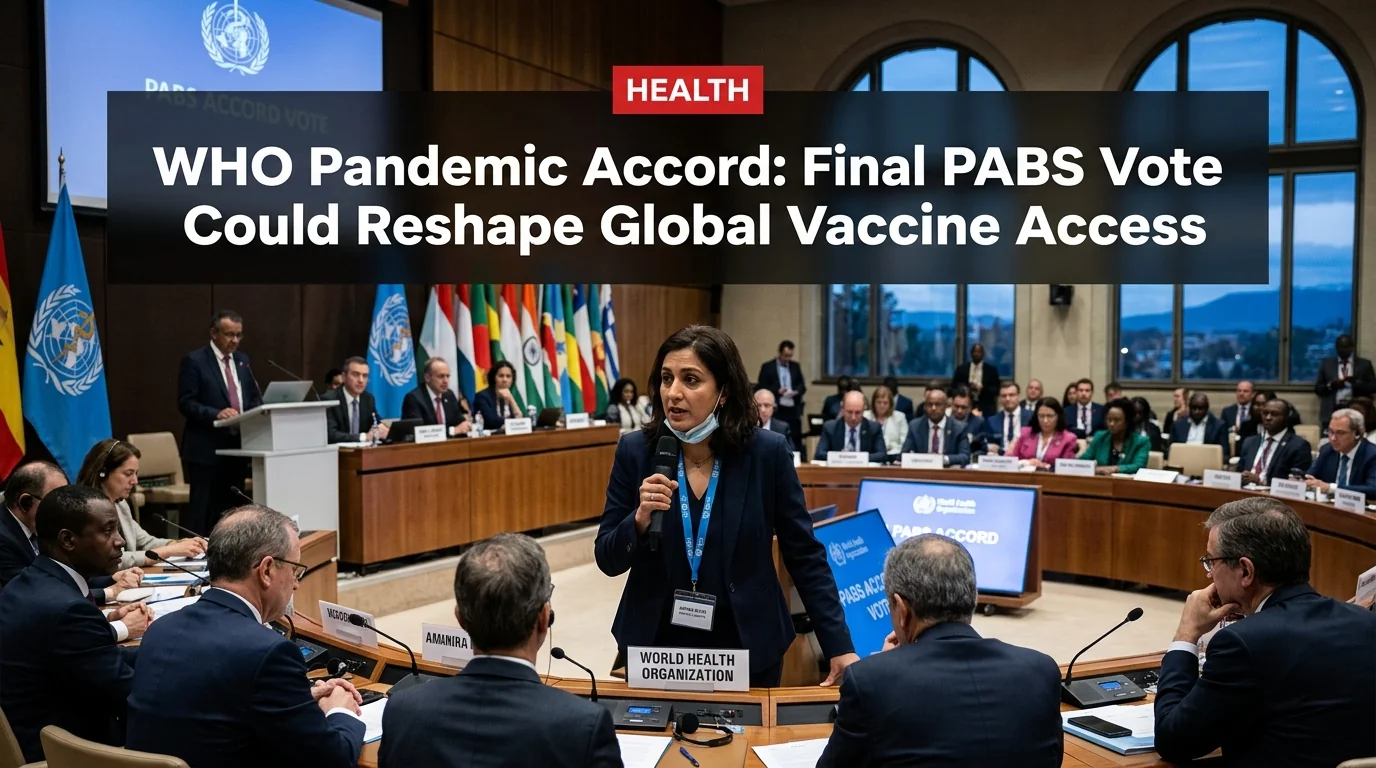
The World Health Organization's most consequential negotiation in two decades entered its final stretch on Monday as delegates from 194 member states gathered in Geneva to hammer out the Pathogen Access and Benefit-Sharing (PABS) system — the last missing piece of the landmark Pandemic Agreement adopted in May 2025.
The sixth meeting of the Intergovernmental Working Group (IGWG) runs from March 23–28, and it carries a hard deadline: finalize the PABS annex now or risk derailing the entire treaty before the 79th World Health Assembly in May.
- **What:** Final negotiations on the PABS annex to the WHO Pandemic Agreement
- **Where:** Palais des Nations, Geneva, Switzerland
- **When:** March 23–28, 2026 (IGWG-6)
- **Why it matters:** Without PABS, the Pandemic Agreement adopted in 2025 remains unenforceable
- **Next step:** Vote at the 79th World Health Assembly, May 18–23, 2026
What Is the PABS System?
At its core, PABS answers a question that haunted the COVID-19 pandemic: when a country detects a dangerous new pathogen, what does it get in return for sharing that information with the world?
During COVID-19, nations that shared viral sequences early — enabling rapid vaccine development — watched wealthy countries hoard the resulting doses. Africa had vaccinated just 6% of its population by the time booster campaigns were underway in Europe and North America.
PABS is designed to prevent that from happening again. Under the current draft, pharmaceutical companies that access shared pathogen data would be required to contribute a portion of their pandemic-related production to a WHO-managed distribution system.
Why Negotiations Are Stalling
Despite years of talks, the March 9 draft text revealed how far apart the two sides remain.
The African region rejected the latest draft outright, insisting that benefit-sharing provisions must be legally binding — not voluntary guidelines that manufacturers can ignore. The G77+China bloc, representing over 80% of the world's population, wants contractual agreements with commercial users of pathogen information.
On the other side, the European Union and pharmaceutical industry groups are pushing for flexibility. The International Federation of Pharmaceutical Manufacturers and Associations (IFPMA) argues that mandatory monetary contributions and prescriptive obligations would "hinder research and innovation."
The U.S. Absence Looms Large
The most conspicuous empty chair in Geneva belongs to the United States. In January 2026, the U.S. officially announced its intent to withdraw from the WHO, ceasing participation in final negotiations under the direction of Health and Human Services Secretary Robert F. Kennedy Jr.
KEY STAT: The United States was the WHO's largest single funder and home to the world's biggest pharmaceutical hub. Its absence creates what experts call a "financial and operational void" in the treaty's architecture.
Kennedy has framed the decision as protecting American sovereignty: "The United States will not be bound by a treaty that locks in the dysfunction of the WHO's past responses."
Instead, Washington is pursuing bilateral health agreements with developing countries — linking aid to rapid pathogen information sharing, essentially building a parallel system outside the WHO framework.
The Key Players
The negotiations involve a complex web of state and non-state actors, each with competing priorities.
| Actor | Position | Key Demand |
|---|---|---|
| G77 + China | Pro-mandatory PABS | Legally binding benefit-sharing; contractual obligations for manufacturers |
| African Region | Rejected March 9 draft | Guaranteed access to pandemic products; legal certainty |
| European Union | Pro-voluntary framework | Flexible, non-prescriptive commitments; protect innovation |
| IFPMA | Industry lobby | Voluntary cooperation; no mandatory monetary contributions |
| WHO Secretariat | Mediator | Finalize by March 28 to meet May WHA deadline |
| United States | Withdrawn | Pursuing bilateral deals outside WHO framework |
A Timeline of the World's Second-Ever Health Treaty
This is only the second time in 78 years that WHO member states have attempted a legally binding treaty under Article 19 of the WHO Constitution. The first was the 2003 Framework Convention on Tobacco Control.
What Happens This Week
WHO Director-General Tedros Adhanom Ghebreyesus opened Monday's session with a pointed warning: "We must get this done. The next pandemic will not wait."
He cautioned against the "dangerous temptation" to extend negotiations yet again, arguing that further delays would only make consensus harder to reach.
The negotiators face three critical unresolved issues:
- Mandatory vs. voluntary contributions — Should the 20% production-sharing requirement be legally binding or aspirational?
- Financial mechanism — How will the PABS system be funded, especially without U.S. contributions?
- Digital sequence data — Should genetic sequence information shared online trigger the same benefit-sharing obligations as physical pathogen samples?
The Stakes
The math is stark. During COVID-19, high-income countries secured over 4 billion vaccine doses while low-income countries received fewer than 100 million in the same period. The Pandemic Agreement was born from that inequity.
If PABS fails, the treaty adopted in May 2025 becomes a symbolic document — aspirational language without operational teeth. If it succeeds, it would create the first binding international framework for sharing both pathogens and the medical products derived from them.
The world is watching Geneva this week. The next pandemic won't check whether the paperwork is done.