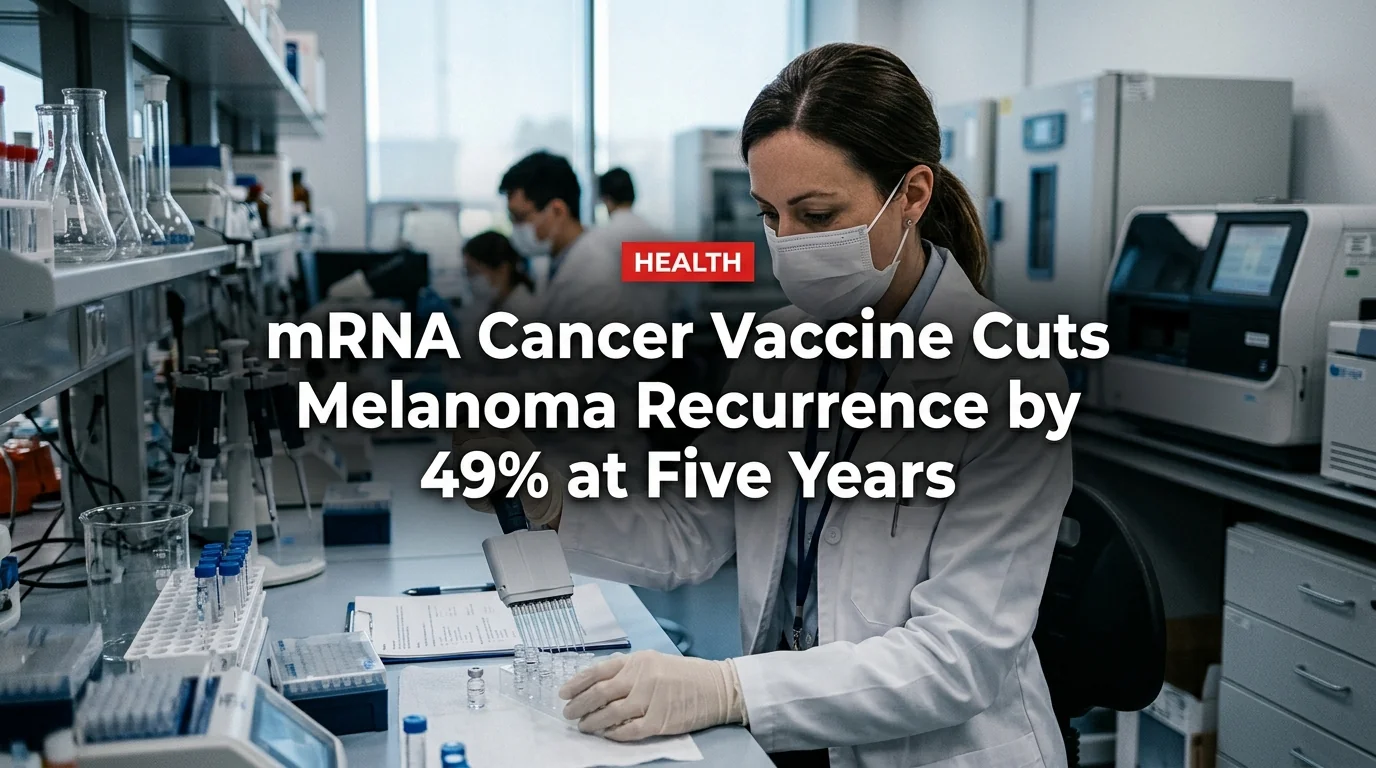
A personalized mRNA vaccine that teaches each patient's immune system to hunt down their specific cancer cells has delivered on its boldest promise: five years after treatment, melanoma recurrence remains cut nearly in half.
Moderna and Merck released landmark five-year follow-up data from the KEYNOTE-942 trial in January 2026, confirming that their experimental therapy — mRNA-4157, now called intismeran autogene — combined with the immunotherapy drug Keytruda reduces the risk of cancer coming back or killing the patient by 49% compared to Keytruda alone.
The result is historic. No mRNA-based cancer vaccine has ever shown durable, randomized benefit at this scale.
How It Works: A Vaccine Built for One Person
Unlike traditional vaccines that target a single known pathogen, mRNA-4157 is built from scratch for each patient. The process takes roughly 30 days:
- Surgeons remove the tumor
- Moderna's algorithm sequences the tumor DNA and identifies up to 34 unique mutations (neoantigens)
- A custom mRNA vaccine is manufactured encoding those exact mutations
- The vaccine trains the patient's T cells to recognize and destroy any remaining cancer cells carrying those mutations
Combined with Keytruda — which removes the molecular "brakes" that cancer uses to hide from the immune system — the therapy creates a two-pronged attack. The vaccine provides GPS coordinates; Keytruda takes the safety off.
- **49% risk reduction** in recurrence or death sustained at 5 years
- **74.8%** of combination patients recurrence-free at 3 years vs 55.6% on Keytruda alone
- **62% reduction** in distant metastasis risk
- **96%** overall survival rate at 2.5 years for combination arm
- Up to **34 neoantigens** encoded per personalized vaccine
- Manufactured in approximately **30 days** per patient
The Numbers That Matter
The KEYNOTE-942 trial enrolled 157 patients with high-risk Stage III/IV melanoma who had undergone surgical resection. The hazard ratio — the gold standard for measuring treatment effect — came in at 0.510, meaning the combination therapy roughly halved the risk of the cancer returning.
What makes the five-year data particularly compelling is durability. Cancer vaccines have a long history of promising early results that fade. This one hasn't. The hazard ratio at five years matches the three-year number almost exactly — suggesting the immune memory created by the vaccine is lasting.
Why This Trial Is Different
Cancer vaccines have failed for decades. The difference this time comes down to personalization.
- Target shared tumor antigens found in many patients
- One-size-fits-all approach
- Weak immune responses in most patients
- Decades of clinical failures
- No randomized trial has shown survival benefit
- Targets up to 34 mutations unique to each patient's tumor
- Custom-built for every individual
- Strong, specific T-cell responses
- Sustained 49% risk reduction at 5 years
- First randomized mRNA cancer vaccine to show durable benefit
Dr. Jeffrey Weber, Deputy Director of NYU Langone Perlmutter Cancer Center and lead investigator, called the results "extraordinarily important," noting it is the first randomized study proving an mRNA vaccine can boost the effectiveness of immunotherapy without adding significant toxicity.
The Road to Approval
Despite the encouraging data, the FDA declined to grant accelerated approval based on the Phase IIb trial alone, citing the relatively small sample size of 157 patients. The companies need their Phase III results.
The Phase III trial, INTerpath-001, is fully enrolled with 1,089 patients — nearly seven times the Phase IIb cohort. Top-line results are expected around September 2026. If positive, Moderna and Merck plan to file for regulatory approval immediately.
Safety Profile: The Other Half of the Equation
A treatment that works but makes patients miserable is not a breakthrough. The five-year safety data shows the combination therapy is tolerable, with side effects consistent with what was already known.
Percentage of patients experiencing each side effect in the combination arm.
Serious treatment-related adverse events occurred in 14.4% of combination patients compared to 10% on Keytruda alone — a modest increase for a therapy that halves cancer recurrence.
Beyond Melanoma
Moderna and Merck are not stopping at skin cancer. The personalized mRNA platform is now being tested across multiple tumor types:
- Non-Small Cell Lung Cancer — Two Phase III trials (INTerpath-002 and INTerpath-009) are actively enrolling
- Bladder Cancer — Phase II trial ongoing
- Renal Cell Carcinoma — Phase II trial ongoing
- Cutaneous Squamous Cell Carcinoma — Phase II trial ongoing
The financial stakes match the medical ones. Merck paid $250 million in 2022 to exercise its option, and the two companies split all costs and profits 50/50. Analysts estimate the personalized cancer vaccine market could reach $10–15 billion annually by the early 2030s if the platform proves effective across multiple cancer types.
What This Means for Patients
For the roughly 100,000 Americans diagnosed with melanoma each year — and the thousands who undergo surgery for advanced disease only to face agonizing recurrence odds — this therapy represents something that has eluded oncology for decades: a cancer vaccine that actually works.
The technology is inherently scalable. The same mRNA manufacturing platform that produced billions of COVID-19 vaccine doses can be repurposed for individual cancer patients. The bottleneck is not production — it's proving the approach works across enough cancers and patients to justify the personalized cost.
Five years of sustained benefit is no longer a hope. It's data. Now the question is whether 1,089 patients in Phase III will confirm what 157 already showed.