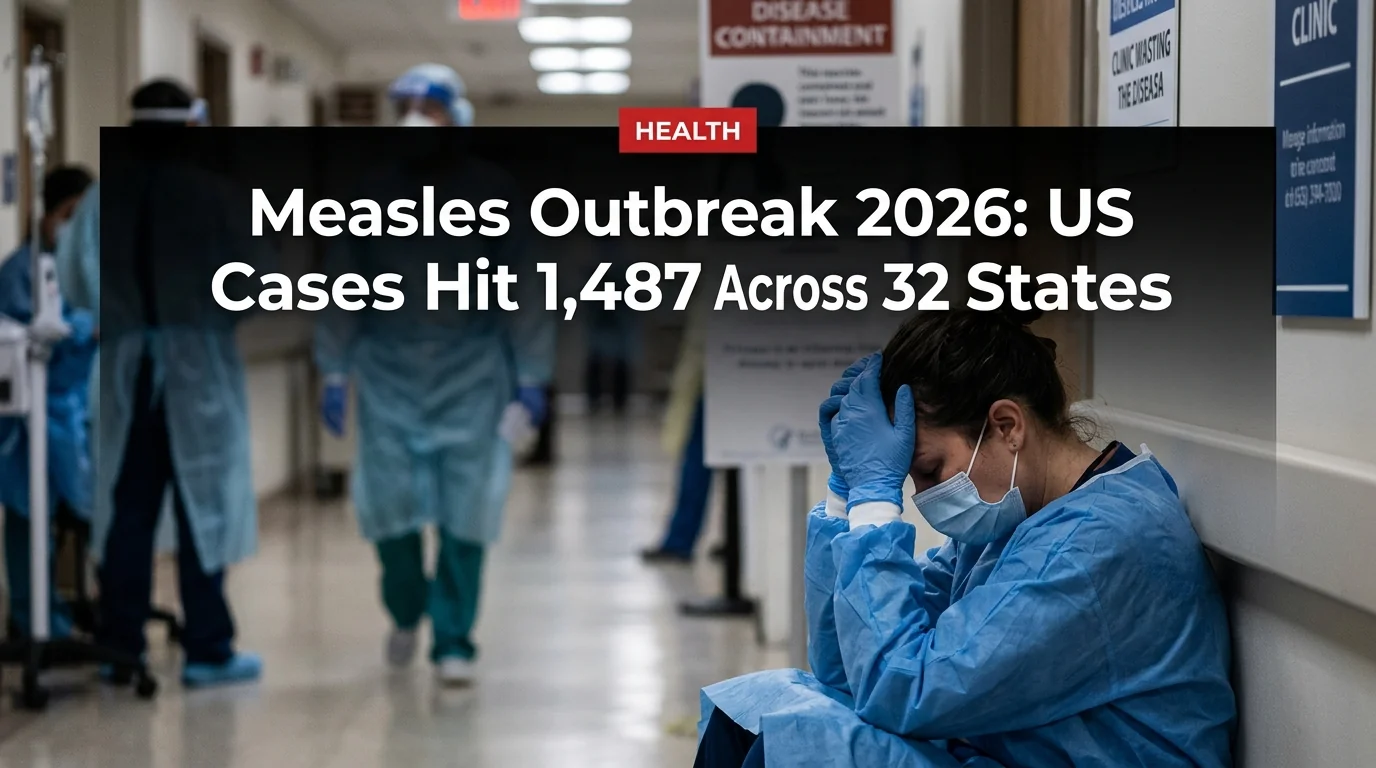
The United States is facing its worst measles crisis in over three decades. As of March 19, 2026, health authorities have confirmed 1,487 cases across 32 jurisdictions — and the number keeps climbing.
With Spring Break travel underway and the country's measles elimination status hanging by a thread, here's everything you need to know.
Where the Outbreaks Are Worst
Four states account for the vast majority of cases. South Carolina alone represents nearly half of all infections nationwide.
| State | Cases | Epicenter | Key Detail |
|---|---|---|---|
| South Carolina | 997 | Spartanburg County | Largest single outbreak since 2000 |
| Utah | 443 | Statewide | Rapid community spread |
| Texas | 147 | Hudspeth & El Paso counties | 108 cases linked to detention facility |
| Florida | 140 | Ave Maria University cluster | Spring Break travel risk |
The remaining 28 jurisdictions — including California, New York, Ohio, Michigan, and Colorado — have reported smaller clusters ranging from single cases to dozens.
Who Is Getting Sick
The demographics tell a clear story.
Children and young adults under 19 make up 74% of all cases. The under-five group is especially vulnerable — measles can cause pneumonia, brain swelling, and permanent hearing loss in young children.
The vaccination gap is stark: 92% of patients were unvaccinated or had unknown vaccination status. Two doses of the MMR vaccine are 97% effective at preventing measles.
Timeline: How We Got Here
What Is Elimination Status and Why It Matters
The US was declared measles-free in 2000, meaning the virus was no longer continuously spreading within the country. For 25 years, cases were limited to travelers bringing it in from abroad.
That's over. Public health experts believe endemic transmission — the constant, local spread of measles — has returned to the United States for the first time in a generation.
If the US officially loses elimination status, it joins countries where measles is considered a permanent, ongoing threat rather than an imported one.
Do You Need the MMR Vaccine?
This is the most important section of this article. Use this decision guide:
- Born before 1957: Generally considered immune (you likely had measles)
- Born 1957–1989: You may have received only ONE dose. The CDC now recommends two. Check with your doctor.
- Born after 1989: You should have received two doses (at 12–15 months and 4–6 years). If you're unsure, a blood test (titer) can confirm immunity.
- Never vaccinated: Get vaccinated now. Both doses can be given 28 days apart.
- The vaccine is free under most insurance plans and available at pharmacies nationwide.
The MMR vaccine is safe, effective, and has been administered billions of times worldwide since 1971. Two doses provide 97% protection against measles.
The Political Dimension
The outbreak has become deeply politicized. HHS Secretary Robert F. Kennedy Jr. — a longtime vaccine skeptic — initially dismissed the 2025 surge as "not unusual" before reversing course and calling it a "top priority."
- Kennedy has now publicly endorsed MMR vaccination
- HHS declared ending the outbreak a "top priority"
- CDC continues data surveillance and contact tracing
- Administration was slow to deploy field officers to outbreak states
- Surgeon General nominee initially hedged on vaccine endorsement
- Acting CDC Director called outbreaks the "cost of doing business"
- Federal judges blocked HHS attempts to alter vaccine schedule
Dr. Jennifer Nuzzo of Brown University told The BMJ: "Back-to-back outbreaks leave no doubt that domestic measles transmission has been re-established."
The Economic Toll
Measles isn't just a health crisis — it's an expensive one.
These figures from Yale School of Public Health include medical treatment, hospitalization, contact tracing, and lost productivity. For context, the entire MMR vaccination program costs a fraction of what outbreak response demands.
Spring Break: The Next Risk Window
Health officials in Florida and Arizona have issued warnings about Spring Break 2026 acting as a potential super-spreader event. Measles is one of the most contagious diseases known — it lingers in the air for up to two hours after an infected person leaves a room.
Eighteen states have not yet reported cases in 2026. Public health experts warn that Spring Break travel could change that.
What Happens Next
Three dates to watch:
- April 13, 2026 — PAHO meets to reassess US elimination status
- Summer 2026 — If outbreaks persist through warm months, endemic status becomes harder to dispute
- November 2026 — Final elimination status assessment expected
The math is simple: measles requires 95% community vaccination to prevent outbreaks. In some of the hardest-hit communities, rates have fallen below 85%. Until that gap closes, the outbreaks will continue.
This article will be updated as new CDC data becomes available. Last updated March 25, 2026.