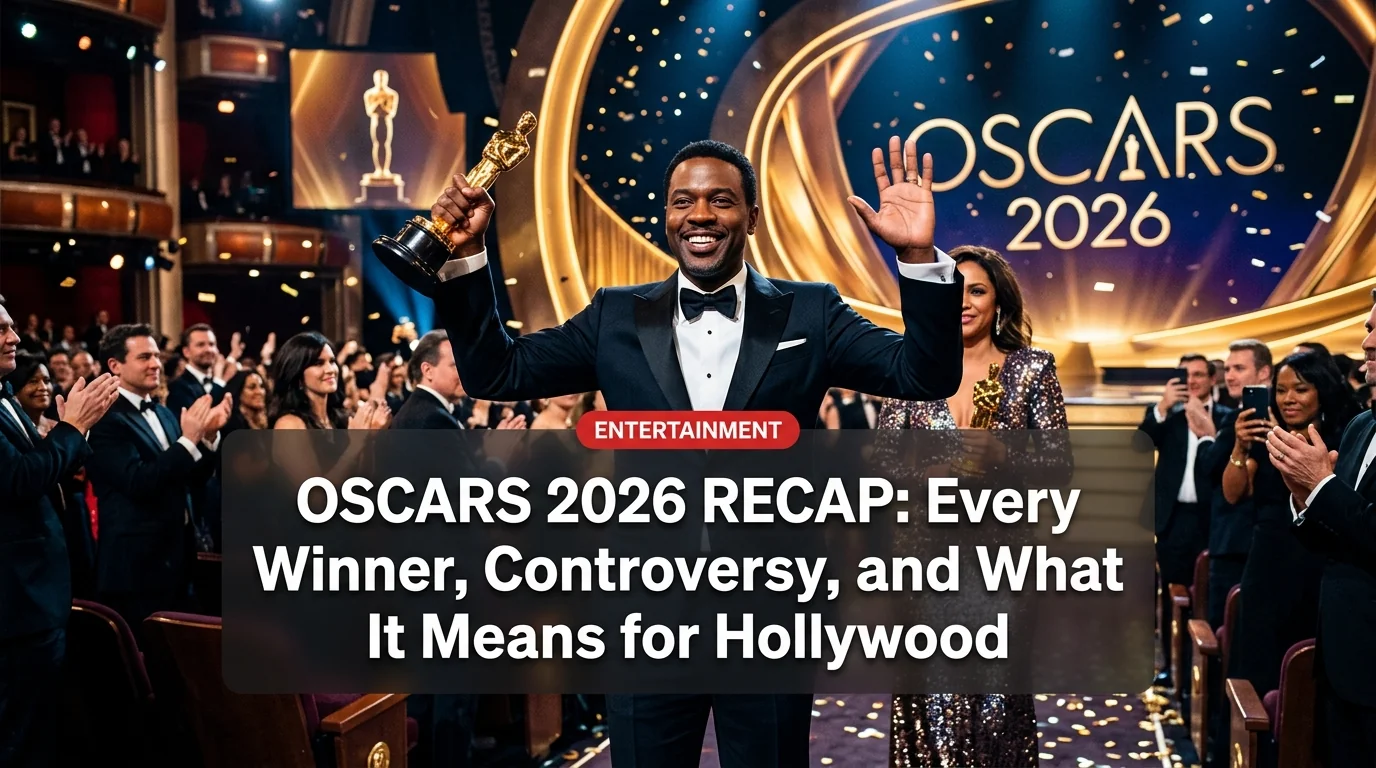
The 98th Academy Awards on March 15, 2026 was supposed to be a celebration. Instead, it became a case study in everything right and wrong with modern Hollywood — historic milestones colliding with production failures, cultural breakthroughs undermined by tone-deaf decisions, and a viewing audience that keeps shrinking even as social media engagement explodes.
Ten days later, the fallout is still unfolding.
The Numbers Tell Two Stories
The Oscars are dying on television and thriving on phones. That paradox defined the entire night: fewer people watched, but more people talked about it than ever. The ceremony was still the most-watched program on Sunday night and topped every awards show this season — but the trajectory is unmistakable.
ABC and Hulu have the broadcast rights through 2028. After that, the ceremony moves to YouTube in 2029. Based on these numbers, that transition can't come soon enough.
The Big Winners
Paul Thomas Anderson's One Battle After Another dominated the night, converting 13 nominations into 6 wins including the top three prizes. But the real story was the breadth of the winners — horror, animation, and K-pop all crashed the party.
| Film | Nominations | Wins | Key Awards |
|---|---|---|---|
| One Battle After Another | 13 | 6 | Best Picture, Director, Adapted Screenplay |
| Sinners | 16 | 4 | Best Actor, Original Screenplay |
| Frankenstein | 9 | 3 | Technical categories (Netflix) |
| KPop Demon Hunters | 4 | 2 | Best Animated Feature, Best Original Song |
| Hamnet | 5 | 1 | Best Actress |
| Weapons | 7 | 1 | Best Supporting Actress |
Sinners entered with a record-tying 16 nominations — the most of the night — but converted only four. Ryan Coogler's win for Best Original Screenplay drew one of the evening's most emotional speeches, described by critics as "profoundly affecting."
Michael B. Jordan's Moment
Jordan's first Oscar win felt like a coronation rather than a surprise. His performance in Coogler's horror-drama hybrid had been the frontrunner since fall festival screenings. At 39, he joins a generation of actors — Timothée Chalamet not among them, as it turns out — who've moved from franchise work into prestige cinema.
Jessie Buckley's Best Actress win for Hamnet was the night's most critically celebrated result. Her portrayal of Shakespeare's wife in the literary adaptation had earned unanimous praise, with several critics calling it the best female performance of the decade.
The KPop Demon Hunters Controversy
This was the moment that defined the night — and not in the way anyone wanted.
When the team behind KPop Demon Hunters took the stage to accept Best Original Song for "Golden" — the first K-pop song to ever win an Oscar — the Academy cut their speech short. The play-off music started, the microphone retracted, and the lights dimmed while six South Korean songwriters were still speaking.
Social media erupted. "Absolutely shameful by the Academy" trended within minutes.
The backlash was compounded by context: this was a historic win. Maggie Kang became the first director of South Korean descent to win Best Animated Feature. The six credited writers of "Golden" were the first South Koreans to win in the Original Song category. Cutting their moment short felt, to many, like the Academy hadn't understood the significance of its own award.
Walt Disney Television's Rob Mills acknowledged the controversy in a post-ceremony interview, calling the situation "difficult" and promising to study the format for an "elegant solution" to group acceptance speeches. Translation: they know they messed up.
The Chalamet Problem
Timothée Chalamet arrived at the Dolby Theatre already on the defensive. In a February CNN/Variety town hall, he'd declared that "no one cares" about ballet or opera — a comment that detonated across the performing arts world.
Did the controversy cost him the Oscar? Probably not — Jordan's performance was widely considered superior. But Chalamet's campaign self-destructed at the worst possible moment. Conan O'Brien's opening joke about "tight security due to threats from the opera and ballet communities" set the tone for a night where Chalamet was a recurring punchline rather than a serious contender.
Sean Penn, Absent and Unforgettable
In perhaps the most surreal moment of the night, Sean Penn won Best Supporting Actor for One Battle After Another — and wasn't there to accept it. He was in Ukraine, meeting with President Volodymyr Zelenskyy.
Presenter Kieran Culkin accepted on Penn's behalf in what observers described as an "awkward" exchange. Penn's absence became its own statement: here was an actor who considered a warzone more important than a gold statue.
The In Memoriam Backlash
The ceremony's "In Memoriam" segment drew immediate criticism for omitting several notable figures, including Eric Dane, James Van Der Beek, and Brigitte Bardot. The annual segment has become one of the most reliably controversial elements of the broadcast, and 2026 was no exception.
What It All Means for Hollywood
- Horror and genre films finally getting Oscar respect (Sinners, Weapons)
- K-pop and international culture breaking through in major categories
- Mandatory Viewing rule forcing members to actually watch nominees
- Social media engagement at all-time highs
- TV viewership in freefall — 9% drop in a single year
- Speech protocol still punishes large international teams
- In Memoriam process remains opaque and controversial
- The ceremony's cultural relevance increasingly depends on controversy rather than celebration
The 98th Academy Awards introduced the "Mandatory Viewing" rule for the first time, requiring members to confirm they'd watched every nominee in a category or abstain from voting. It's a reform designed to combat the perception that Oscars are popularity contests rather than merit-based awards. Whether it changed outcomes is impossible to prove, but the breadth of winners — spanning horror, animation, literary drama, and K-pop — suggests it might be working.
What Happens Next
The Academy has several fires to put out. The speech protocol review is expected to produce new rules by the 2027 ceremony. Rob Mills indicated that Conan O'Brien has the hosting gig "if he wants it" for next year. The Scientific and Technical Awards ceremony is scheduled for April 28, 2026.
But the biggest question is existential: with the YouTube transition looming in 2029 and traditional viewership declining year after year, the Academy must decide whether the Oscars are a television event that happens to be on social media, or a social media event that happens to be on television.
Based on the numbers, that decision has already been made for them.
The 99th Academy Awards are expected to take place in March 2027 at the Dolby Theatre in Hollywood.