
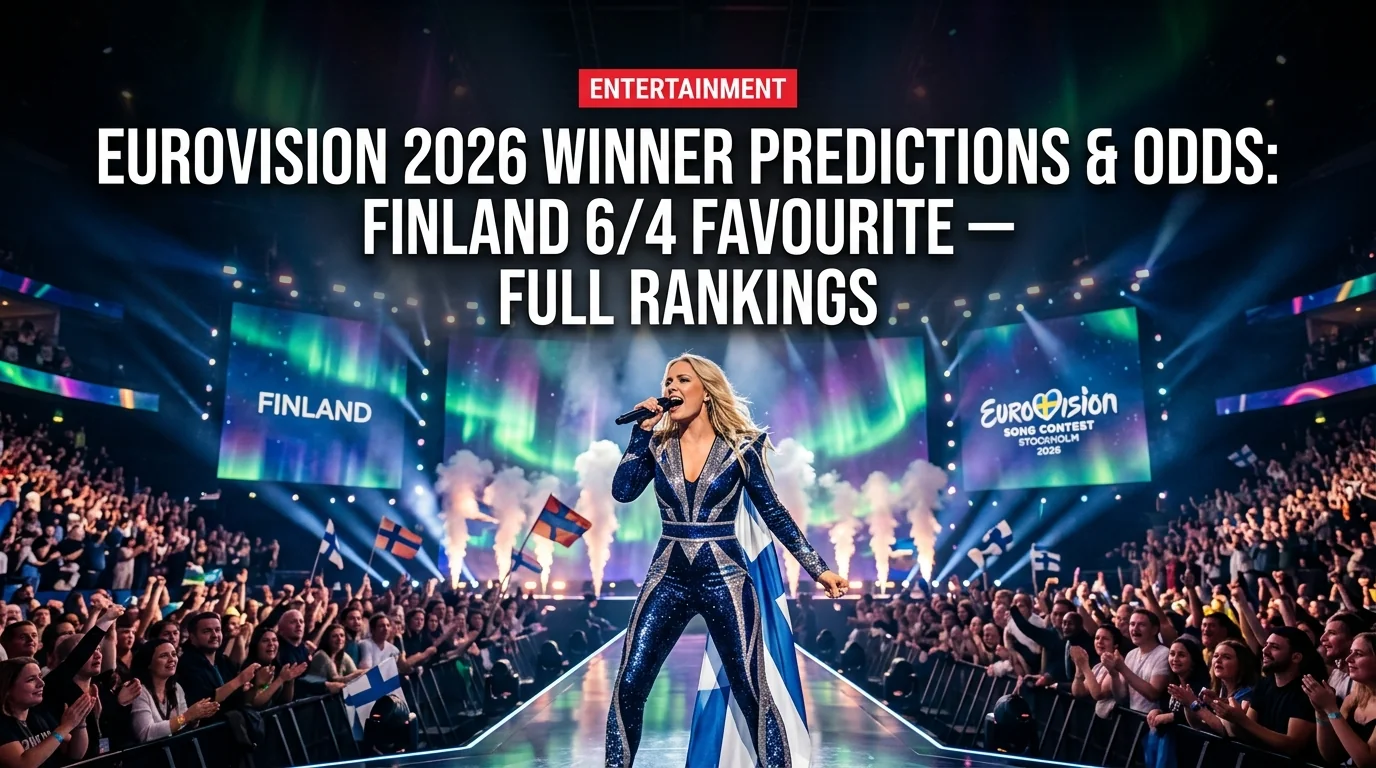
With exactly one month to go until the Eurovision 2026 Grand Final in Vienna, the bookmakers have spoken — and Finland is the runaway favourite to lift the trophy on May 16.
The 70th Eurovision Song Contest takes place at the Wiener Stadthalle in Vienna, Austria, following Austria's dramatic victory at last year's contest in Basel. Thirty-five countries will compete across two semi-finals on May 12 and 14 before the grand final crowns a winner.
Finland: The Dominant Favourite
Finland's entry has set the betting markets alight. Linda Lampenius and Pete Parkkonen won the Finnish national selection (UMK) with "Liekinheitin" — a high-voltage fusion of classical violin, electronic production, and stadium-ready pop. Bookmakers currently price Finland at 6/4, implying roughly a 40% chance of winning — an unusually high probability for a Eurovision market at this stage.
Lampenius is a celebrated violinist who brings genuine concert-hall chops to Eurovision staging. The combination of technical brilliance and commercial songwriting has lit up both the jury circuit and public polls. Several major bookmakers have already shortened Finland's odds twice since UMK aired in February.
The Full Odds Table: Every Contender Ranked
Here's how the field stacks up as of late April 2026, based on aggregated bookmaker data:
1. Finland — 6/4 (40% implied probability)
Entry: "Liekinheitin" — Linda Lampenius & Pete Parkkonen Finnish Eurovision entries tend to polarise — from Lordi's shock 2006 win to Käärijä's near-miss in 2023. This year's entry has the rare quality of appealing to both juries and televoters. If the live performance delivers what rehearsal footage suggests, Finland will be extremely hard to beat.
2. France — 6/1 (11% implied probability)
Represented by: TBD (internal selection) France has been agonisingly close in recent years without a win since 1977. La Délégation Française has reportedly put serious resources into this year's entry, chasing the grand prix on home-continent soil. The jury vote could be France's great equaliser.
3. Denmark — 7/1 (9% implied probability)
Denmark's entry is widely praised in fan forums for its stripped-back emotional resonance — a contrast to the high-production entries expected to dominate. Dark horse potential if the televote swings sentimental.
4. Australia & Greece — 8/1 (8% implied probability each)
Australia continues to punch well above its weight for a non-European nation. Greece's entry is classic Mediterranean pop with a modern sheen — strong televoter bait in southern Europe and the diaspora.
5. Romania — The Dark Horse
Bookmaker-listed Romania is generating significant fan community buzz as a late-breaking contender. Romania has historically performed above expectations when they bring something unexpected. Worth a flutter at longer odds.
- Finland hasn't won Eurovision since Lordi in 2006
- France last won in 1977 — the longest drought of any Big-4 country
- Australia has never won but regularly finishes top 10
- Austria (last year's winner) qualifies automatically for the Grand Final as host
- The Big-4 (UK, France, Germany, Italy) skip the semi-finals entirely
How the Voting Works in 2026
Eurovision uses a split voting system. 50% of the final score comes from a national jury of five music industry professionals. The other 50% comes from public televoting across all participating countries and a global vote open to viewers worldwide.
Each country awards points on both the jury and televote side: the classic 1–8, 10, and the coveted 12 points (douze points) to their top pick. Countries cannot vote for themselves.
The semi-finals on May 12 and 14 will whittle the 35-country field down to a Grand Final of approximately 26 acts — 10 qualifiers from each semi-final, plus the Big-4 and Austria.
- France (musical sophistication)
- Denmark (songcraft)
- Finland (technical performance)
- Finland (spectacle + energy)
- Greece (diaspora bloc votes)
- Australia (global appeal)
What Could Upset Finland?
Eurovision is famously unpredictable. Three factors could cost Finland the trophy:
- Semi-final jitters — Finland competes in a semi-final, not the Grand Final automatically. A bad night could end their run before it starts (unlikely given current form, but possible).
- Political voting patterns — Nordic bloc votes are reliable but Eurovision results increasingly reflect geopolitical sentiment, especially regarding Eastern European blocs.
- A breakthrough moment — Eurovision history is littered with acts that nobody saw coming: Måneskin (Italy, 2021), Loreen's second win (Sweden, 2023). One breakout rehearsal could shift the entire market.
How to Watch Eurovision 2026
The semi-finals on May 12 and 14 and the Grand Final on May 16 will be broadcast live across Europe and available internationally. US viewers can stream the Grand Final on Peacock (NBC's streaming platform). The BBC carries coverage in the UK; Australian viewers get the SBS broadcast.
Linos.ai will have live updates, a running scoreboard, and winner predictions throughout Grand Final night.
Odds correct as of April 21, 2026. Always check current bookmaker prices before placing bets. Gambling involves risk — bet responsibly.