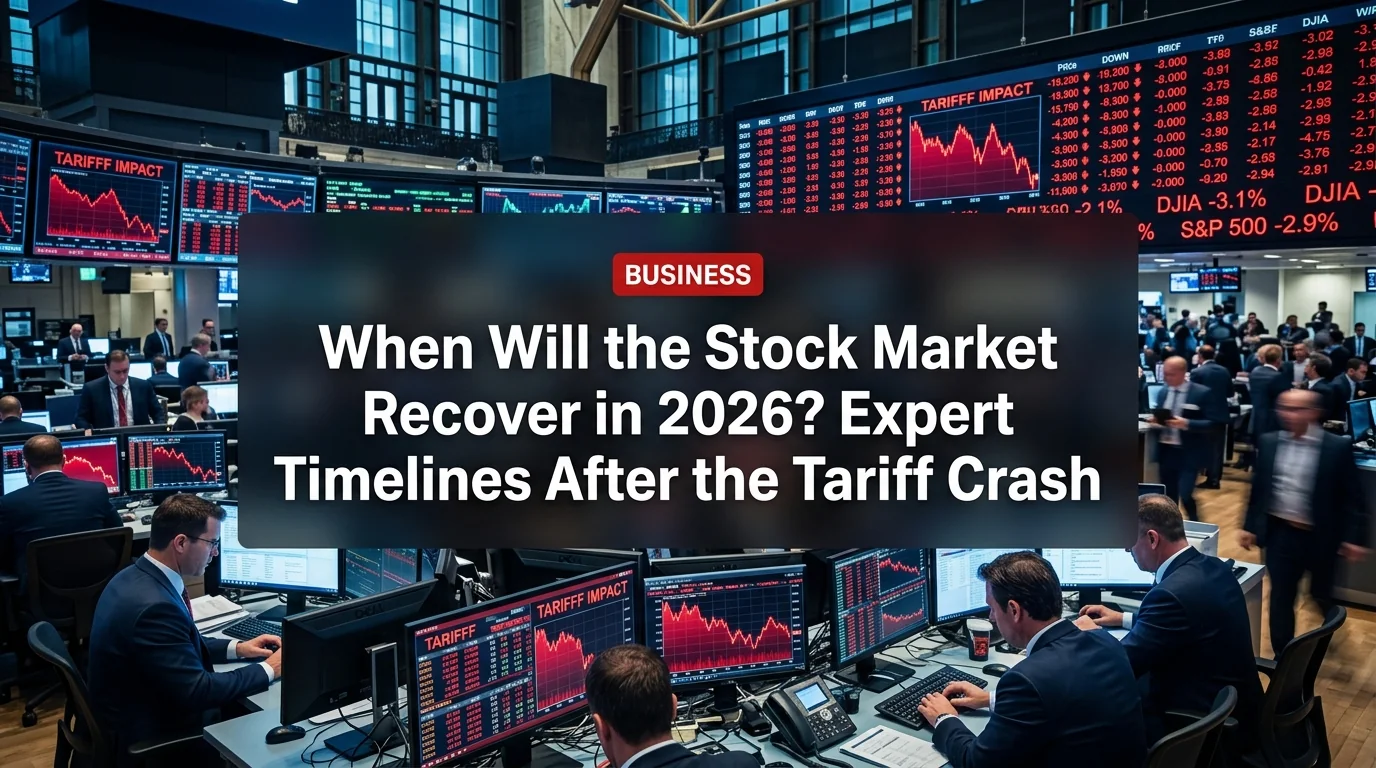
The S&P 500 just logged one of its worst weeks since 2020. President Trump's sweeping tariff announcements sent markets into a tailspin. Investors are now asking the same urgent question: when will the stock market recover?
The honest answer depends on several variables. But history, Wall Street forecasts, and current macro signals all point to a clearer picture than the panic suggests.
How Bad Is the 2026 Tariff Crash?
By most measures, the April 2026 sell-off ranks among the sharpest in recent memory. The S&P 500 fell roughly 15-18% from its February peak within six weeks of the tariff announcements. The Nasdaq dropped harder as tech and semiconductor stocks bore the brunt given their deep China supply-chain exposure.
The Dow Jones Industrial Average briefly dipped below 38,000. Market volatility (the VIX fear gauge) spiked above 45, comparable to COVID's March 2020 crash and the 2022 inflation shock.
What Goldman Sachs and JPMorgan Are Saying
Wall Street's biggest voices have published sharply different outlooks.
Goldman Sachs revised its 12-month S&P 500 target downward, citing a 35% probability of a US recession if tariffs remain in place through Q3 2026. Their base case still shows the index recovering to prior highs within 12-18 months, contingent on a partial trade deal or tariff exemptions before summer.
JPMorgan took a more cautious stance, warning prolonged trade uncertainty could suppress corporate earnings for two full quarters. Their analysts modeled a U-shaped recovery over 12-24 months.
Morgan Stanley expects a bottoming process in Q2 2026, followed by a gradual recovery once the Federal Reserve signals readiness to cut rates.
Historical Crash Recovery Times: What the Data Shows
Every major crash feels permanent in the moment. History says otherwise.
The most relevant analog is 2018 — the last US-China trade war crash. That selloff was also tariff-driven and reversed quickly once markets priced in a deal framework. Recovery took roughly 3 months from the December 2018 bottom.
The 2026 tariffs are larger in scope, but the mechanism is the same: presidential policy, not structural economic failure. Markets can recover fast when the policy reverses or softens.
5 Signals That a Recovery Is Starting
Instead of guessing the exact date, watch for these indicators that historically precede a sustained market recovery:
- VIX drops below 25 — Sustained readings below 25 signal institutional buyers are returning.
- Fed pivot language — Any Federal Reserve statement hinting at rate cuts due to slowing growth triggers relief rallies.
- Trade deal headlines — Even partial tariff exemptions can snap markets upward within hours.
- Earnings beats with raised guidance — If Q1 2026 results beat lowered expectations, it breaks the negative sentiment spiral.
- Breadth expansion — When more than 70% of S&P 500 stocks rise on a given day, it historically marks durable bottoms.
- Markets bottom an average of 6-9 months before economic data confirms recovery
- S&P 500 has recovered to new highs after every single crash in its 100-year history
- Missing the top 10 recovery days cuts 10-year returns by roughly 50%
- Policy-driven crashes (tariffs, rate hikes) recover faster than structural crashes (banking crises, bubbles)
The Recession Risk Factor
The market's recovery timeline hinges on whether the US enters a recession.
If GDP contracts for two consecutive quarters, which several banks now assign 30-40% probability, the recovery runway extends significantly. Recession-accompanied bear markets take an average of 2-3 years to fully recover.
If the US avoids recession, the base case for most forecasters, the recovery could look like 2018-2019: a sharp bottom, a policy catalyst, and new highs within 12 months.
What Should Investors Do Now?
Do:
- Maintain diversification; do not overweight any single sector or country
- Consider dollar-cost averaging into index funds if your time horizon is 5+ years
- Review bond allocation; short-duration Treasuries have outperformed during this selloff
- Keep 3-6 months of emergency cash outside markets
Do not:
- Try to time the exact bottom — virtually no professional investor does this successfully
- Sell everything and wait for certainty — certainty arrives after the recovery, not before
- Over-concentrate in tariff-exposed sectors (autos, electronics, retail) until trade policy clears
- GDP contracts Q2-Q3 2026
- Tariffs stay elevated through year-end
- Recovery timeline: 24-36 months
- S&P 500 could test 4,200-4,500
- Trade deal or exemptions emerge by summer
- Fed cuts rates once in H2 2026
- Recovery timeline: 9-14 months
- S&P 500 back near highs by Q1 2027
Bottom Line
The 2026 tariff crash is severe but it is a policy-driven event, not a systemic financial crisis. History's most relevant parallel — 2018 — saw full recovery in under 100 days once trade tensions peaked.
Wall Street's consensus: markets bottom in Q2 2026 and recover to prior highs within 12-18 months in the base case. The wild card is whether tariffs escalate further or a deal framework emerges before summer.
The investors who fare best in downturns are usually those who keep buying, stay diversified, and resist the urge to wait for certainty that never comes at the right price.