
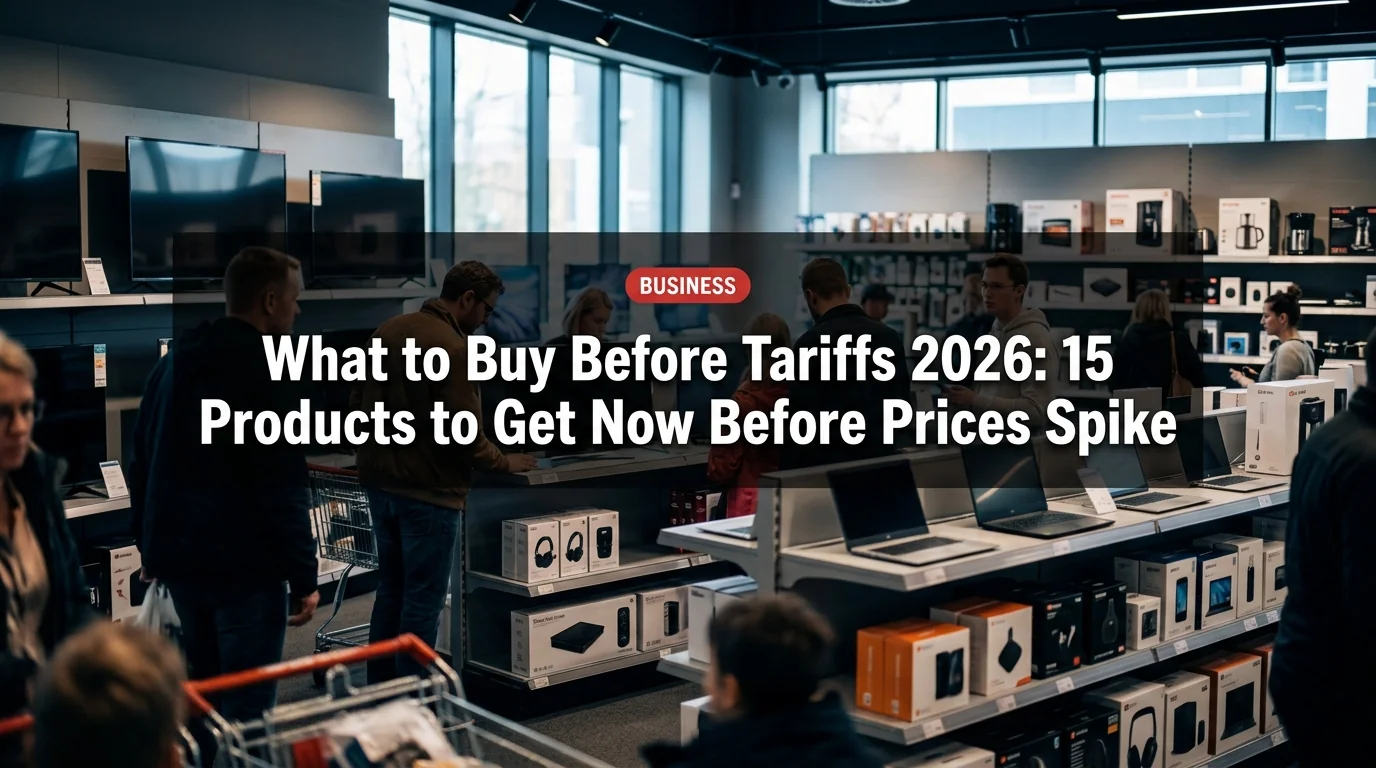
With President Trump's sweeping "Liberation Day" tariffs now in effect — a 10% baseline on all imports, rising to 145% on Chinese goods — prices across dozens of product categories are set to climb fast. Retailers are burning through pre-tariff inventory, and once it's gone, the new prices hit.
This is not a drill. Analysts at Goldman Sachs and JPMorgan both project consumer prices will rise 1.5–2.5% this year from tariffs alone, with certain categories spiking 15–30%. Here's exactly what to buy before the price increases become permanent.
Why Now? The Tariff Timeline
Most major U.S. retailers carry 30–60 days of inventory. Goods already shipped before the tariff deadlines will sell at current prices. Once that inventory clears — likely by late May or June — replacement stock will carry the full tariff-inflated cost.
The window to buy at old prices is measured in weeks, not months.
1. Smartphones
Expected price increase: 15–25%
Over 90% of iPhones are manufactured in China. Apple has already signaled price adjustments for its 2026 lineup, and analysts expect even current models to see shelf price hikes as inventory turns over. A $999 iPhone 16 Pro could effectively become a $1,150–$1,250 device.
Samsung's Galaxy S25 series, assembled in Vietnam (34% tariff rate), faces similar pressure. If you've been planning an upgrade, buy now — or wait until Apple's India manufacturing ramps up, which won't fully materialize until late 2026 at the earliest.
2. Laptops and Tablets
Expected price increase: 15–20%
Chromebooks, Windows laptops, and iPads are predominantly Chinese-manufactured. A $600 laptop could hit $690–$720 by summer. Dell, HP, Lenovo, and ASUS have all announced "pricing reviews" — corporate-speak for incoming increases.
If you need a laptop in 2026, buy before June.
3. Televisions
Expected price increase: 10–20%
Flat-panel TVs come almost entirely from South Korea (Samsung, LG), China (Hisense, TCL), and Mexico. With China at 145% and Mexico at 25%, budget and mid-range TVs will see the biggest increases. A $400 65-inch TCL could climb to $460–$480.
Premium brands like Sony and Samsung (assembled in Mexico or Malaysia) face 20–25% rate exposure.
4. Home Appliances
Expected price increase: 10–20%
Washers, dryers, refrigerators, and dishwashers have already been through one tariff round (2018-era Section 232). This time the hit is broader. GE Appliances (Chinese-owned), Whirlpool, and LG Electronics all source components heavily from China, even when final assembly is domestic.
Industry group AHAM warns appliance prices could rise $100–$300 per unit by Q3 2026.
5. Gaming Consoles and Accessories
Expected price increase: 15–25%
The PlayStation 5, Xbox Series X, and Nintendo Switch 2 are all manufactured in China or Vietnam. Sony has warned of "pricing impacts." Console prices have historically been sticky — Sony held the PS5 at $499 for years — but under 145% tariff pressure, increases are likely inevitable.
Game controllers, headsets, and accessories (especially from brands like Razer, Logitech, and Turtle Beach) will see immediate increases, as their inventory turns over faster.
- Lock in pre-tariff pricing on high-ticket items
- Pre-tariff inventory still widely available
- Electronics work the same regardless of when you buy
- Avoid potential supply shortages if retailers slow orders
- Ties up capital early
- Some products may improve (new iPhone model in Sept)
- Tariffs may be negotiated down (uncertainty)
- Risk of buying something you didn't truly need
6. Vehicles
Expected price increase: $3,000–$10,000+
The 25% tariff on imported vehicles is the single biggest consumer wallet hit. If you're buying a foreign-made car — Toyota Camry (Japan), Honda CR-V (Canada/Mexico), BMW 3 Series (Germany) — expect $3,000–$10,000 added to sticker price once dealer lots cycle through current inventory.
Even "American-made" vehicles often rely on imported parts, pushing up costs. Cox Automotive projects average new vehicle prices will hit $52,000 by end of 2026, up from $48,000 today.
If you're in the market for a car, the next 4–6 weeks may be your last window at pre-tariff pricing.
7. Power Tools and Hardware
Expected price increase: 15–30%
Dewalt, Milwaukee, Ryobi, and Bosch all manufacture heavily in China. A $200 cordless drill could become a $240–$260 purchase. Contractors and DIYers should stock up on consumables and tools now.
Home Depot and Lowe's have both quietly noted "vendor price renegotiations" — expect new shelf prices by May.
8. Clothing and Footwear
Expected price increase: 10–25%
Over 36% of U.S. apparel imports come from China, with Vietnam, Bangladesh, and Cambodia also heavily tariffed. Nike (Vietnam: 46% tariff), Adidas, and Gap are all exposed. Basics from Amazon, Shein, and Temu — which built their entire model on Chinese manufacturing — face the steepest hikes.
Stock up on work essentials, children's clothing (kids grow — buy ahead a size), and athletic wear.
9. Furniture
Expected price increase: 20–35%
China dominates global furniture manufacturing. IKEA, Wayfair, and Ashley Furniture source substantially from Chinese factories. Sofas, beds, and dining sets — already seeing price pressure from 2024 supply chain costs — are set for another significant jump.
- China accounts for ~26% of all U.S. furniture imports
- Average sofa price could rise $150–$400 by mid-2026
- IKEA has announced a global price increase review for Q2 2026
- Custom furniture (domestically made) largely unaffected
- Mattresses: largely domestic production, less exposure
10. Toys and Baby Gear
Expected price increase: 15–25%
The Toy Association estimates 80% of toys sold in the U.S. are made in China. With a 145% tariff rate, the math is brutal. A $30 Lego set doesn't become $73.50 overnight — retailers absorb some costs, margins compress — but by Q4 2026 (holiday season), expect significant price increases.
Parents planning for birthdays and the 2026 holiday season: buy now.
11. Bicycles and Exercise Equipment
Expected price increase: 20–30%
Peloton, Trek, and Specialized all rely on Asian manufacturing. Indoor cycling equipment, weights, and treadmills were hammered by supply chain issues in 2021-22 and are now facing tariff pressure. If you've been putting off a home gym purchase, the window is closing.
12. Small Kitchen Appliances
Expected price increase: 15–20%
Air fryers, coffee makers, Instant Pots, and blenders are predominantly Chinese-made. Ninja, Keurig, Cuisinart, and Breville all source substantially from Chinese factories. A $100 air fryer could become $115–$120 by summer.
13. Solar Panels and Batteries
Expected price increase: 30–50%
This one matters for homeowners considering solar. Chinese solar panels dominate the market and already faced existing tariffs — the new rates stack on top. Enphase, SunPower, and installation companies are all warning of price increases. If you've been getting quotes for a solar installation, lock in pricing now.
14. Pet Products
Expected price increase: 10–20%
Pet food, toys, accessories, and electronics (GPS trackers, feeders) are heavily Chinese-sourced. Chewy and Petco have both flagged incoming price increases. Stock up on non-perishable food, treats, and accessories.
15. Holiday Gifts (Buy Early)
Expected price increase: 15–30% by Q4
If you have any major purchases planned for birthdays, anniversaries, graduations, or the 2026 holiday season — buy now. Electronics, toys, clothing, and home goods will all be more expensive by fall. Buying a $500 gift today could save you $75–$150 compared to buying the same item in November.
What's Probably Fine to Wait On
Not everything is affected equally. Domestically produced goods — American-made furniture, local food, domestic vehicles assembled in the U.S. from local parts — have minimal direct tariff exposure. Services (software, streaming, haircuts) aren't tariffed at all. Real estate is unaffected.
Also: tariffs are negotiable. Several countries are already in talks with the U.S., and some rates could be reduced or paused. The China situation, however, looks entrenched — both sides have dug in.
The Bottom Line
You have roughly 4–8 weeks before pre-tariff inventory is gone. For high-ticket items — phones, laptops, cars, appliances, furniture — the savings from buying now are real and measurable. For smaller purchases, the urgency is lower but the direction is clear: prices are going up.
Shop strategically, not frantically. Buy what you actually need. But if a purchase was already on your 2026 roadmap, move it forward.