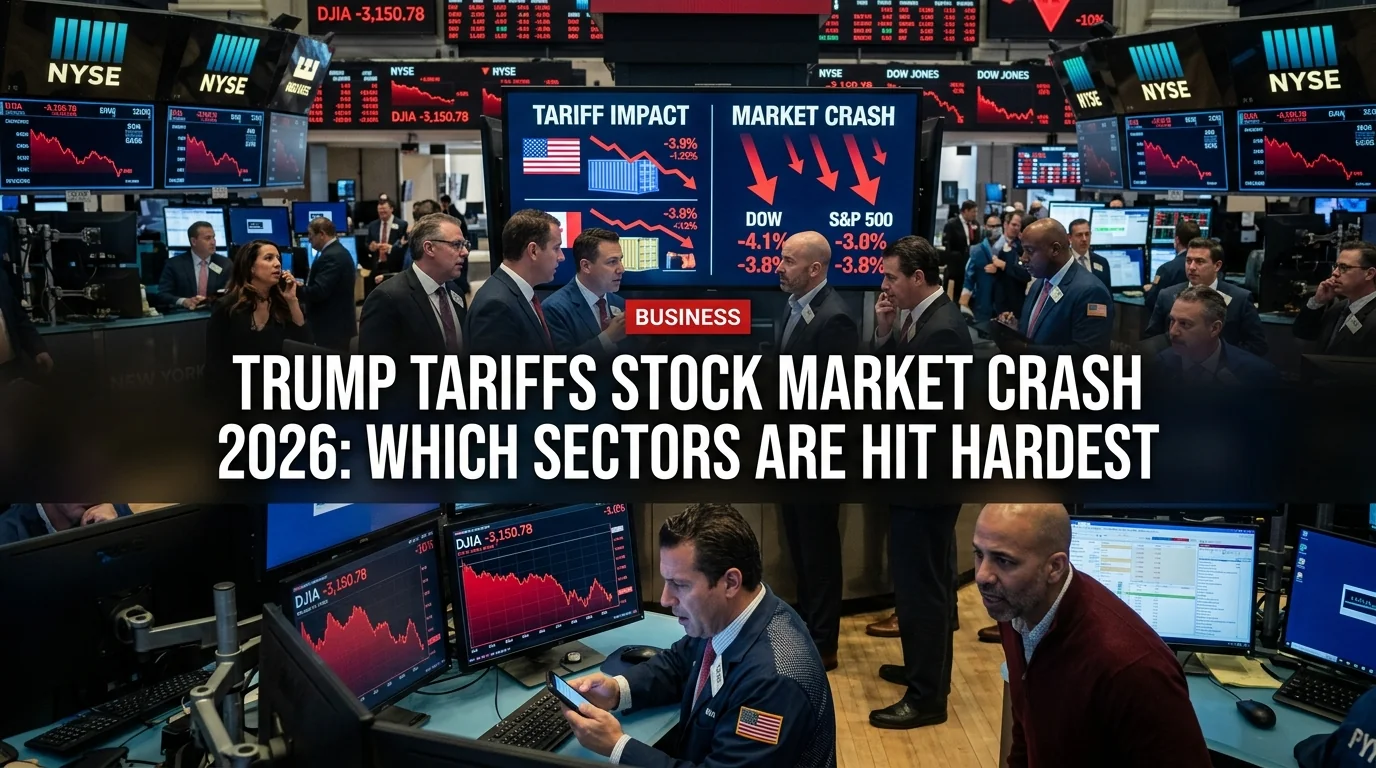
The stock market has entered its most turbulent stretch in years. Since President Trump unveiled sweeping global tariffs in early April 2026 — a 10% baseline duty on all imports under Section 122, with steeper rates on dozens of countries — the S&P 500 has shed hundreds of points, the Nasdaq has entered correction territory, and recession warnings are flashing from Wall Street to Main Street.
If you're watching your 401(k) shrink and wondering whether to panic or hold, here's a clear breakdown of what's actually happening, which sectors are taking the biggest hits, and what comes next.
What Triggered the Sell-Off?
The proximate cause is straightforward: tariffs are a tax on imports, and markets hate taxes on trade. When Trump signed the Section 122 executive order imposing a 10% universal tariff — and reciprocal tariffs of 20–50% on targeted countries — investors immediately started pricing in the downstream effects.
Higher import costs squeeze corporate margins. Retaliation from trading partners threatens U.S. export revenues. And the uncertainty alone freezes business investment decisions. All three dynamics are showing up simultaneously in Q1 2026 earnings calls.
The Sectors Getting Crushed
Technology: The Biggest Loser
Tech is the hardest-hit sector, and the math is simple: almost every major consumer electronics product sold in the U.S. is manufactured in Asia. Apple, Dell, HP, and dozens of others face tariff rates of 25–34% on goods made in China, Taiwan, and Vietnam.
Apple's stock dropped significantly after analysts calculated that a fully U.S.-compliant iPhone supply chain would add hundreds of dollars to per-unit costs — costs that can't be passed to consumers without crushing demand. Nvidia, despite being a U.S. chipmaker, faces retaliation risk as China signals restrictions on rare earth mineral exports critical to GPU manufacturing.
Retail: The Thin-Margin Squeeze
Retailers operate on razor-thin margins, and tariffs on apparel, footwear, and consumer goods imported from Southeast Asia are directly compressing them. Companies like Nike, Gap, and Dollar Tree source heavily from Vietnam and Cambodia — countries hit with some of the highest reciprocal tariff rates.
Walmart issued a rare earnings guidance cut, warning that tariff-driven cost increases could not be fully absorbed. The company faces a painful choice: raise prices and lose budget-conscious shoppers, or absorb costs and destroy margins.
Industrials and Manufacturing: The Supply Chain Tangle
American manufacturers who depend on foreign steel, aluminum, and components are caught in a bind. Raw material costs are rising, but so are the costs of finished goods from overseas competitors. General Motors and Ford have both flagged uncertainty around their Mexican and Canadian manufacturing exposure under the new tariff regime.
The construction and infrastructure sector faces particularly acute pressure as steel and aluminum tariffs drive up materials costs at a time when the housing market was already struggling with affordability.
The Sectors Holding Up
Not everything is in freefall. A few sectors are proving relatively resilient:
Energy: Domestic oil and gas producers benefit when energy prices spike. With oil touching $100/barrel amid global supply disruption fears, energy stocks are outperforming.
Defense: Tariffs don't affect the U.S. defense industrial base the same way, and ongoing geopolitical tensions mean defense budgets aren't shrinking. Lockheed, Raytheon, and Northrop Grumman have held their ground.
Utilities and Domestic Services: Companies whose revenues come entirely from domestic consumers — power companies, telecom providers, domestic restaurant chains — are relatively insulated from tariff exposure.
Agriculture (selective): While farmers exporting soybeans and pork face retaliation risks from China, domestic food producers serving the U.S. market have seen less pressure.
What Analysts Are Saying
Wall Street consensus has shifted dramatically in the past month. At the start of 2026, most major banks had S&P 500 year-end targets in the 6,000–6,500 range. Several have now issued downgrades.
The bearish camp argues that the inflationary pressure from tariffs will force the Federal Reserve to keep rates higher for longer — eliminating the rate-cut tailwind that markets had been counting on. Meanwhile, any retaliatory escalation from China, the EU, or Canada could turn a correction into a bear market.
The bullish counter-argument: tariffs are a negotiating tool, not a permanent policy. If Trump uses them to extract favorable trade deals — as he has signaled — markets could reverse sharply when deals are announced. Some analysts point to his first term, when the Phase 1 trade deal with China triggered a significant market rally.
Recession Risk: How Real Is It?
The word economists are starting to use is "stagflation" — a combination of slowing growth and rising prices. Tariffs are by definition inflationary (they raise the cost of imported goods), and the uncertainty they create can slow business investment and hiring, reducing growth.
The Atlanta Fed's GDPNow tracker entered negative territory in late Q1 2026 — a first since the pandemic — suggesting the tariff shock may already be hitting GDP growth. Two consecutive quarters of negative GDP growth would officially constitute a recession.
Consumer sentiment surveys tell a similar story. Confidence has fallen sharply, particularly among lower-income households who spend a higher proportion of income on imported goods like electronics, clothing, and appliances.
What Should Investors Do?
This is the question everyone's asking, and the honest answer depends heavily on your time horizon.
Short-term traders are navigating one of the most volatile tape environments in years. Tariff headlines move markets dramatically — a single tweet from the White House can swing the S&P 500 by 1–2% intraday. Volatility indices (VIX) have spiked to levels not seen since the 2022 bear market.
Long-term investors face a different calculus. Historically, market corrections of 10–20% — even those triggered by policy shocks — have been buying opportunities for investors with 5+ year horizons. The U.S. economy's structural strengths (consumer spending, tech innovation, energy production) don't disappear because of tariffs.
Defensive positioning that analysts broadly recommend in tariff environments includes: overweighting domestic-facing sectors (utilities, healthcare, domestic services), reducing exposure to supply-chain-heavy tech and retail, and holding more cash to deploy if markets fall further.
- The S&P 500 has historically recovered from every correction caused by trade policy uncertainty
- Dollar strengthening during trade wars can partially offset import cost increases
- Tariff revenue ($600B+ annually at current rates) is larger than most federal budget line items
- The last major trade war (2018–2019) saw a 20% S&P correction followed by a 40% rally
- 70% of U.S. GDP is consumer spending — tariff-driven inflation is the main transmission risk
The Bottom Line
The 2026 tariff market crash is real, driven by legitimate concerns about inflation, retaliation, and supply chain disruption. Technology and retail are the hardest-hit sectors; energy and utilities are relative safe havens.
But markets are pricing in a worst-case scenario. If tariff negotiations produce deals — or if the administration exempts key sectors — the reversal could be as dramatic as the selloff. The risk is that escalation continues and stagflation takes hold before a deal is reached.
Watch the headlines, but don't let short-term volatility derail long-term financial plans. The investors who panic and sell at the bottom are the ones who miss the recovery.