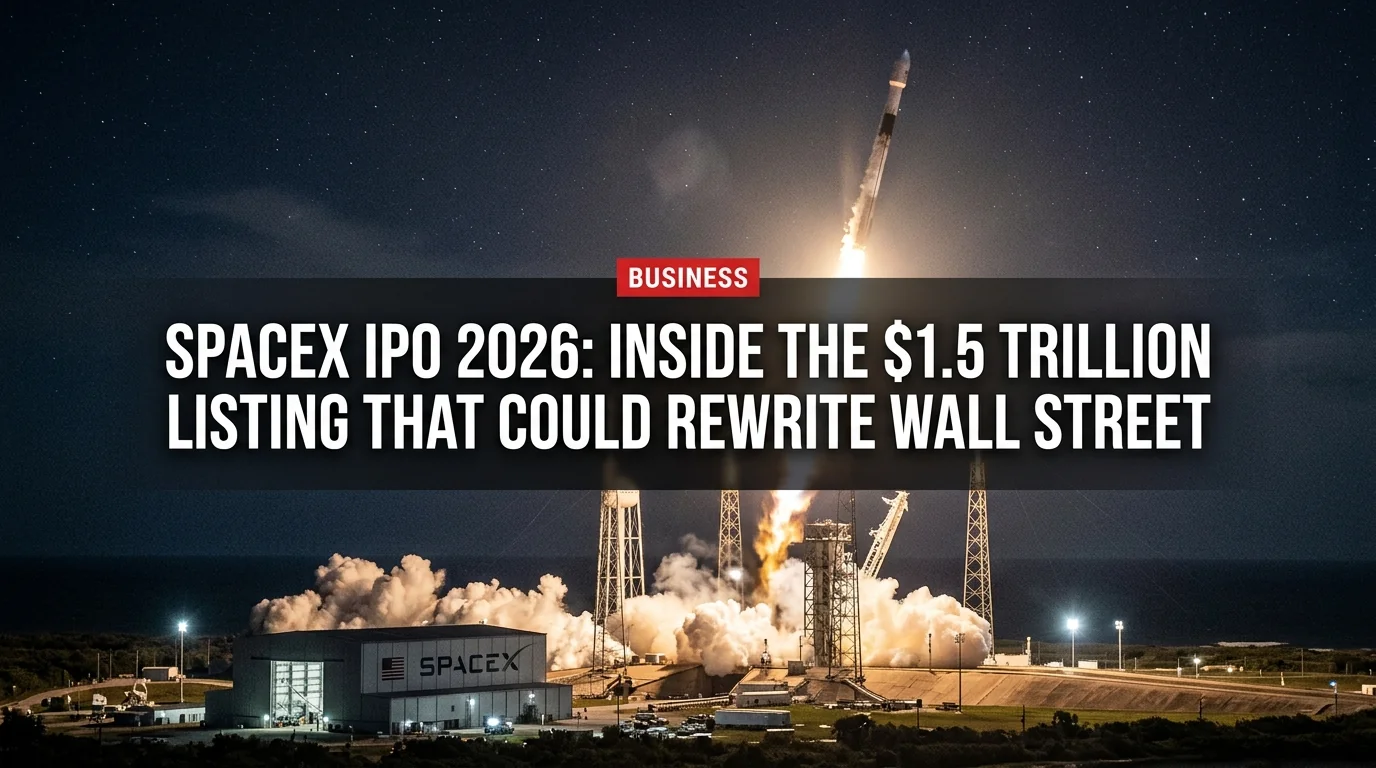
SpaceX is preparing to go public in what would be the largest Initial Public Offering in financial history — a $1.5 trillion listing that dwarfs Saudi Aramco's $29.4 billion record raise. The mid-2026 IPO isn't just a tech milestone. It's the moment space stops being a frontier and becomes a mainstream asset class.
But behind the headline number lies a story most coverage misses: the real engine of this valuation isn't Starlink's 16 million subscribers or Starship's reusable rockets. It's Starshield — SpaceX's classified military satellite division — and a web of defense contracts worth tens of billions.
The Numbers That Matter
How SpaceX Built a Trillion-Dollar Company
SpaceX's path to a $1.5 trillion valuation didn't happen overnight. It was built through a decade of strategic moves that transformed a rocket company into an integrated defense-AI-telecom conglomerate.
Starshield: The Division Nobody Talks About
While Starlink gets the headlines, Starshield is the profit engine that makes institutional investors salivate. Here's why.
Starshield is SpaceX's government-only business unit. It builds Earth observation satellites, secure military communications networks, and hosted payloads for intelligence agencies. At least 183 Starshield satellites are already in orbit, with the 600-satellite Golden Dome constellation representing the next major deployment.
The contracts tell the story:
| Contract | Value | Client | Purpose |
|---|---|---|---|
| NRO Spy Constellation | $1.8B | National Reconnaissance Office | Classified Earth observation |
| Golden Dome AMTI | $2.0B | Pentagon / Space Force | Air moving target indicator satellites |
| PLEO Expansion | $13.0B ceiling | Space Development Agency | Proliferated LEO transport layer |
| Italy Government Deal | $1.6B | Italian Government | Encrypted comms & internet |
KEY STAT: Starshield revenue is estimated at $2 billion annually — roughly 25% of SpaceX's satellite-related income — with margins significantly higher than consumer Starlink.
The Space Development Agency is even considering replacing 140 planned Transport Layer satellites with Starshield technology, which would consolidate SpaceX's grip on America's orbital defense infrastructure.
The xAI Merger Changes Everything
The February 2026 acquisition of xAI transformed SpaceX from an aerospace firm into something unprecedented: an integrated AI and space infrastructure company.
The play is audacious. SpaceX plans to build "orbital data centers" — Terafab units that run AI workloads in space, where cooling is free and power comes from unlimited solar exposure. The first units are rumored for late 2026.
This solves one of AI's biggest constraints. Earth-based data centers are running into power grid limits and cooling challenges. Space has neither problem. With xAI providing the AI backbone and SpaceX providing the launch infrastructure, no competitor can replicate this vertical integration.
Golden Dome: The $175B to $831B Wildcard
The biggest variable in SpaceX's future isn't commercial — it's military.
President Trump's Golden Dome missile defense system represents a generational defense spending commitment. The numbers are staggering:
Projected Golden Dome total cost in billions of dollars over 20 years
SpaceX, through Starshield, is positioned to capture a significant share of this spending. The 600-satellite "air moving target indicator" constellation is just the beginning. Space-based interceptors, tracking networks, and command infrastructure could all flow through Starshield.
The Bull Case vs. The Bear Case
- $1.5T valuation backed by $22-24B in 2026 revenue and $8B profit
- Starlink's 16M+ subscribers provide recurring consumer revenue
- Starshield's high-margin government contracts offer stability
- xAI merger creates unmatched AI-space vertical integration
- Golden Dome spending could exceed $400B over 20 years
- No competitor has both launch capability and satellite constellation at scale
- Dual-class shares give Musk 79% voting control — governance nightmare
- Over-reliance on a single provider for national security raises Pentagon concerns
- Amazon's Project Kuiper is a well-funded alternative for government contracts
- Musk's "unpredictable behavior" is a documented risk factor
- Orbital data centers are unproven technology
- Starship V3 must prove reliability for next-gen deployments
Who's Running the Show
The IPO's success may hinge less on Musk and more on the team around him.
Gwynne Shotwell, SpaceX's President and COO, is widely credited as the "steady hand" managing government relationships. Former NASA chief Bill Nelson has publicly said his confidence in SpaceX stems largely from Shotwell's leadership.
Bret Johnsen, CFO, is leading the financial architecture of the listing. Terrence O'Shaughnessy, a retired four-star general, runs Starshield's military integration as VP of Special Programs.
The underwriting consortium — Goldman Sachs, JPMorgan Chase, Bank of America, and Morgan Stanley — represents the heaviest firepower Wall Street can assemble.
What Happens Next
If the $25–50 billion raise goes through, it won't just be the biggest IPO ever. It will mark the moment space infrastructure joined oil, semiconductors, and cloud computing as a pillar of the global economy.
The question isn't whether SpaceX can justify a $1.5 trillion valuation. With $22 billion in projected revenue, monopolistic launch economics, and a defense contract pipeline measured in hundreds of billions, the numbers work. The question is whether public market investors are comfortable handing that much capital to a company where one person holds 79% of the votes — and occasionally tweets his way into SEC investigations.
For Wall Street, that's the trillion-dollar bet.