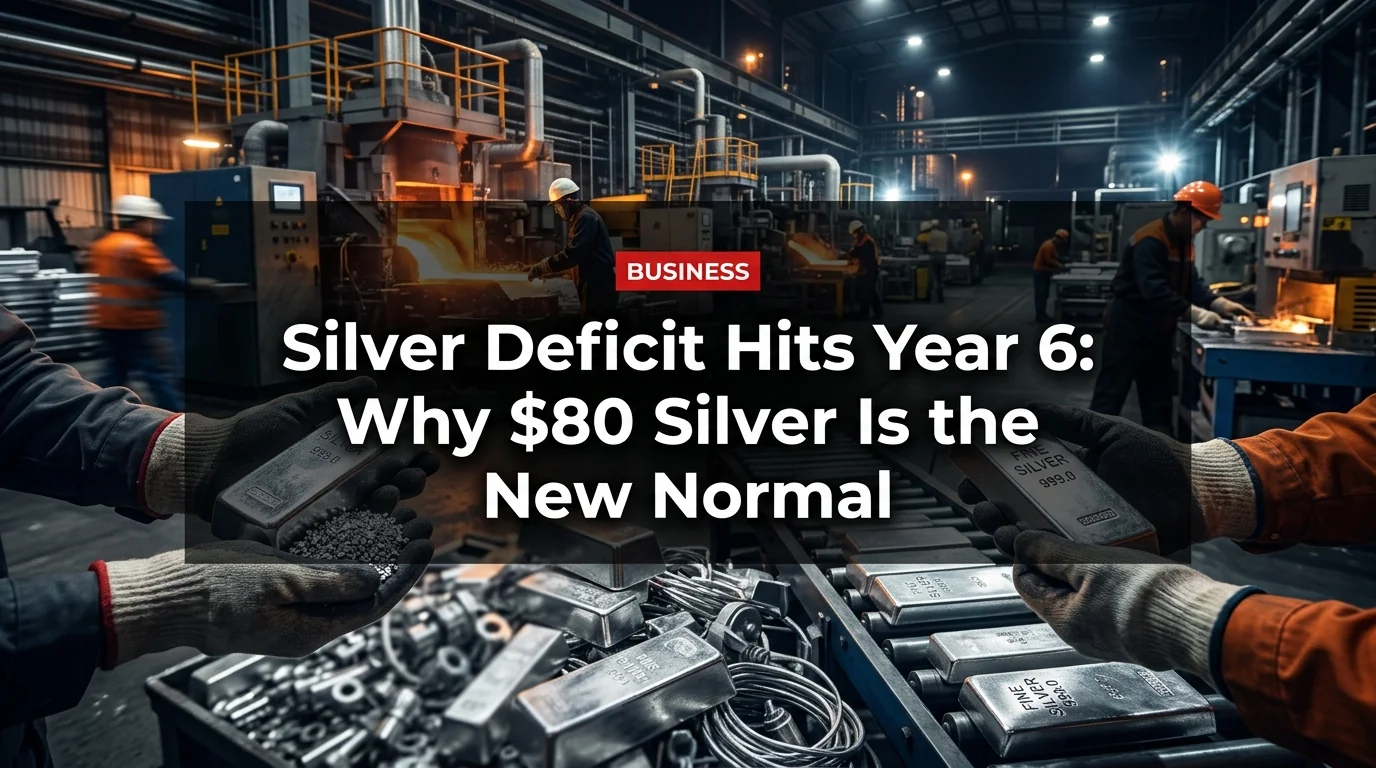
The global silver market is running on fumes. For the sixth consecutive year, the world will consume more silver than it produces — and the 67-million-ounce gap in 2026 is reshaping everything from solar panel manufacturing to retail investment strategy.
- **Sixth straight deficit year** — cumulative shortfall now exceeds 745 million ounces since 2021
- **Silver hit $121.60/oz** in January 2026, the highest price in history
- **Physical investment up 20%** as Western buyers pile back in
- **70% of silver is a byproduct** of mining other metals, limiting supply response
The Numbers Tell the Story
The Silver Institute confirmed on February 10, 2026 that global supply will reach a decade-high of 1.05 billion ounces this year — and it still won't be enough.
| Category | 2025 | 2026 Forecast | Change |
|---|---|---|---|
| Total Supply | 1.03B oz | 1.05B oz | +1.5% |
| Mine Production | 812M oz | 820M oz | +1% |
| Recycling | 187M oz | 200M+ oz | +7% |
| Total Demand | ~1.2B oz | ~1.12B oz | -7% |
| Annual Deficit | 95–117M oz | 67M oz | Narrowing |
| Physical Investment | 189M oz | 227M oz | +20% |
| Industrial Fabrication | 665M oz | 650M oz | -2% |
The deficit is narrowing — but not closing. And the cumulative drain on above-ground inventories is becoming critical. COMEX registered stocks have fallen below 90 million ounces, a level that traders describe as a structural floor.
What's Driving Demand Through the Roof
Solar Still Dominates — But It's Complicated
Solar photovoltaics now account for 30-40% of total silver industrial demand, up from just 11% in 2014. But here's the twist: solar demand is actually falling slightly in 2026, even as installations hit new records.
The reason is thrifting. Manufacturers have gotten aggressive about reducing silver content per cell, and some are substituting copper entirely for lower-end applications. BloombergNEF projects a 7% drop in silver consumption from PV installations this year.
KEY STAT: Solar panels consumed roughly 160 million ounces of silver in 2026 — down from peak levels despite record installations worldwide.
But what solar gives back, new sectors take. AI data centers and electric vehicle infrastructure are growing at a 3.4% compound annual rate through 2031, more than offsetting the thrifting gains.
The Investment Surge
Physical silver investment is the real story of 2026. At 227 million ounces, it's up 20% year-over-year and at a three-year high. Western retail buyers are back after sitting out much of 2024, and Indian demand remains strong despite record prices crushing jewelry and silverware purchases.
Philip Newman, Managing Director at Metals Focus, attributed the rally to "investor concerns over stagflation, the Federal Reserve's independence, and government debt sustainability."
The Supply Problem No One Can Fix Fast
Here's why silver deficits persist even when prices triple: approximately 70% of global silver production is a byproduct of mining copper, lead, zinc, and gold. You can't just "mine more silver" — you have to mine more of everything else first.
The major miners are responding — but slowly. Hecla Mining has doubled its exploration budget to $55 million. Pan American Silver is ramping up its Juanicipio mine in Mexico. Coeur Mining acquired New Gold to expand its North American footprint. But new mines take 7-10 years from discovery to production.
Michael Steinmann, CEO of Pan American Silver, struck an optimistic tone: "Looking ahead to 2026, we expect another strong year of cash flow generation. Our integration of Juanicipio continues to exceed expectations."
The Gold-Silver Ratio Flashes a Signal
One metric that precious metals traders are watching closely: the gold-silver ratio has dropped below 50 for the first time since 2012. Historically, a falling ratio suggests silver is outperforming gold — a pattern that tends to accelerate in late-cycle commodity bull markets.
With gold itself trading at record levels amid geopolitical uncertainty, the compression in the ratio suggests that silver's industrial fundamentals are adding a premium on top of its monetary appeal.
What Happens Next
The consensus among analysts at J.P. Morgan, Citigroup, and Bank of America — all of whom raised price targets to $65–100 earlier this year — is that silver's structural deficit has at least two more years to run.
Three forces will determine whether prices stabilize or surge again:
- Inventory drawdown pace — LBMA and COMEX vaults are the market's buffer. If drawdowns accelerate, expect another price spike.
- Substitution threshold — At what price does copper substitution in solar become the default? The industry is testing that limit right now.
- AI and EV wildcards — Every new data center and EV charging network adds incremental silver demand that didn't exist five years ago.
The skeptics aren't wrong to flag risks. BMI (Fitch Solutions) warns that silver lacks the stabilizing influence of central bank purchases that supports gold. A sharp economic downturn could crush industrial demand and send prices tumbling.
But for now, the math is simple: the world needs more silver than it can produce, and that equation isn't changing anytime soon.
KEY STAT: At current deficit rates, cumulative above-ground inventory depletion since 2021 has exceeded 745 million ounces — roughly 70% of a full year's mine production.
Data sources: The Silver Institute, Metals Focus, Oxford Economics, BloombergNEF. Price data as of March 20, 2026.