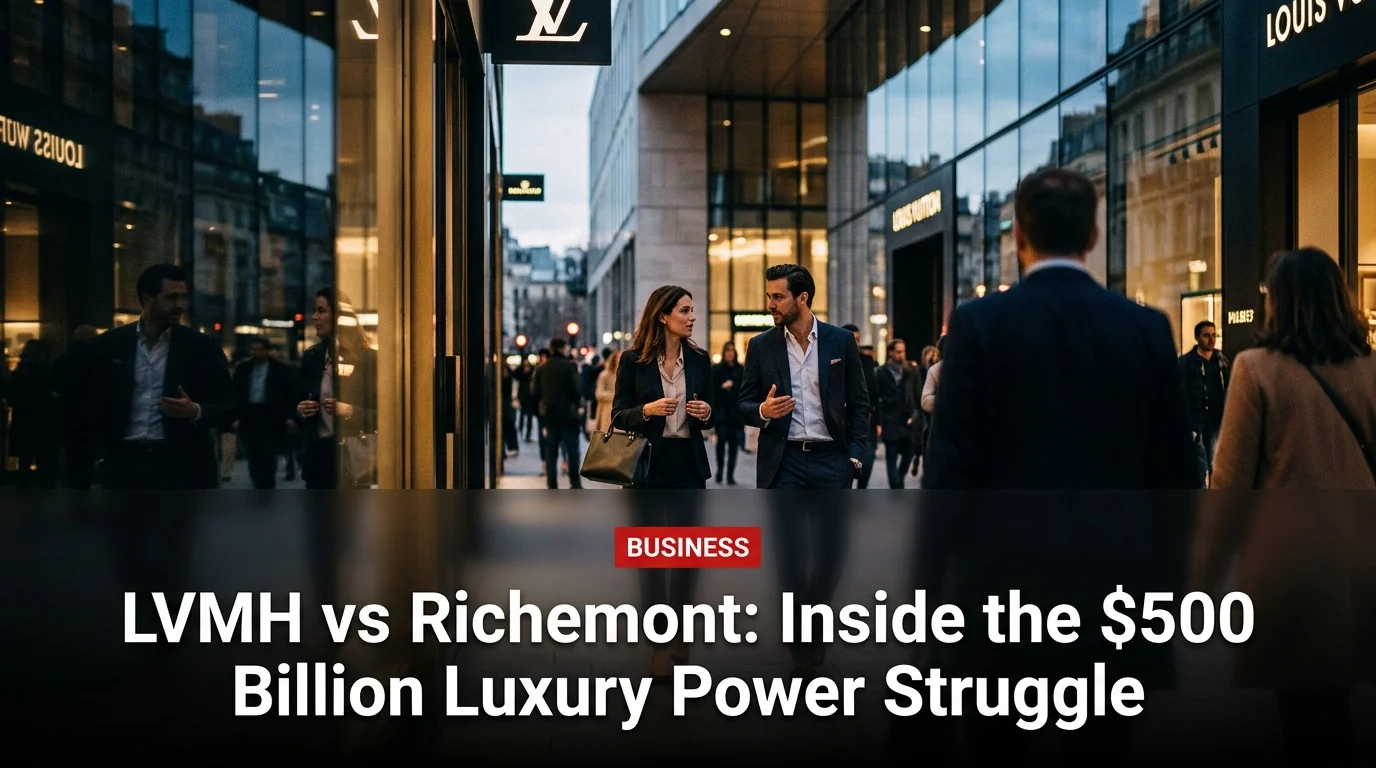
Bernard Arnault doesn't make small moves. When the world's richest man quietly purchased a personal stake in Richemont — owner of Cartier, Van Cleef & Arpels, and a dozen other hard-luxury houses — in June 2024, the luxury world understood the signal immediately: LVMH wants Cartier.
Now, in March 2026, with LVMH's market capitalization hovering around $420 billion and Richemont valued at roughly $95 billion, the question isn't whether Arnault wants to merge. It's whether anything can stop him.
The Stakes: Two Empires, One Crown
The global luxury goods market is controlled by a handful of conglomerates, but none come close to the combined firepower of LVMH and Richemont. One dominates "soft luxury" — fashion, leather goods, perfume. The other rules "hard luxury" — fine jewelry and Swiss watchmaking.
- Market cap: ~$420 billion
- Revenue: ~€87 billion (2025)
- 75+ brands including Louis Vuitton, Dior, Tiffany, Bulgari
- 6,000+ retail stores worldwide
- Strength: Fashion, leather goods, spirits
- Market cap: ~$95 billion
- Revenue: ~€21 billion (2025)
- 25+ brands including Cartier, Van Cleef & Arpels, IWC
- 2,300+ boutiques worldwide
- Strength: High jewelry, Swiss watches
A combined entity would generate over €105 billion in annual revenue and control roughly 20–25% of the entire global personal luxury goods market — a concentration never before seen in the industry.
The Wolf in Cashmere
Arnault earned his nickname "the wolf in cashmere" through decades of aggressive, patient acquisitions. His playbook is well-documented: take a small stake, build relationships, wait for the right moment, then strike.
The Tiffany acquisition is the template. Arnault pursued that deal for over a year, survived a pandemic, fought through a lawsuit, and still closed it — at a reduced price. Patience is the strategy.
Johann Rupert's Fortress
Standing between Arnault and Cartier is Johann Rupert, Richemont's 75-year-old South African chairman. Rupert has built what amounts to a corporate fortress: he controls 51% of voting rights despite owning only 10.2% of the capital, a dual-share structure specifically designed to prevent hostile takeovers.
Rupert has been blunt about his intentions. When asked about Arnault's stake purchase, he responded diplomatically — "I understand he wishes to remain independent, and I think that's very good" — while making clear through every structural decision that Richemont will not be absorbed on his watch.
But Rupert is 75. The luxury industry is watching the succession question with intense interest. Without a clear family successor firmly in place, the fortress could develop cracks.
The Antitrust Wall
Even if Richemont's board were willing, regulators would have something to say. A combined LVMH-Richemont would own Cartier, Tiffany, Bulgari, and Van Cleef & Arpels — four of the world's top six jewelry houses under one roof.
- The EU European Commission and U.S. FTC would both scrutinize the deal for monopolistic concentration in high-end jewelry
- In October 2025, the EU already fined luxury groups €157 million for anti-competitive pricing practices
- LVMH's Tiffany acquisition required concessions and took 15 months of regulatory review
- A Richemont deal would be 5–6 times larger and far more concentrated
Antitrust lawyers broadly agree: a full merger would face immediate challenges in both Europe and the United States. The high-end jewelry and watch markets are already concentrated, and combining the top two players would likely require divestitures so significant they could undermine the deal's strategic rationale.
The China Factor
Complicating the picture is the luxury sector's dependence on Chinese consumers, who account for roughly 35% of global luxury spending. LVMH's January 2026 guidance warned of a "soft" year driven partly by slowing Chinese demand.
A China slowdown creates a paradox. On one hand, it reduces the urgency of expansion. On the other, it increases the logic of consolidation — combining forces to weather a down cycle with shared infrastructure, supply chains, and retail footprints.
Analysts at ODDO BHF argue a merger would create an "unbeatable titan" in jewelry, giving LVMH the watchmaking prestige it currently lacks. Bernstein named Richemont its top luxury pick for 2026, partly on the strength of its unique portfolio.
The Third Option: Kering
There's a wildcard. Kering — owner of Gucci, Saint Laurent, and Bottega Veneta — has been struggling, posting negative organic growth in 2025. Some industry observers have floated a Kering-Richemont "merger of equals" as a defensive play to create a second super-conglomerate that could compete with LVMH.
- Creates a credible LVMH competitor with both fashion and jewelry
- Gives Richemont independence from Arnault
- Kering's fashion portfolio complements Richemont's hard luxury
- Kering's recent underperformance makes it a weak partner
- Cultural integration between French fashion and Swiss watchmaking would be difficult
- François-Henri Pinault (Kering CEO) and Rupert have no established alliance
Most analysts consider this scenario unlikely but not impossible — especially if Arnault's pressure intensifies.
What Happens Next
The smart money says this plays out over years, not months. Arnault's most likely path:
- Continue building his personal stake in Richemont just below disclosure thresholds (3% or 5%), maintaining strategic pressure without triggering alarm
- Wait for the succession question — when Rupert eventually steps back, the governance fortress could weaken
- Use activist investors as proxies — groups like Bluebell Capital, which pressured Richemont on governance in 2022–2023, may resurface if stock performance lags
- Pursue individual brands rather than the whole group — a targeted bid for Cartier alone, possibly through a joint venture structure, could sidestep some antitrust concerns
For investors, the calculus is straightforward. If you believe the merger eventually happens, Richemont shares at current levels represent a significant premium opportunity. If you believe Rupert's fortress holds, Richemont's independent portfolio — anchored by Cartier's extraordinary brand power — still represents the best pure play on hard luxury in public markets.
Either way, Bernard Arnault isn't going anywhere. And neither is his ambition.