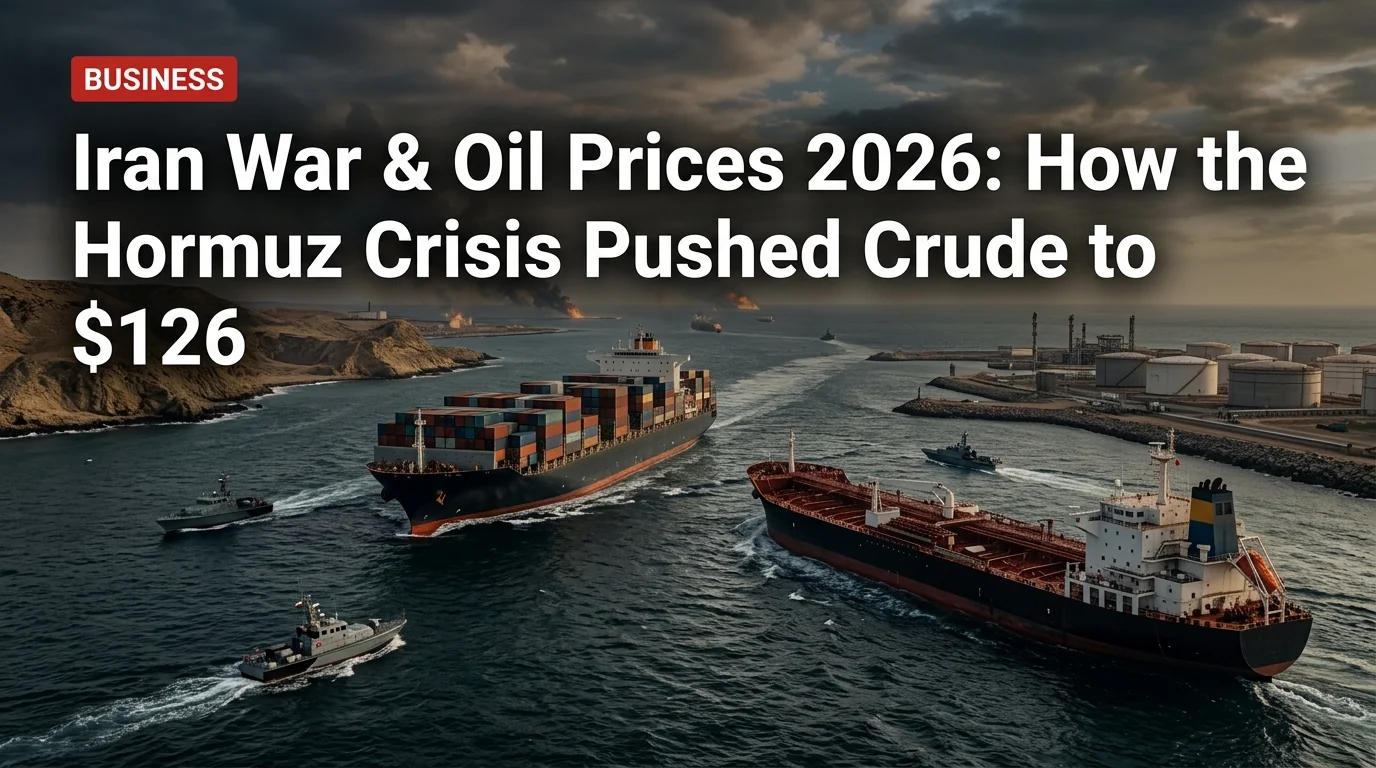
On February 28, 2026, U.S. and Israeli airstrikes on Iran set off the largest supply disruption in the history of the global oil market. Within days, Iran retaliated by closing the Strait of Hormuz — a narrow waterway responsible for roughly 20% of the world's daily oil supply. What followed was an energy shock that economists are already comparing to the 1970s oil crisis.
Brent crude, which was trading in the mid-$60s before the conflict, surged past $100 per barrel by March 8 for the first time in four years. It peaked at $126 per barrel within weeks. As of March 30, 2026, prices remain elevated above $117 — a 40%+ increase since the war began.
What Is the Strait of Hormuz — and Why Does It Matter?
The Strait of Hormuz is a 21-mile-wide chokepoint between Iran and Oman connecting the Persian Gulf to the open ocean. Nearly 20 million barrels of oil pass through it every day, along with almost 20% of global liquefied natural gas (LNG) shipments.
For Iran, the strait is both its lifeline and its leverage. The country pumps roughly 3.3 million barrels per day, with 90% of its oil exports shipped through Kharg Island — right through the Strait. When Iran closed it on March 4, 2026, the ripple effects were immediate and severe.
The Oil Price Timeline
What It Means for Gas Prices
Higher oil prices translate directly to higher gas prices at the pump. In the weeks following the Hormuz closure, U.S. gas prices climbed sharply — though American consumers are somewhat insulated compared to Europe and Asia.
The U.S. Energy Information Administration (EIA) has already revised its 2026 Brent crude forecast upward to $78.84 per barrel (from an earlier $57.69 estimate), with Q2 2026 expected to average around $91 per barrel. If the Strait remains closed or operates at reduced capacity beyond May, prices above $120 could persist.
The LNG Crisis: Europe and Asia Hit Hardest
While oil markets dominate headlines, the liquefied natural gas shock may ultimately cause more lasting damage.
Qatar — the world's largest LNG exporter — declared force majeure on all exports following an attack on its Ras Laffan industrial complex, reducing Qatar's LNG production capacity by 17%. LNG tanker spot rates jumped over 40% in a single trading session. European wholesale gas prices could triple to $100 per megawatt hour if disruptions persist, analysts warn. Asian spot LNG prices have already surged 140%.
The U.S. is more sheltered — the EIA projects the Henry Hub natural gas price to average around $3.80 per million British thermal units (MMBtu) in 2026 — but higher global energy costs still drive up prices across the American supply chain.
Recession Risk: Is a Global Downturn Coming?
Historically, oil shocks and recessions go hand in hand. Nearly every post-World War II recession has been preceded by a sharp rise in oil prices combined with restrictive monetary policy — a combination now firmly in play.
Oxford Economics has already downgraded its world GDP growth forecast for 2026 to 2.6%, with Brent crude expected to average $114 per barrel in Q2. The McKinsey Global Survey from March 2026 found that 72% of executives now cite geopolitical instability and energy prices as their top concerns — a dramatic shift from just months earlier.
The IMF's January 2026 projection of 3.3% global growth looks increasingly optimistic.
What Comes Next: Three Scenarios
Scenario 1 — Diplomatic Ceasefire (Most Optimistic) If a ceasefire is brokered and the Strait reopens to commercial traffic by late April or May, the EIA projects Brent declining toward $70/barrel by Q4 2026 as supply normalizes. Global recession risk drops significantly.
Scenario 2 — Partial Transit Resumes (Baseline) Oxford Economics' base case assumes partial Strait resumption by May 2026, with Brent averaging $114 in Q2 before falling. Global growth is sluggish but avoids outright contraction. This is the current market consensus.
Scenario 3 — Extended Closure (Worst Case) If the Strait remains fully closed beyond June, analysts warn Brent could hold above $120 for months. European recession becomes near-certain. Global GDP growth potentially falls below 2% — the technical threshold for a global recession as defined by the World Bank.
What You Can Do Now
- Lock in gas prices where possible — use rewards credit cards that offer fuel discounts
- Check if your utility offers fixed-rate energy plans before prices rise further
- Review your investment portfolio — energy stocks (XOM, CVX, SLB) have surged; consider rebalancing
- If buying a home or refinancing, watch how oil-driven inflation affects Fed rate decisions
- Expect higher prices on imports, especially electronics, clothing, and food shipped via cargo vessels
The 2026 Iran war and Hormuz crisis is not just a geopolitical story — it's an economic emergency unfolding in real time. Whether it spirals into a full global recession or stabilizes depends on diplomatic progress in the coming weeks. Either way, the days of $60 oil look far behind us for 2026.
Updated March 30, 2026. Figures sourced from the EIA, IEA, Oxford Economics, and IMF.