
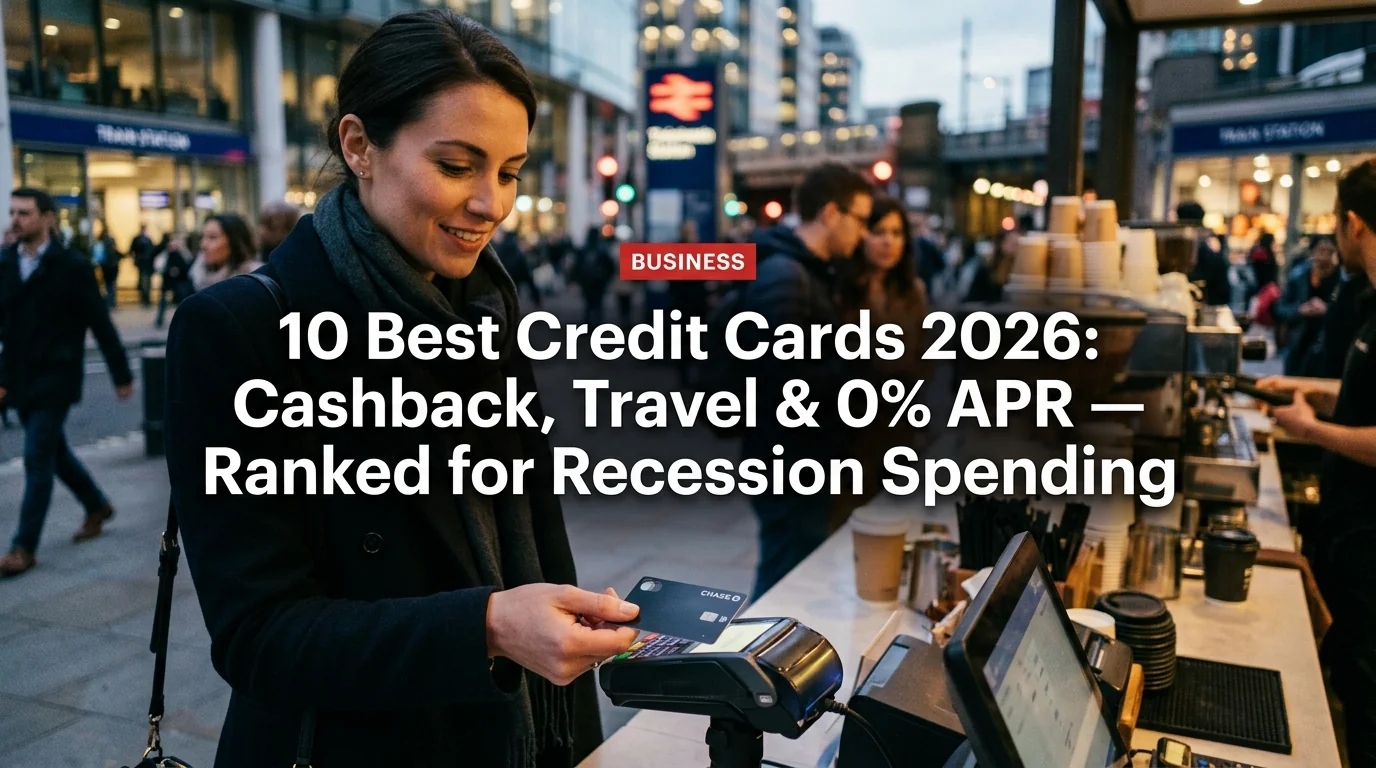
Credit card rewards have never mattered more. With tariff-driven price increases pushing everyday costs up 12–18% from 2024 levels, the right card can claw back hundreds — or even thousands — in real money each year. Here are the 10 best credit cards in 2026, ranked by value for how most Americans actually spend.
How We Ranked These Cards
Every card on this list was evaluated on five criteria: annual fee vs. real-world value, welcome bonus quality, ongoing rewards rate, 0% APR availability, and recession-era usefulness — meaning high rewards on groceries, gas, and utilities where tariff inflation hits hardest.
Top Pick: Best Overall Cashback
1. Chase Freedom Unlimited
Annual Fee: $0 | Rewards: 1.5% on everything, 3% dining, 3% drugstores
The best no-fee cashback card for 2026. Flat-rate 1.5% on all purchases means no category tracking, and the 3% dining rate is category-leading for a no-annual-fee card. Pair it with the Chase Sapphire Preferred to convert cashback to transferable travel points.
Welcome bonus: $200 after $500 spend in 3 months — easiest threshold on this list.
Recession edge: No annual fee means zero risk during a budget squeeze. The 3% drugstore rate is quietly one of the most useful features given rising prescription costs.
2. Citi Double Cash Card
Annual Fee: $0 | Rewards: 2% on everything (1% when you buy, 1% when you pay)
The simplest high-value cashback card available. Two percent flat on every purchase, no categories, no rotating bonuses, no mental overhead. For anyone who just wants the math to work without effort, Citi Double Cash is the answer.
Best for: People who hate managing cards. One card, maximum simplicity, competitive returns.
3. Blue Cash Preferred from American Express
Annual Fee: $95 (waived first year) | Rewards: 6% groceries (up to $6K/year), 6% streaming, 3% transit & gas
The grocery card of 2026. Six percent back at US supermarkets is the highest rate available anywhere on that category — and with food prices up significantly due to tariffs, this is where the math gets compelling fast. A household spending $600/month on groceries earns $432/year on that category alone, easily offsetting the $95 fee.
Welcome bonus: $300 statement credit after $3,000 spend in 6 months.
4. Chase Sapphire Preferred
Annual Fee: $95 | Rewards: 3x dining, 3x streaming, 2x travel, 1x everything else
The best entry-level travel rewards card in 2026. Points transfer 1:1 to United, Hyatt, Southwest, and a dozen other programs — meaning a point is worth $0.015–$0.025 in travel redemptions, not the $0.01 face value.
Welcome bonus: 60,000 points ($750 in Chase Travel portal) after $4,000 spend in 3 months. This is one of the strongest bonuses at the $95 price point.
Who it is for: Anyone who travels 1–3 times per year and wants flexibility without paying $500+ for premium cards.
5. Capital One Venture Rewards
Annual Fee: $95 | Rewards: 2x miles on everything, 5x on hotels and rental cars via Capital One Travel
The simplest travel card on this list. Two miles per dollar on every purchase, redeemable against any travel purchase or transferred to 15+ airline partners. No blackout dates, no portal required.
Welcome bonus: 75,000 miles ($750 in travel) after $4,000 spend in 3 months.
Recession edge: Miles can be redeemed retroactively against purchases — you book the cheapest available flight anywhere, then erase the charge. No point games required.
6. Wells Fargo Active Cash Card
Annual Fee: $0 | Rewards: 2% unlimited cashback on all purchases
If you want 2% back with no annual fee, this and Citi Double Cash are your two options. Wells Fargo edges out slightly with a better welcome bonus and a useful cell phone protection benefit (up to $600 coverage when you pay your bill with the card).
Welcome bonus: $200 after $500 spend in 3 months.
7. Discover it Cash Back
Annual Fee: $0 | Rewards: 5% rotating quarterly categories (up to $1,500/quarter), 1% everything else
Discover matches all cashback earned in your first year — effectively making this a 10% cashback card in year one on rotating categories. Q1 2026 categories include grocery stores and drug stores, which is well-timed for inflation-hit households.
Best for: First-year value maximizers and people who enjoy category optimization.
8. The Platinum Card from American Express
Annual Fee: $695 | Rewards: 5x on flights booked direct or through Amex Travel, 5x on hotels via Amex
Expensive, but the credits nearly cover the fee for frequent travelers: $200 hotel credit, $200 airline incidental credit, $200 Uber Cash, $240 digital entertainment credit, Global Entry/TSA PreCheck credit, and unlimited Priority Pass lounge access.
Annual value for frequent flyers: $800–$1,200 in credits and perks against $695 fee — net positive if you use them.
Welcome bonus: 80,000 points after $8,000 spend in 6 months.
9. Citi Simplicity Card
Annual Fee: $0 | APR: 0% intro for 21 months on balance transfers and purchases
The best 0% APR card of 2026. Twenty-one months interest-free is the longest available offer in the current rate environment, making this the right card if you are carrying a balance, financing a large purchase, or consolidating debt before paying it off.
No late fees, no penalty APR — genuinely no-tricks 0% for almost two years.
Best for: Anyone with existing high-interest debt to transfer or a large planned expense.
10. Amazon Prime Visa
Annual Fee: $0 (requires Prime membership at $139/year) | Rewards: 5% at Amazon and Whole Foods, 2% dining/gas/drugstore, 1% everything else
If you already pay for Amazon Prime, this is a no-brainer. Five percent back at Amazon during a period when online shopping is up due to store price hikes is meaningful real money. The Whole Foods 5% rate also stacks with Prime discounts.
Welcome bonus: $150 Amazon gift card upon approval.
- 5% at Amazon and Whole Foods on a no-additional-fee card
- Instant approval and card number for digital use
- $150 gift card instantly on approval
- 2% at restaurants, gas stations, and drugstores
- Requires active Prime membership ($139/year)
- Not useful if you do not shop heavily on Amazon
- No travel transfer partners
- Lower value outside Amazon ecosystem
How to Pick the Right Card for 2026
Maximize grocery and gas spending? Blue Cash Preferred (6% groceries) or Chase Freedom Unlimited (3% drugstores).
Want simple flat-rate cashback? Citi Double Cash or Wells Fargo Active Cash (both 2%, no fee).
Planning travel in 2026? Chase Sapphire Preferred for flexibility, Capital One Venture for simplicity.
Carrying debt or financing a purchase? Citi Simplicity — 21 months at 0% is the best offer available.
Heavy Amazon shopper? Amazon Prime Visa pays for itself within 3 months of typical spending.
Serious frequent flyer? Amex Platinum pencils out positive if you use the credits.
- Never carry a balance on a rewards card — 20-29% APR erases years of cashback in weeks
- Welcome bonuses are where the real year-one value comes from — prioritize them
- Two no-fee cards (one cashback, one travel) beats one premium card for most people
- Grocery and gas rewards matter more in 2026 than in prior years due to tariff-driven price increases
- Credit score of 670+ gets you most cards here; 740+ unlocks the best terms
Bottom Line
The best credit card in 2026 is the one you will actually use consistently. A 2% flat cashback card used every day beats a 5% category card you forget to activate. Pick one, maximize the welcome bonus, and never carry a balance — that combination outperforms almost any other personal finance move you can make right now.