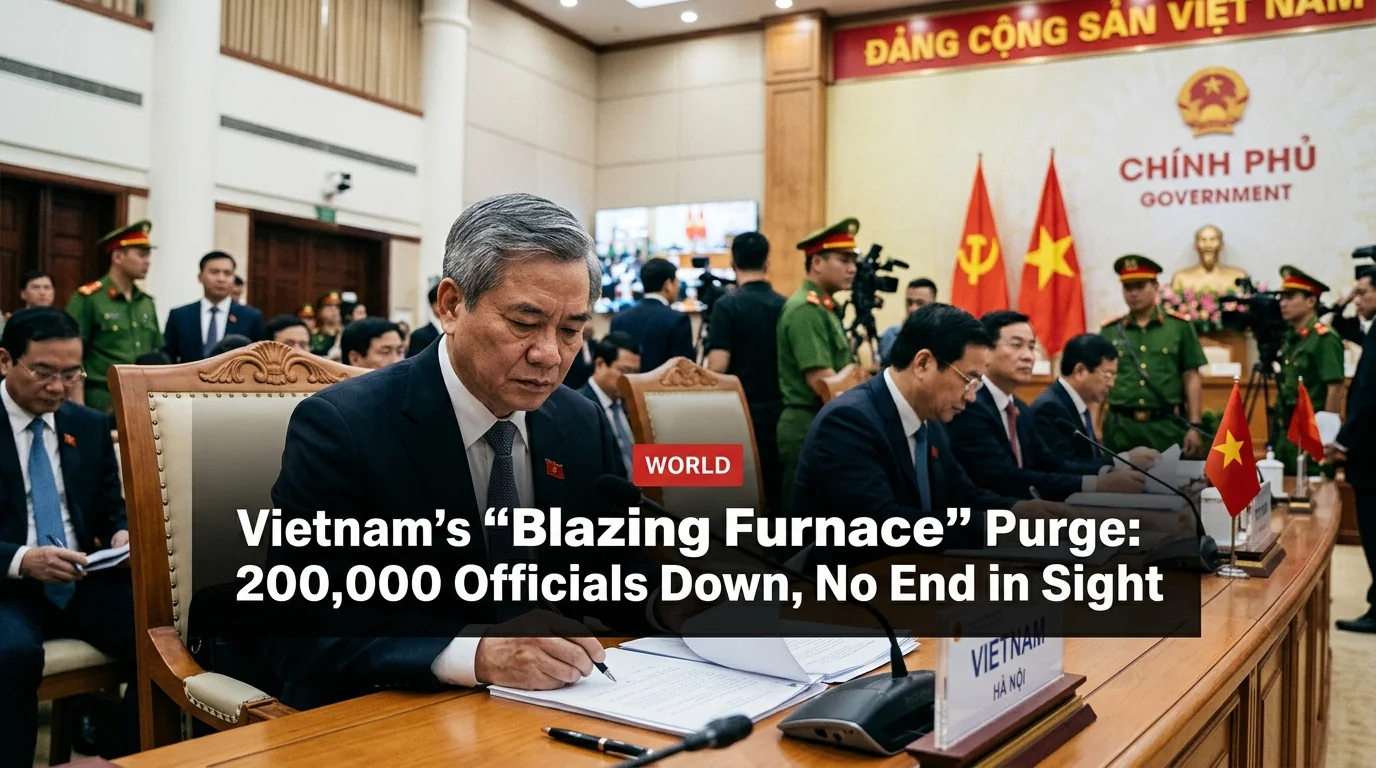
Vietnam's Communist Party has disciplined over 200,000 members since 2016 in what may be the most aggressive anti-corruption campaign in Southeast Asian history. The "Blazing Furnace" — or Đốt Lò — has toppled two presidents, removed a third of the Politburo, and produced a death sentence for one of the country's richest women.
Now, under General Secretary Tô Lâm, the campaign is accelerating — with 1,151 new corruption cases and 2,367 defendants announced in early 2026 alone.
The Scale of the Purge
The numbers are staggering even by Chinese standards. In just 16 months between January 2023 and May 2024, one-third of Vietnam's most powerful political body was wiped clean — including two of the "four pillars" of state power.
Who Fell and Why
| Official | Former Title | Removed | Reason |
|---|---|---|---|
| Nguyễn Xuân Phúc | President | Jan 2023 | COVID-era repatriation flight scandal |
| Võ Văn Thưởng | President | Mar 2024 | Violations tied to Phúc Sơn Group |
| Vương Đình Huệ | National Assembly Chair | Apr 2024 | Assistant arrested for Thuận An Group bribery |
| Trương Thị Mai | Permanent Secretary | May 2024 | Past "shortcomings" (2016–2021) |
| Phạm Bình Minh | Deputy PM | Jan 2023 | Repatriation flight bribes |
| Lê Minh Khái | Deputy PM | Feb 2025 | Đại Ninh resort project violations |
| Trương Mỹ Lan | Chairwoman, Van Thinh Phat | Apr 2024 | Sentenced to death for $12.5B embezzlement |
The Trương Mỹ Lan case alone is extraordinary. She siphoned $12.5 billion from Saigon Commercial Bank in what prosecutors called a scheme causing $27 billion in total damages — roughly 6% of Vietnam's GDP.
Timeline: The Purge Accelerates
The Tô Lâm Consolidation
Tô Lâm is no reformer in the Western sense. A former Minister of Public Security with deep ties to Vietnam's surveillance apparatus, he has used the anti-corruption campaign to systematically remove rivals and consolidate power to a degree not seen since the party's founding.
At the 14th National Party Congress in January 2026, he was unanimously re-elected as General Secretary for another five-year term. He is also expected to assume the presidency — combining the two most senior positions in a move that mirrors Xi Jinping's consolidation in China.
- Tô Lâm now holds more concentrated power than any Vietnamese leader since Hồ Chí Minh
- He has set a target of **10% annual GDP growth** from 2026 to 2030
- Vietnam aims for "high middle-income status" by 2030 and "developed country" status by 2045
- The anti-corruption campaign is expanding to target "wastefulness" and "internal threats"
The Paradox: Growth vs. Paralysis
Here is the tension at the heart of Vietnam's moment: the same campaign that restored public trust in the party has also paralyzed the bureaucracy.
Officials across Vietnam now practice what analysts call "dare not do" governance — refusing to approve projects for fear that today's signature becomes tomorrow's indictment. The result: $2.5 billion in foreign aid delayed. Infrastructure projects stalled. Decision-making frozen at every level.
KEY STAT: Disbursed FDI rose 8.8% in early 2026, but total registered FDI fell 12.6% — a sign that existing investors are executing, but new money is hesitating.
The government is trying to break this logjam. New investment laws taking effect in March and July 2026 simplify procedures, reduce conditional business lines, and decentralize approval authority. A new Anti-Corruption Law effective July 1 exempts foreign investors from asset and income declaration requirements in state-owned enterprises.
But the structural problem remains: in a system where corruption was the lubricant for getting things done, removing it without replacing it with efficient institutions creates friction.
Why Global Investors Are Watching
Vietnam is the single largest beneficiary of the "China+1" manufacturing strategy. Companies from Samsung to Intel have bet billions on Vietnam as an alternative production base. The country's political stability — or lack of it — directly affects global supply chains.
| Metric | 2024 | 2026 (Jan-Feb) | Trend |
|---|---|---|---|
| Disbursed FDI | — | $3.21B | ↑ 8.8% YoY |
| New FDI projects | — | 620 projects | ↑ 61.5% in capital |
| Total registered FDI | — | $6.03B | ↓ 12.6% YoY |
| Corruption Perceptions Index | 41/100 | — | Up from 31 in 2012 |
The mixed signals tell the story: companies already in Vietnam are doubling down, but new investors are pausing to assess the political landscape.
What Comes Next
The "Blazing Furnace" is not slowing down. As of March 2026, the Airports Corporation of Vietnam has been placed on the campaign's monitoring list, and Tô Lâm has publicly vowed to "resolutely and persistently intensify" the fight.
The question is no longer whether Vietnam can sustain the purge — it clearly can. The question is whether Tô Lâm can simultaneously purge the system and run it at 10% growth. History suggests that concentrated power either delivers transformation or accelerates decay. Vietnam is about to find out which.
This article draws on reporting from Reuters, Asia Times, SCMP, Control Risks, CSIS, and Vietnamese state media. All figures verified against multiple sources.