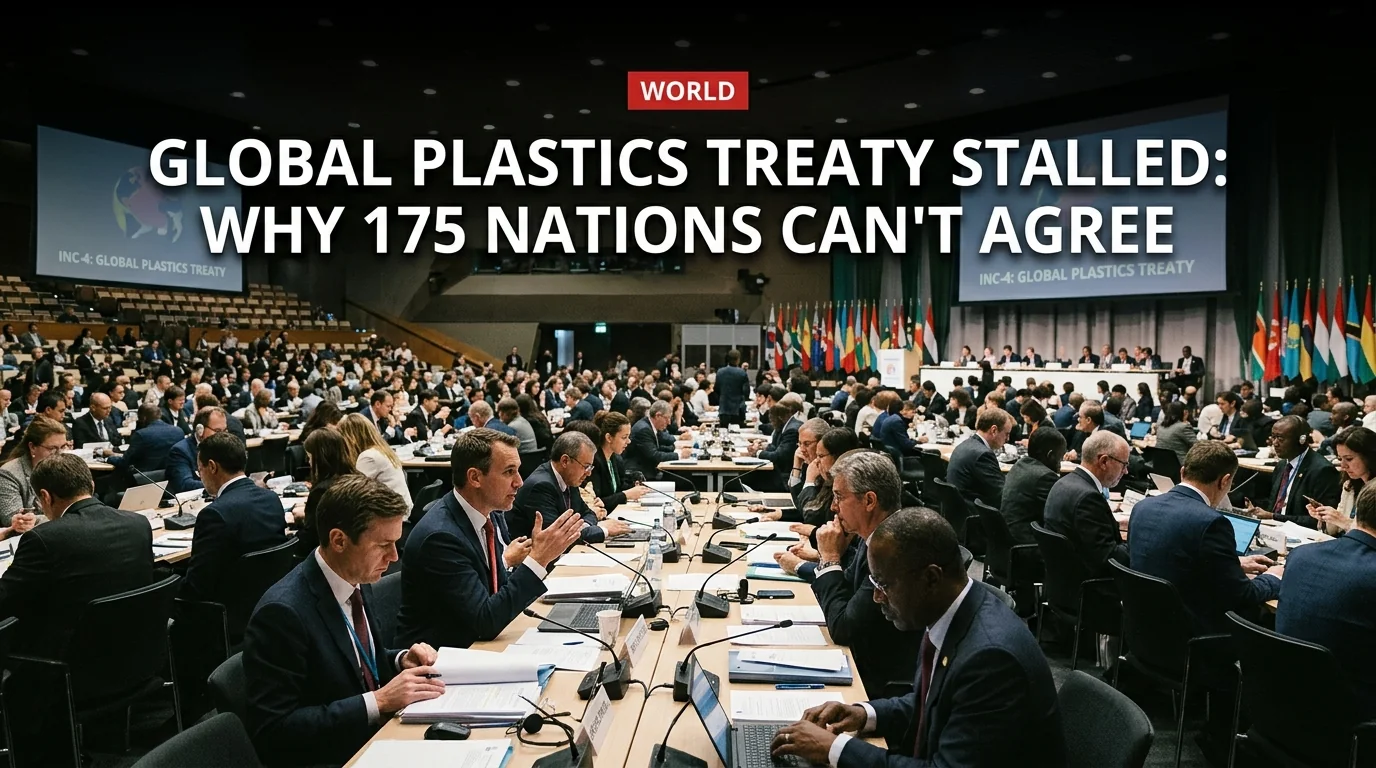
Four years after 175 nations voted to end plastic pollution, the world still doesn't have a treaty. The negotiations — once hailed as the most important environmental deal since the Paris Agreement — have collapsed twice, lost their chair, and now face a make-or-break year under new leadership.
Here's where things stand, who's blocking progress, and why 2026 is the last real window to get this done.
The Core Conflict: Production Caps vs. Recycling
The treaty's central battle comes down to a deceptively simple question: should the world make less plastic, or just manage more of it?
- Led by Norway, Rwanda, and the EU
- 75+ member nations including most of Africa, Latin America, Pacific Islands
- Demands: Binding caps on virgin plastic production
- Argument: You can't recycle your way out of a tripling of production
- Wants toxic chemical bans and mandatory product redesign
- Led by Saudi Arabia, Russia, Iran, Kuwait
- Backed at times by the United States and India
- Demands: Voluntary national waste management plans
- Argument: Production caps violate "economic sovereignty"
- Wants focus on recycling infrastructure and "advanced recycling"
This isn't an abstract policy debate. It's a fight between countries drowning in plastic waste and countries profiting from making it.
By the Numbers: A Crisis in Scale
Without a treaty, production is projected to nearly triple by 2060. The plastics industry currently consumes an estimated 21–31% of the remaining carbon budget for keeping warming under 1.5°C.
Four Years of Failed Talks
The New Chair's Gambit
Julio Cordano, Chile's ambassador and a veteran of COP25 climate negotiations, has stepped into what may be the toughest diplomatic job in environmental politics. His roadmap, released March 16, lays out a careful sequence designed to rebuild trust:
- Virtual check-ins every 4–6 weeks with heads of delegation
- In-person informal meeting in Nairobi, June 30 – July 3, with regional pre-meetings
- An informal reference document drafted under the chair's authority — not a consensus text, but a map of where agreement exists
- INC-5.4 targeted for late 2026 or early 2027 as the formal negotiating session
Cordano has emphasized three principles — transparency, inclusivity, and predictability — a pointed contrast to the previous chair's approach, which was widely criticized for closed-door dealings.
Who Wants What: The Money Behind the Deadlock
Follow the money, and the deadlock makes sense.
Plastic is made from fossil fuels. The nations blocking production caps are the same ones that profit most from oil and gas extraction. As the energy transition threatens petroleum demand for fuel, petrochemicals — and plastics — represent the industry's growth strategy.
Meanwhile, an unlikely coalition is pushing the other direction:
- **85+ major corporations** — including Unilever, Nestlé, Coca-Cola, and PepsiCo — have called for binding global rules through the Business Coalition for a Global Plastics Treaty
- **160 financial institutions** representing $15.5 trillion in assets have signed statements demanding an ambitious treaty
- **$576 billion** in potential global revenue could be generated by 2040 through harmonized Extended Producer Responsibility (EPR) frameworks
When Coca-Cola and PepsiCo are asking for more regulation than Saudi Arabia will accept, the political dynamics are genuinely unusual.
What a Treaty Could Actually Look Like
If negotiations succeed, the most likely outcome would include several key pillars:
| Component | High Ambition Position | Petrostate Position | Likely Compromise |
|---|---|---|---|
| Production limits | Binding 75% cut by 2040 | No limits whatsoever | Phased voluntary targets with review |
| Toxic chemicals | Ban 6,000+ chemicals in plastics | National-level decisions | Priority list of ~200 chemicals |
| EPR frameworks | Mandatory global standard | Voluntary national plans | Regional frameworks with guidelines |
| Traceability | Digital Product Passports (EU model) | No requirements | Optional tracking systems |
| Financing | Dedicated global fund | Existing mechanisms only | Small new fund + existing channels |
The EU is already moving ahead unilaterally on Digital Product Passports for plastics, expected to become mandatory by late 2026 — a signal that ambitious nations won't wait forever.
Why 2026 Matters
Renée Sharp of the Natural Resources Defense Council framed the stakes bluntly: "No treaty is better than a weak treaty that creates an illusion of progress."
The High Ambition Coalition has made clear it won't sign a deal that ignores production. The petrostate bloc won't sign one that includes binding caps. Cordano's job is to find the narrow ground between these positions — or acknowledge that no ground exists.
The Nairobi meeting in July will be the real test. If Cordano can produce a reference document that both sides engage with, INC-5.4 has a chance. If the same petrostate filibuster tactics that sank Busan and Geneva reappear, the treaty process may effectively be over.
Four years of negotiations. Two collapsed summits. One new chair. And a planet producing 460 million tonnes of plastic per year while diplomats argue about whether that's a problem worth solving.
The clock isn't just ticking — it's buried under plastic.