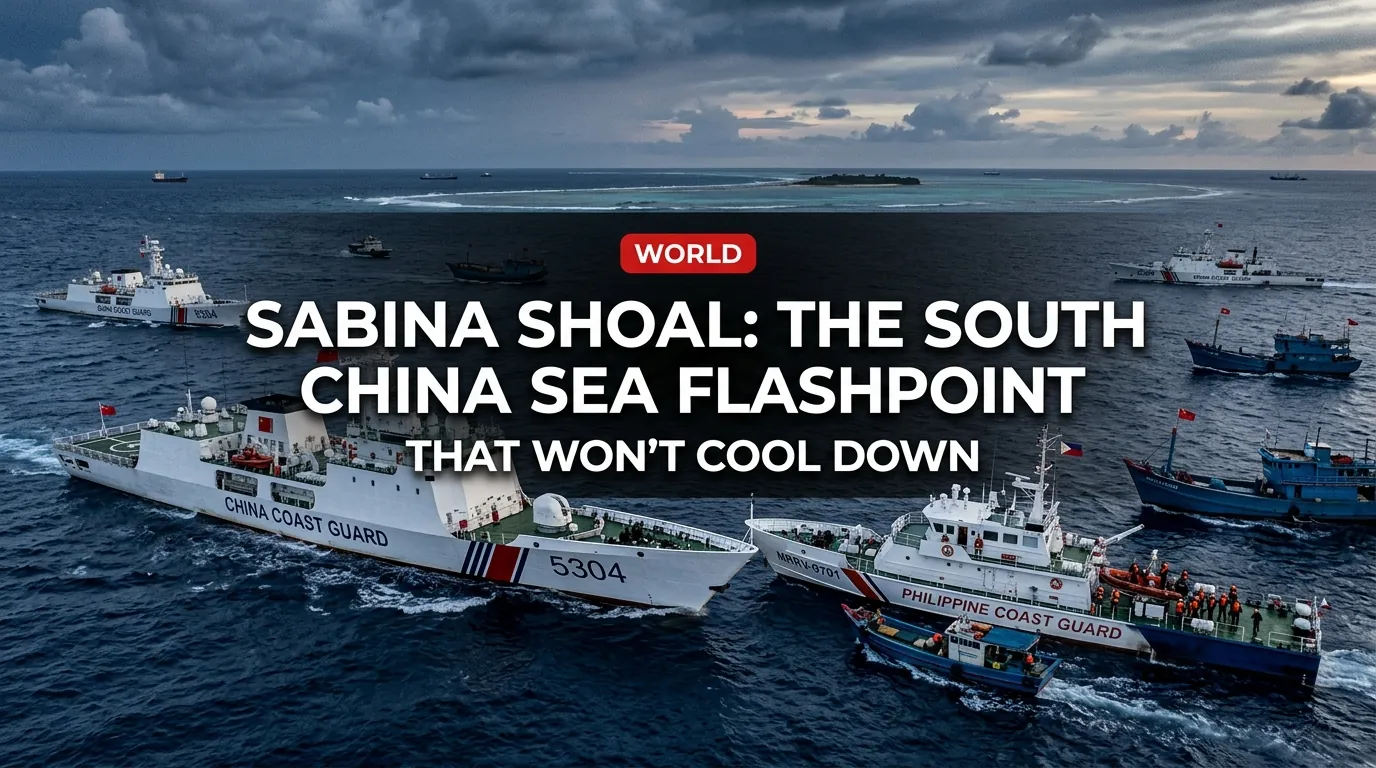
A submerged reef 75 nautical miles off the Philippine island of Palawan has become the most volatile square mile of ocean on Earth. Since April 2024, Sabina Shoal — known as Escoda Shoal in Manila and Xianbin Jiao in Beijing — has been the scene of repeated ship rammings, water cannon attacks, and a five-month naval standoff that brought two nuclear-armed alliance systems uncomfortably close to collision.
As of March 2026, no resolution is in sight. If anything, the situation is getting worse.
Why Sabina Shoal Matters
Sabina Shoal is not just another disputed reef. It serves as the staging point for Philippine resupply missions to Second Thomas Shoal (Ayungin), where the grounded warship BRP Sierra Madre maintains Manila's territorial claim. It also sits adjacent to Reed Bank, which holds significant untapped oil and gas reserves.
Control Sabina, and you control access to both.
The Standoff: A Timeline of Escalation
The Ships: David vs. Goliath
The naval mismatch at Sabina Shoal is staggering. The Philippines' most capable vessel, the Teresa Magbanua, is dwarfed by China's coast guard flagship.
- 97 meters long
- Built by Mitsubishi Shipbuilding
- Cost: $97 million (Japanese ODA loan)
- Role: Multi-Role Response Vessel
- Armed with water cannons
- 165 meters long
- Largest coast guard ship in the world
- Displacement: 12,000 tons
- Role: Patrol and enforcement
- Armed with water cannons and deck guns
China's strategy is what analysts call "cabbage tactics" — surrounding a feature with concentric layers of fishing boats, maritime militia, coast guard cutters, and navy ships until the adversary is squeezed out. At the height of the 2024 standoff, Manila counted 71 Chinese vessels operating in formation around the shoal.
The Ghost of Scarborough
For the Philippines, this is deeply personal. In 2012, Manila withdrew from Scarborough Shoal under a diplomatic deal brokered by the United States. China stayed. It never left.
That loss — widely seen as a national humiliation — drives every decision at Sabina Shoal today. President Ferdinand Marcos Jr. and Defense Secretary Gilberto Teodoro have repeatedly signaled that the Philippines will not repeat the Scarborough mistake.
The Money Problem
Determination alone doesn't fuel ships. The Philippines faces a painful budget reality in 2026.
- PCG budget increased to PHP 42.5 billion (up from PHP 33.3B in 2025)
- Senate approved PHP 8.6 billion for new patrol vessels
- One new 97-meter vessel and three 87-meter ships on order
- Global oil surge (Dubai crude at $100/barrel) forcing patrol cutbacks
- Routine coast guard patrols reduced as of March 2026
- China outspends the Philippines on maritime enforcement by roughly 10:1
Philippine Coast Guard spending (billion PHP). Source: Department of Budget and Management
What Comes Next
Three factors will shape the next chapter of this standoff:
1. The ASEAN Chair. The Philippines takes the rotating ASEAN chairmanship in 2026 and plans to push for a legally binding Code of Conduct in the South China Sea. Experts are skeptical — Beijing has stalled COC negotiations for over two decades — but the diplomatic spotlight gives Manila leverage it won't have again for years.
2. The US Alliance. Joint Philippine-US patrols continue, and Washington has reaffirmed that the Mutual Defense Treaty covers attacks on Philippine vessels in the South China Sea. But American attention is stretched thin, and Manila knows it cannot rely solely on the alliance.
3. The Oil Factor. With crude prices spiking, the Philippines is already cutting patrols. If prices stay above $100, maintaining even a rotational presence at Sabina Shoal becomes financially unsustainable without external support.
The Bigger Picture
Sabina Shoal is a microcosm of the broader contest reshaping the Indo-Pacific. A rising power is asserting control over strategic waterways. A smaller neighbor is fighting back with transparency, alliances, and stubborn presence. And the world's most important trade route — carrying $5.3 trillion in goods annually — runs right through the middle of it.
The reef itself is barely above water at high tide. The stakes above it could not be higher.