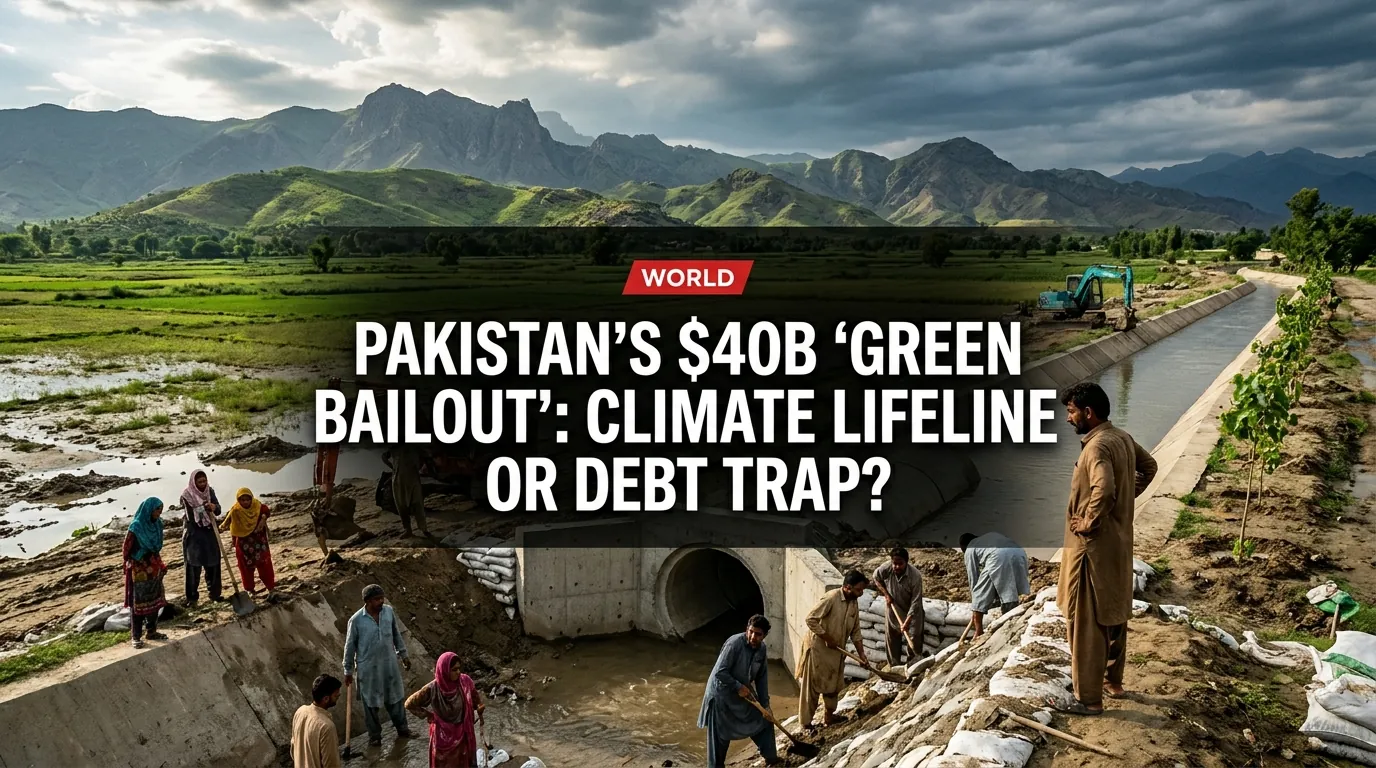
Pakistan has secured the largest climate-linked financing deal in history — a $40 billion World Bank framework spanning 2026 to 2035. Marketed as a transformative "green bailout," the package aims to rebuild a nation devastated by catastrophic floods while steering it toward sustainable growth.
But behind the headline number lies a complex web of conditions, creditor politics, and sovereign risk. Is this a genuine lifeline, or another chapter in Pakistan's cycle of debt dependency?
The Deal at a Glance
The Country Partnership Framework (CPF) 2026–2035, approved by the World Bank Executive Board on January 14, 2025, replaces the traditional 4-year lending cycle with a decade-long structural plan. It's a first for any South Asian nation — and for the World Bank itself.
How It Works: Not a Grant, Not a Gift
Let's be clear about what this is and isn't. The $40 billion is not free money. It's a performance-based financing package — loans and credits that Pakistan must earn through measurable reform milestones.
- Longest-ever World Bank commitment to Pakistan (10 years vs. typical 4)
- Shields development from Pakistan's volatile political cycles
- Ties funding to measurable outcomes, not political promises
- Mobilizes private capital alongside sovereign lending
- Adds to Pakistan's already crushing $130B+ external debt
- Half the package depends on attracting private investors — far from guaranteed
- Mid-term review in 2030 could cut funding if targets are missed
- Critics call the "$40 billion investment" label misleading — it's mostly debt
A Timeline of Crisis and Response
The 2022 floods fundamentally changed the calculus. Pakistan — responsible for less than 1% of global emissions — suffered climate damages exceeding its annual GDP growth. The traditional IMF stop-gap model was clearly failing a country that needed structural transformation, not another emergency check.
The Six Pillars
The framework targets six outcomes that read like a national overhaul:
| Pillar | Target | Current Baseline |
|---|---|---|
| Child stunting | Reduce from 40% to ~27% | Among worst globally |
| Learning poverty | Quality foundational education | 75% of children can't read by age 10 |
| Climate resilience | Flood-proof infrastructure | $30B+ in annual climate damages |
| Clean energy | Sustainable energy transition | Heavy coal/gas dependency |
| Fiscal space | Progressive public spending | 50%+ of revenue goes to debt service |
| Private investment | Raise from 10% to 20% of GDP | Lags India and Bangladesh |
The Debt-for-Nature Gambit
Perhaps the most innovative — and controversial — aspect is Pakistan's push for debt-for-nature swaps. The concept is simple: creditors forgive portions of debt in exchange for binding commitments to environmental conservation.
Pakistan has already signed a declaration with Canada, Germany, and the UK to explore Nature Performance Bonds — instruments that reward measurable ecosystem rehabilitation. A national carbon exchange is expected to launch later in 2026, allowing Pakistan to monetize its mangrove restoration and reforestation projects.
But there's a catch. China holds nearly $30 billion of Pakistan's bilateral debt and has historically resisted write-downs. Without Beijing's participation, debt-for-nature swaps remain limited in scale.
The Skeptics Have a Point
Not everyone is celebrating. Independent fact-checkers at Soch pointed out that the government's framing of "$40 billion investment" is misleading — this is predominantly a loan facility, not foreign direct investment.
Media critics, including commentator Palki Sharma, have questioned whether institutions can ensure funds aren't diverted away from their intended climate and development purposes. Pakistan's track record with aid accountability doesn't inspire automatic confidence.
What Success Looks Like
*All figures in billions USD*The framework includes a formal Performance and Learning Review in 2030 that will determine whether the second half of funding is released. Pakistan must demonstrate progress across all six pillars — not just spend the money, but prove it worked.
The World Bank is also pressing Pakistan to double its private investment ratio. If successful, this could generate an estimated $60 billion per year in export potential, fundamentally reshaping an economy that has lurched from crisis to crisis for decades.
The Bigger Picture
Pakistan's deal is being watched by every climate-vulnerable developing nation. If it works, it establishes a template: long-term, performance-linked frameworks that replace the cycle of emergency bailouts with structural transformation.
If it fails, it confirms what critics already suspect — that climate finance at this scale is too complex, too political, and too dependent on good governance to succeed in fragile states.
- The $40B framework is the World Bank's largest-ever country commitment
- Pakistan ranks among the top 5 most climate-vulnerable nations globally
- A 2030 mid-term review will decide whether the second $20B is released
- Pakistan's first national carbon exchange is expected to launch in 2026
- Success depends on doubling private investment from 10% to 20% of GDP
The money is on the table. The conditions are set. Now Pakistan has to prove that the world's biggest climate bet isn't just another loan it can't repay.