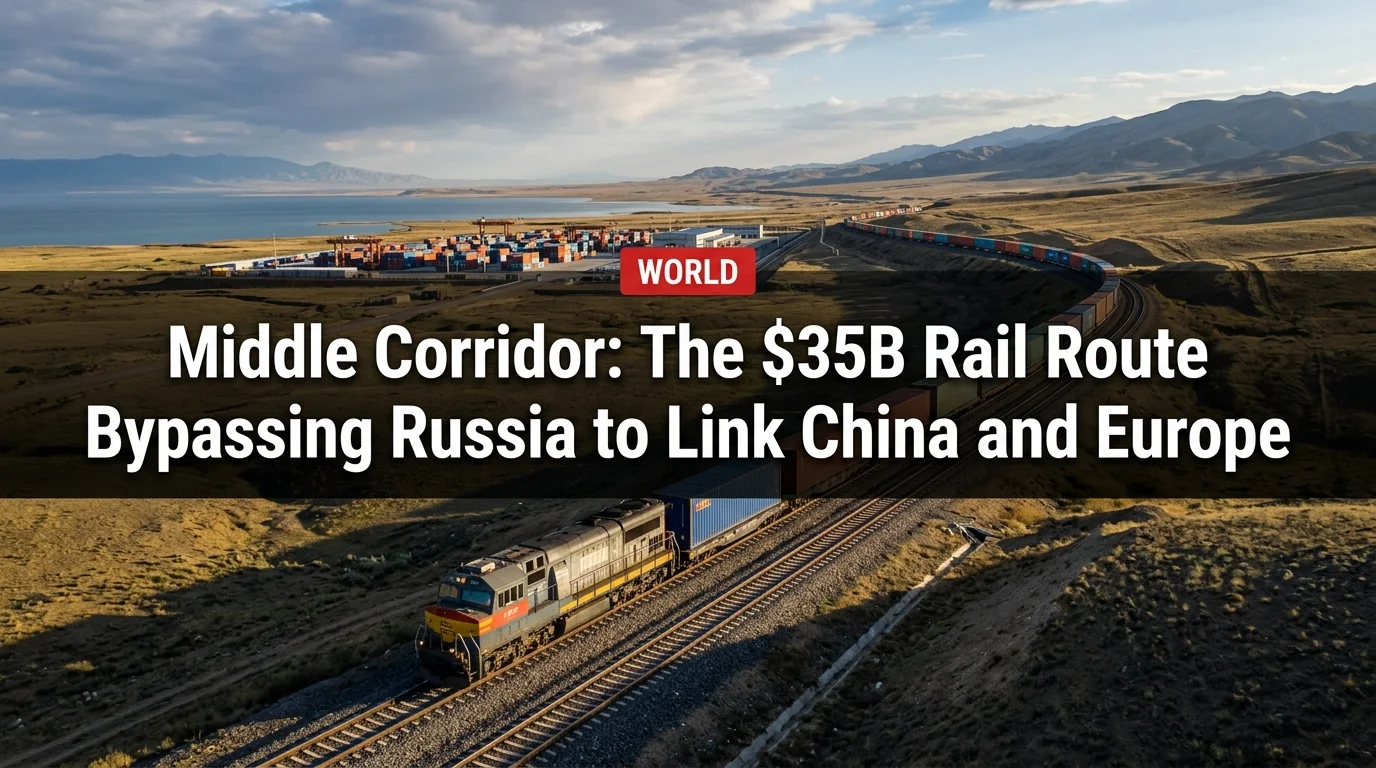
A decade ago, shipping goods overland from China to Europe meant one thing: the Northern Route through Russia. That monopoly is over.
The Middle Corridor — a rail-sea-rail network running from Xi'an through Central Asia, across the Caspian Sea, and into Europe via the Caucasus — has exploded from a logistical afterthought into a strategic priority backed by tens of billions in investment. In 2024, cargo volumes hit 4.8 million tons, up 63% year-over-year. By 2027, the route aims to handle 10 million tons annually.
The question isn't whether the Middle Corridor will matter. It's whether it can scale fast enough to meet demand.
The Route at a Glance
The Trans-Caspian International Transport Route (TITR) connects China to Europe in 12–15 days — down from 50+ days a decade ago — through five countries and two sea crossings:
Xi'an → Kazakhstan → Caspian Sea → Azerbaijan → Georgia → Türkiye → Europe
Why Now? Three Forces Colliding
1. Russia became unreliable
When Russia invaded Ukraine in February 2022, Western sanctions didn't just hit Russian banks — they disrupted the Northern Route that carried the vast majority of China-Europe overland trade. Shippers needed alternatives immediately. The Middle Corridor, previously dismissed as too slow and fragmented, suddenly had customers lining up.
2. The U.S. entered the game
In August 2025, the Washington Declaration brokered peace between Armenia and Azerbaijan — and created the TRIPP (Trump Route for International Peace and Prosperity), a 43-kilometer transit link through Armenian territory. Vice President J.D. Vance followed up in February 2026 with a South Caucasus tour that secured $25 billion in procurement contracts for U.S. firms.
The geopolitical message was clear: Washington wants a seat at the table.
3. Money is finally flowing
The EU pledged €10.8 billion through its Global Gateway initiative. The U.S. locked in $25 billion in contracts. Kazakhstan, Azerbaijan, and Georgia are pouring billions into ports, railways, and digital customs systems.
The Infrastructure Race
| Project | Country | Investment | Capacity | Timeline |
|---|---|---|---|---|
| Kuryk Port Complex | Kazakhstan | $1.1B | 180,000 TEUs/year | Construction starts 2026, operational 2028 |
| Alat Port Expansion | Azerbaijan | Undisclosed | 25M tons/year | Completion by end of 2026 |
| Anaklia Deep Sea Port | Georgia | ~$800M | 600,000 containers/year | Phase 1 by 2027 |
| TRIPP Rail Link | Armenia | U.S.-funded | 43km transit corridor | Construction H2 2026, completion 2028 |
| Almaty Railway Bypass | Kazakhstan | Undisclosed | 130km electrified line | Under construction |
| Tbilisi Dry Port | Georgia | AD Ports Group | Multimodal hub | Operational since late 2024 |
The Caspian Sea crossing — long the corridor's weakest link — is getting the most urgent attention. A Georgian company will launch new ferry services between Kazakhstan's Kuryk port and Azerbaijan's Alat port in the first half of 2026, starting with two vessels and scaling to six by 2028. Kazakhstan's KTZ Express is acquiring six new vessels of its own.
Who Controls the Corridor?
The Middle Corridor isn't owned by any single country. It's governed by a patchwork of bilateral deals, joint ventures, and multilateral bodies:
- **Middle Corridor Multimodal Ltd** — Joint venture of Kazakhstan (KTZ), Azerbaijan (ADY), and Georgian Railways. China Railway Container Transport Corp joined as a shareholder in August 2025.
- **TITR International Association** — The primary coordinating body for the route's permanent members.
- **TRIPP Development Company** — A U.S.-Armenian joint venture (74% U.S.-owned) managing the Armenian transit link.
This fragmented governance is both the corridor's greatest vulnerability and its defining feature. Unlike China's Belt and Road, no single power dominates. That makes it attractive to Western backers — and slow to coordinate.
The Cost Problem
Shipping a forty-foot container via the Middle Corridor currently costs $2,500–$3,250 — competitive with sea freight on time, but not on price. The joint ventures aim to cut costs by 50% through larger "super-ferry" systems and unified digital customs.
KEY STAT: Uzbekistan alone forecasts 1.5 million tons of cargo via the Middle Corridor in 2026 — a figure that would have been unthinkable three years ago.
The Caspian Problem Nobody Wants to Talk About
There's an inconvenient truth lurking beneath the investment hype: the Caspian Sea is shrinking. Water levels are dropping approximately 20 centimeters per year, threatening port depths and vessel operations. If dredging operations can't keep pace, the corridor's maritime link — the piece that makes the whole system work — faces a natural bottleneck that no amount of money can easily fix.
Timeline: From Afterthought to Strategic Priority
What It Means
The Middle Corridor won't replace maritime shipping or even the Northern Route entirely. Analyst Emil Avdaliani notes it remains a "complementary route" handling under 8% of China-EU overland trade.
But that misses the point. The corridor's value isn't just commercial — it's strategic. It gives Europe a China trade route that doesn't depend on Russian goodwill. It gives Central Asian nations economic leverage they've never had. And it gives the U.S. a foothold in a region where China and Russia have long dominated.
The $35.8 billion bet is that geography still matters — and that the ancient Silk Road can be rebuilt with modern rails, digital customs, and a lot of geopolitical will.
The first phase of TRIPP construction is expected to begin in the second half of 2026. Linos.ai will track progress as contracts are awarded.