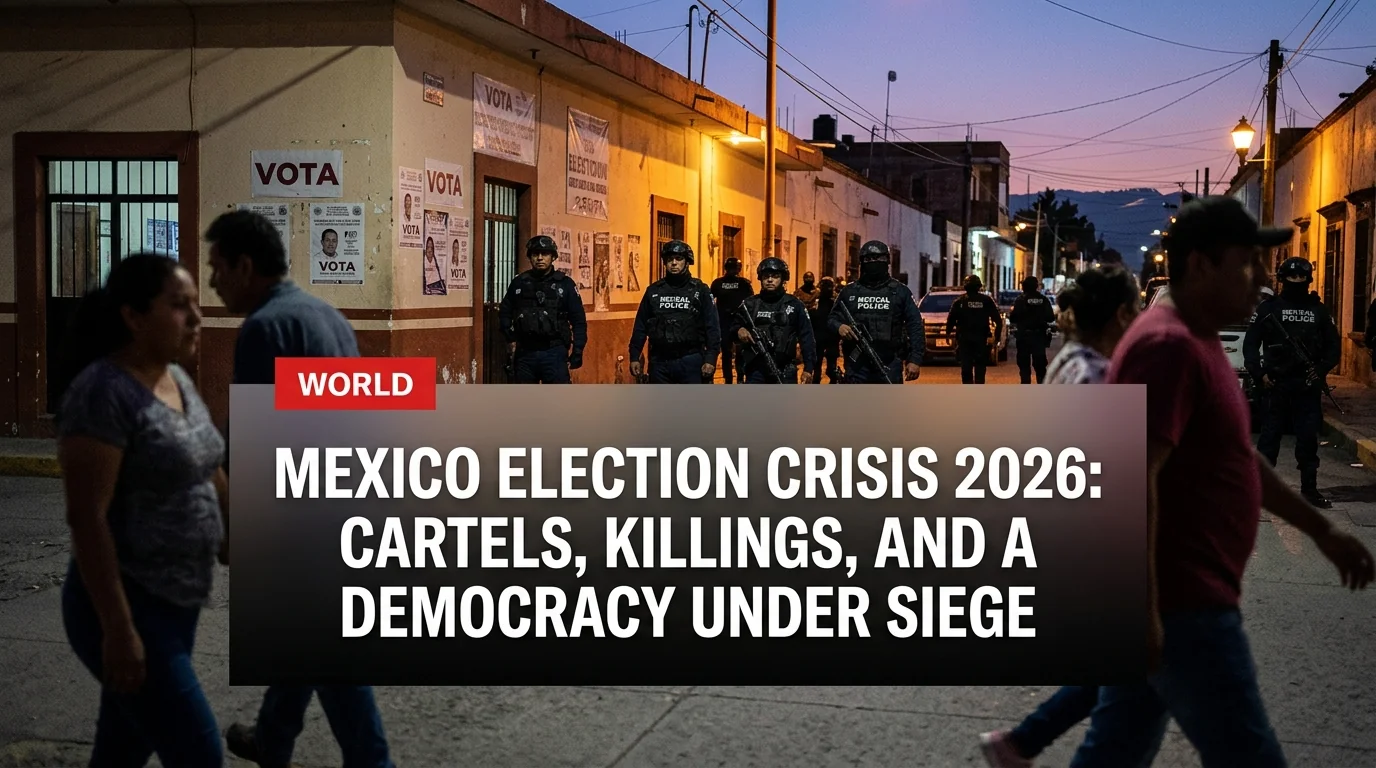
Mexico is hurtling toward a security catastrophe. The killing of the country's most wanted cartel boss has unleashed a wave of violence across a dozen states — and it's happening just as the nation's democratic institutions face their deepest stress test in decades.
The convergence of three crises — a cartel succession war, a failed electoral reform, and the aftermath of controversial judicial elections — has created what analysts now call the most dangerous political environment in modern Mexican history.
The Trigger: El Mencho's Death
On February 22, 2026, Mexican military forces killed Nemesio Oseguera Cervantes — better known as "El Mencho" — during an operation in Tapalpa, Jalisco. The leader of the Jalisco New Generation Cartel (CJNG) had been Mexico's most wanted fugitive for over a decade.
The operation, backed by U.S. intelligence, was hailed as a victory by President Claudia Sheinbaum's administration. But within hours, the consequences became clear.
CJNG fighters launched narcobloqueos — coordinated highway blockades using hijacked trucks and burning vehicles — across Jalisco, Michoacán, and Guanajuato. The cartel's internal succession battle is now spilling into civilian areas, with rival factions competing for territory previously held under El Mencho's iron grip.
Three Crises Colliding at Once
Mexico isn't just dealing with one problem. Three separate institutional failures are compounding simultaneously.
- **Crisis 1:** CJNG succession war after El Mencho's death is triggering territorial violence across western and central Mexico
- **Crisis 2:** President Sheinbaum's electoral reform was defeated in Congress on March 10, fracturing her own coalition
- **Crisis 3:** The 2025 judicial elections — where 881 federal judges were popularly elected — face accusations of cartel infiltration
The Legislative Fracture
On March 10, 2026, Sheinbaum's proposed electoral reform — a successor to AMLO's original "Plan B" — was defeated in the Chamber of Deputies. It fell 71 votes short of the required two-thirds majority. The shock: the votes came not from the opposition, but from Sheinbaum's own coalition partners. Both the Green Party (PVEM) and the Workers' Party (PT) broke ranks.
Alberto Anaya, leader of the PT, publicly criticized the reform as "an overreach that centralizes power without addressing security." The defeat has left Sheinbaum politically weakened at the worst possible moment.
The Judicial Election Fallout
The roots of the current crisis trace back to September 2024, when then-President AMLO signed a constitutional reform mandating popular elections for all federal judges. The first round took place on June 1, 2025, with 881 positions filled.
Critics warned it would happen, and it did: low voter turnout combined with reports of cartel intimidation in multiple districts. Julio Ríos Figueroa, a law professor at ITAM, described the result as "democratic erosion" — judges now beholden to political parties or, worse, criminal organizations.
A second round in 2027 will elect 4,000 more judges, and experts fear those races will be even more compromised.
The Violence Numbers
The data tells a stark story about where Mexico stands heading into mid-2026.
| Metric | Figure | Change |
|---|---|---|
| Armed clashes (security forces vs cartels) | Up significantly | +26% in 2025 vs 2024 |
| Extortion cases nationwide | Surging | +23.1% since 2024 |
| Candidates assassinated (2024 cycle) | 34–37 killed | Over 2,000 withdrew |
| Political-criminal attacks (2024) | 1,700+ incidents | Historical record |
| Cartel territorial control (U.S. estimate) | 35–40% of Mexico | Per March 2026 ODNI report |
| GDP growth (2025) | 0.3% | Near stagnation |
The U.S. Office of the Director of National Intelligence released a threat assessment on March 18, 2026, identifying Mexican cartels as a top homeland security concern and estimating that organized crime maintains "territorial control" over 35–40% of the country.
Timeline: How Mexico Got Here
What Comes Next
Three immediate pressure points loom:
The 2026 FIFA World Cup (June). Mexico is a co-host, and the Sheinbaum administration has pledged to secure all venues. "The fans will be guaranteed absolute safety," the president said. But security analysts at Integralia Consultores warn that the cartel realignment could produce violence spikes precisely during the tournament.
Budget war against the INE. Following the legislative defeat, analysts expect Sheinbaum to pursue budget cuts targeting the National Electoral Institute (INE), Mexico's autonomous electoral body. Weakening the INE ahead of the 2027 midterms — where 17 governorships are at stake — would further erode election integrity.
CJNG succession. With El Mencho dead and no clear successor, the cartel is fragmenting. Yussef Farid, a risk consultant at EMPRA, warns that fragmentation historically produces more violence, not less, as factions fight for control of trafficking routes and extortion networks.
KEY STAT: Mexico's 2025/2027 judicial election cycle involves over 7,000 candidates competing for roughly 6,600 positions — the largest judicial election experiment in any Western democracy.
Why This Matters Beyond Mexico
The crisis is a case study in what happens when institutional reform, criminal power, and political ambition collide. Mexico is attempting something no major democracy has tried: electing its entire federal judiciary by popular vote. The UN Special Rapporteur has warned that the process "jeopardizes institutional integrity."
For the United States, the stakes are immediate. The USMCA trade agreement depends on a functioning Mexican judiciary. Foreign investment has already slowed — Mexico's near-stagnant 0.3% GDP growth in 2025 reflects what analysts call the "governing scarcity" dilemma.
The next 90 days will determine whether Mexico can hold its institutions together through the World Cup, the cartel succession war, and the political fallout of a fractured ruling coalition. The evidence so far is not encouraging.