
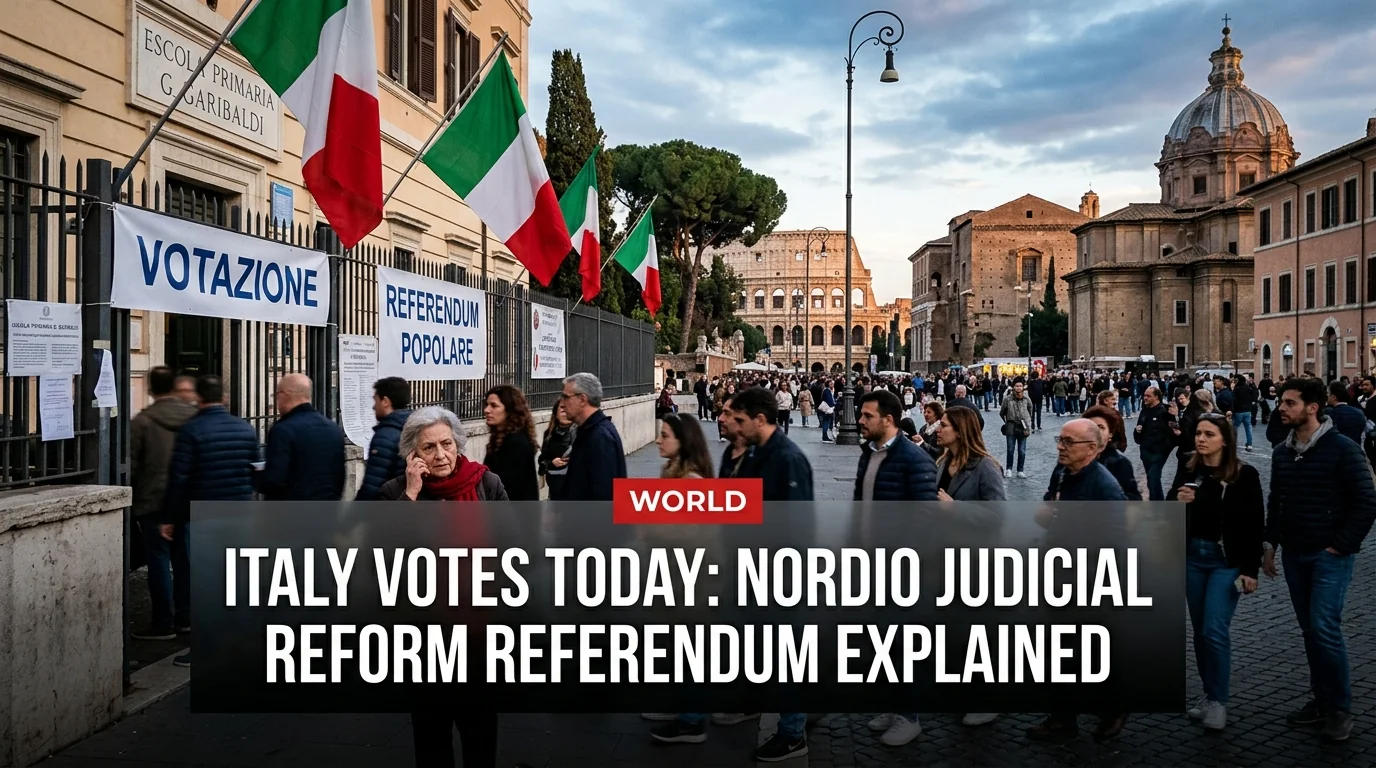
Italy heads to the polls today in a constitutional referendum that could fundamentally reshape its judicial system. The vote, taking place March 22–23, asks Italians a single question: should the country's judiciary be restructured from the ground up?
The reform — championed by Justice Minister Carlo Nordio and backed by Prime Minister Giorgia Meloni's coalition — rewrites seven articles of the 1948 Constitution. No quorum is required. A simple majority of valid votes decides the outcome.
What the Nordio Reform Actually Changes
The reform package contains four major structural changes to Italy's judicial architecture. Each one is controversial. Together, they represent the most significant overhaul of the Italian judiciary since the post-war republic was founded.
- **Referendum dates:** March 22–23, 2026
- **Type:** Confirmatory constitutional referendum
- **No quorum required** — valid regardless of turnout
- **Constitutional articles modified:** 87, 102, 104, 105, 106, 107, 110
- **Senate approval:** October 30, 2025 (without two-thirds majority)
The Four Pillars of Reform
1. Separation of Judges and Prosecutors
Currently, Italian judges and prosecutors belong to a single professional body. A magistrate can switch between judging cases and prosecuting them during their career. The reform ends this, forcing magistrates to choose one path permanently at the start of their careers.
Why it matters: Supporters say a prosecutor who might later become a judge — or vice versa — creates conflicts of interest. Critics counter that separating careers could expose prosecutors to political pressure by isolating them from the broader judicial body.
2. Splitting the High Council of the Judiciary (CSM)
The CSM is the powerful self-governing body that manages judicial careers, assignments, and promotions. Under the reform, the single CSM splits into two separate councils — one for judges, one for prosecutors. Both would still be chaired by the President of the Republic.
3. Selection by Lottery, Not Election
Perhaps the most radical change: CSM members would no longer be elected by their peers. Instead, two-thirds of judicial members would be chosen by sortition — random selection from eligible magistrates. The remaining "lay members" (law professors and attorneys) would also be drawn by lot from a parliamentary list.
- Breaks power of internal judicial factions
- Reduces campaign-style politicking within the judiciary
- Merit-agnostic selection prevents patronage networks
- Removes democratic accountability within the judiciary
- Random selection may produce less qualified council members
- Parliamentary control over the lay-member list introduces political influence
4. New High Disciplinary Court
Disciplinary proceedings against magistrates — currently handled internally by the CSM — would move to a brand-new 15-member High Disciplinary Court (ACD). Its members would also be selected partly by lot.
Why Italy Is Doing This Now
Italy's judicial system has been a political battleground for decades. The "Clean Hands" anti-corruption investigations of the 1990s demonstrated the enormous power Italian prosecutors wield. Since then, successive governments have attempted reform — and successive judiciaries have pushed back.
Meloni's coalition argues Italy is the only major Western democracy where judges and prosecutors share a single career track. Justice Minister Nordio has been blunt: a "No" vote would leave Italy "on the margins of all Western democracies" and stall judicial reform for years.
Who Supports What
- Fratelli d'Italia (Brothers of Italy)
- Lega (League)
- Forza Italia
- Justice Minister Carlo Nordio
- Goal: Break judicial factionalism, increase impartiality
- Partito Democratico (PD)
- Five Star Movement (M5S)
- National Association of Magistrates (ANM)
- CGIL (Italy's largest trade union)
- Goal: Protect judicial independence from political interference
The opposition's case is straightforward: the reform weakens the judiciary's ability to check government power. Elly Schlein, leader of the Democratic Party, has framed it as part of a broader pattern alongside the separate "premierato" reform that would introduce direct election of the Prime Minister.
The No-Quorum Factor
Unlike Italy's abrogative referendums (which require 50%+ turnout to be valid), this confirmatory constitutional referendum has no minimum quorum. If only 10% of Italians vote, the result still counts. This fundamentally changes the strategic calculation.
In past Italian referendums, low turnout has killed reform efforts. In 2022, five justice-related referendums all failed because turnout was just 20.9% — well below the 50% quorum needed for those abrogative votes. That barrier doesn't exist here.
KEY STAT: Italy has held four constitutional referendums since 2001. Only two passed — both times because they had no quorum requirement, just like this one.
What Happens After the Vote
If Yes wins, the reform takes effect and Italy begins the complex process of establishing two separate judicial councils, a new disciplinary court, and transitioning all current magistrates into permanent career tracks. Implementation legislation will take months.
If No wins, the reform dies — but unlike 2016, Meloni has stated she will not resign over the result. Still, a rejection would severely weaken her government's legislative agenda and embolden the opposition heading into the premierato battle expected later this year.
The Bigger Picture
This referendum is the opening act of a constitutional drama that could stretch through all of 2026. If Meloni's coalition clears this hurdle, the premierato reform — direct election of the Prime Minister — will likely face its own referendum later this year. That vote carries even higher stakes for Italy's balance of power.
For now, 60 million Italians have a simpler question before them: should judges and prosecutors be separated, and should the judiciary govern itself differently? The answer will echo far beyond the courtroom.
Voting is open March 22–23, 2026. Polls close at 3:00 PM on March 23. Results are expected by late evening.