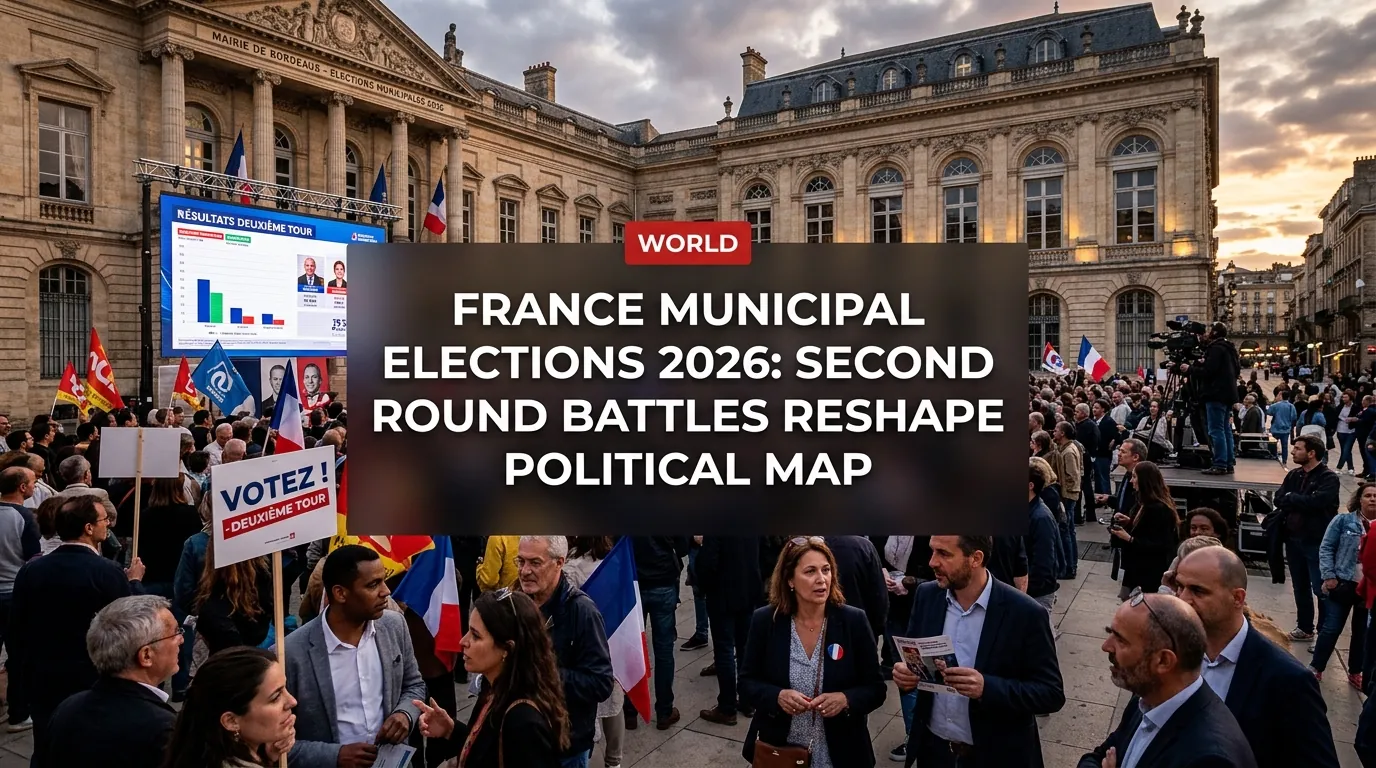
France heads to the polls on Sunday for the decisive second round of municipal elections, a vote that is already reshaping the country's political landscape and setting the stage for a seismic 2027 presidential race.
After a fragmented first round on March 15 left no single bloc dominant, voters across 35,000 municipalities are casting ballots in runoffs that could hand the far-right National Rally (RN) its biggest-ever haul of local seats — while testing whether the left can hold its urban strongholds.
- **35,000+** municipalities voting in runoffs across France
- **289** National Assembly seats — the threshold that toppled Barnier's government in December 2024
- **3 prime ministers** in 12 months — France's worst political instability in decades
- **March 22, 2026** — second round voting day
The Races That Matter Most
While municipal elections decide local mayors and councils, the stakes this time are unmistakably national. President Emmanuel Macron — with roughly one year left in his term — is watching closely as his centrist movement faces erosion from both flanks.
- Socialist Emmanuel Grégoire leads first-round polling
- Conservative Rachida Dati in striking distance
- LFI's Sophia Chikirou splitting the left vote
- The capital has been run by the left for 25 years
- Incumbent left-wing mayor Benoît Payan in a dead heat
- RN candidate Franck Allisio running neck-and-neck
- A win here would be the RN's biggest city capture ever
- Symbolic battleground for France's north-south divide
The Far-Right's Local Surge
The first round confirmed what polls had been signaling for months: the National Rally is no longer just a protest vote in presidential elections. It is building a genuine local governing network.
First-round vote share (%) in cities over 100,000 population, based on compiled results from March 15.
The RN performed particularly well across southern France, making gains in Toulon, Nice, and securing an outright first-round win in Perpignan. Marine Le Pen's party is now positioned to govern more French towns than at any point in its history.
KEY STAT: The RN won outright in the first round in Perpignan and advanced to runoffs in over 200 towns where it had never previously fielded candidates.
Meanwhile, Jean-Luc Mélenchon's La France Insoumise (LFI) expanded its footprint in northern industrial cities like Roubaix and posted strong numbers in Toulouse, Lille, and Limoges.
How France Got Here: A Timeline of Crisis
These municipal elections do not exist in a vacuum. They arrive at the end of two years of political chaos unprecedented in the Fifth Republic.
Three prime ministers toppled or replaced in barely 12 months. A parliament so fragmented that no coalition can hold. And a president whose term expires in 2027 with approval ratings in the low 20s. This is the backdrop against which French voters are choosing their local leaders — and, implicitly, signaling which national forces they trust.
What the Numbers Tell Us
France's political instability has had real economic consequences, adding urgency to these local votes.
The deficit has ballooned past EU targets, the credit rating has been cut, and public debt now exceeds 110% of GDP. Voters in cities across France are choosing mayors who will have to manage tighter budgets with less support from a paralyzed central government.
The Green Question
Two of France's most prominent Green mayors — Pierre Hurmic in Bordeaux and Grégory Doucet in Lyon — face tight runoffs after narrower-than-expected first-round leads. Both won surprise victories in 2020 on a wave of climate enthusiasm. Whether they can hold their seats will signal whether the Greens remain a governing force or fade back to the margins.
- Greens have governing track record in Bordeaux and Lyon
- Climate policy remains popular among urban, educated voters
- Local incumbency advantage with concrete achievements to point to
- National Green brand weakened by infighting since 2022
- Cost-of-living crisis has pushed environmental policy down voter priorities
- Centrist and conservative challengers running on pragmatic green-lite platforms
The 2027 Shadow
Every major party leader is treating these municipal elections as a dry run for the presidential race. The results will determine fundraising momentum, alliance strategies, and — critically — which candidates appear "inevitable" and which appear finished.
For Marine Le Pen, a strong municipal showing would bolster her third presidential bid. For the fractured left, holding Paris and winning back cities would prove that a united front can work. For Macron's centrists, anything short of catastrophe would count as a win at this point.
What to Watch Tonight
Polling stations close at 6 PM in most towns and 8 PM in major cities. Initial projections are expected by 8:30 PM local time (7:30 PM UTC). The key questions:
- Does the RN flip Marseille? A win in France's second-largest city would be historic and would reshape the 2027 calculus overnight.
- Does Paris stay left? A conservative or centrist win in the capital would be the biggest political earthquake of the cycle.
- Do the Greens hold Lyon and Bordeaux? Two losses would effectively end the Green governing experiment.
- What's the abstention rate? High turnout benefits the left historically; low turnout favors the right.
Results will trickle in throughout the evening. But one thing is already clear: whoever wins tonight, France's political map will look fundamentally different by morning — and the road to 2027 will have its first clear signposts.