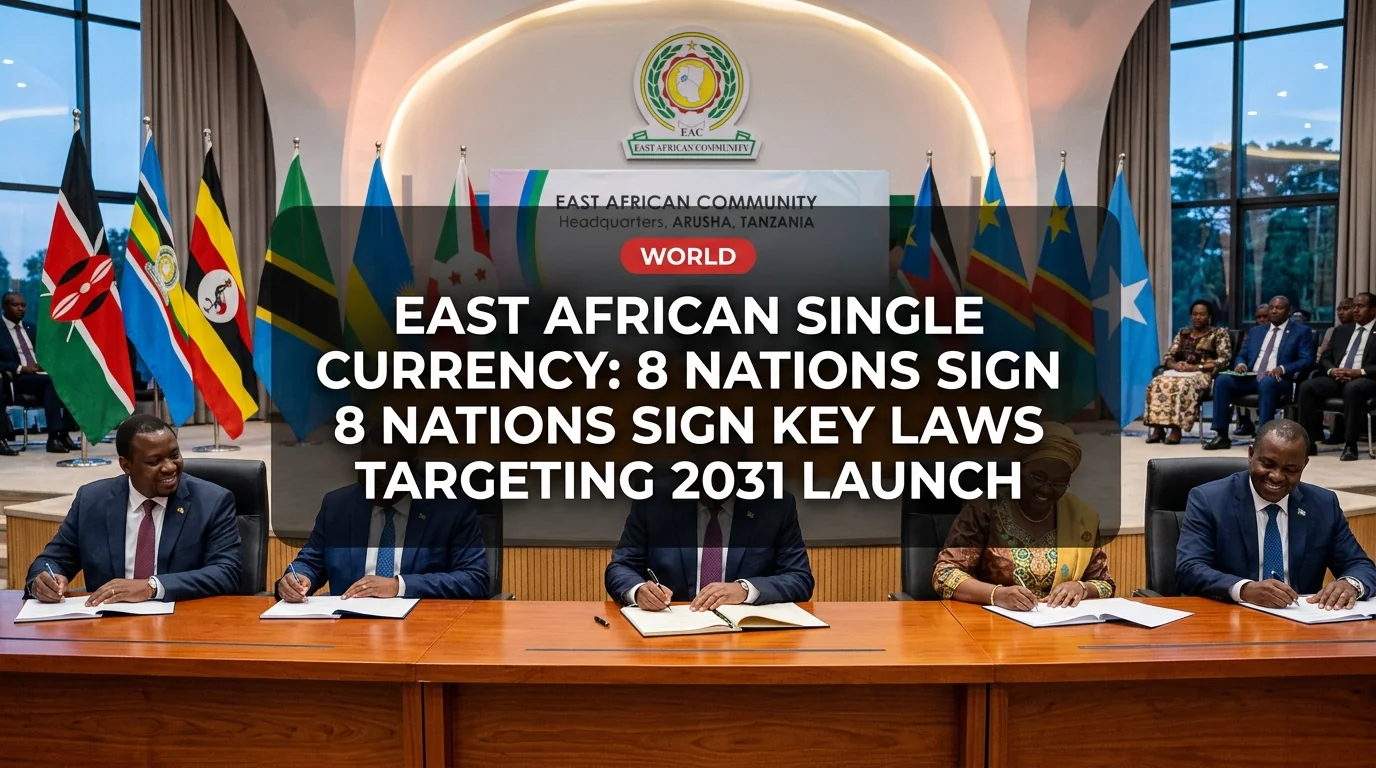
Eight East African heads of state have signed landmark legislation at their March 2026 summit in Arusha, Tanzania, establishing the institutional backbone for a single regional currency — a project decades in the making that now targets 2031 for launch.
The laws, assented to by presidents from Kenya, Tanzania, Uganda, Rwanda, Burundi, South Sudan, the Democratic Republic of Congo, and Somalia, create three critical institutions: the East African Statistics Commission, the Surveillance Compliance and Enforcement Commission, and formalize the framework for the East African Monetary Institute (EAMI).
- **8 nations** signed preparatory monetary union laws at the Arusha summit
- **2031** is the revised target date for the single currency launch
- **2028** is the deadline for all member states to meet convergence criteria
- **15%** of EAC trade is currently intra-regional — the currency aims to change that
- **$300B+** combined GDP of the East African Community bloc
From 2024 Dream to 2031 Reality
The East African Monetary Union Protocol was signed in November 2013, setting an ambitious 10-year timeline for a shared currency. That original 2024 deadline was never realistic.
In August 2024, EAC Secretary General Veronica Mueni Nduva officially pushed the target to 2031, citing member states' inability to meet macroeconomic convergence criteria and delays in establishing key institutions.
The Four Tests Every Nation Must Pass
Before any shared banknotes are printed, all eight member states must simultaneously meet and sustain four macroeconomic benchmarks for three consecutive years — from 2028 through 2031.
This is where the project faces its steepest challenge. Several member states have historically struggled with these thresholds. South Sudan and the DRC, both newer EAC members, face particularly steep climbs given their conflict-affected economies and volatile inflation.
The Headquarters Question Nobody Can Answer
One of the most politically fraught obstacles isn't economic — it's geographic. The East African Monetary Institute, the precursor to what will eventually become the East African Central Bank, still has no confirmed host country.
Four nations have submitted bids to house the EAMI headquarters, including Uganda. The decision has been deferred repeatedly at successive summits, with each partner state viewing the institution as both a prestige symbol and an economic anchor.
KEY STAT: Intra-regional trade accounts for just 15% of total EAC trade. Currency conversion costs between member states can reach up to 35% on certain corridors — a massive drag on commerce that a single currency would eliminate.
"There is a lot of integration that is happening as far as the work that banks do; they are working together," said Edith Mwanje, Uganda's permanent secretary for East African Community Affairs. "We have, however, delayed in putting in place the EAMI. The decision has to be taken on who hosts its headquarters — that's what has delayed."
What's Already Working
Despite the headline delays, the monetary integration machinery is not standing still.
- East African Payments System (EAPS) already enables multi-currency transactions across borders
- Central banks actively coordinating through the Monetary Affairs Committee
- Legal frameworks for tax harmonization and double-taxation avoidance under review
- EAC Financial Services Commission bill passed by the East African Legislative Assembly
- Growing public appetite for regional integration and lower transaction costs
- No host country selected for EAMI headquarters after years of negotiations
- Several member states consistently miss convergence criteria targets
- Non-tariff barriers continue to hinder free trade despite 2017 elimination act
- New trade disputes emerging (Uganda-South Sudan e-permit conflict in late 2025)
- Political will to surrender national monetary sovereignty remains unproven
The Ghost Currency That Went Viral
The path to the East African single currency has been complicated by misinformation. In March 2024, a social media account calling itself the "Government of East Africa" posted specimen images of a banknote for a currency dubbed the "SHEAFRA" — the Shilling of East Africa and Franc — claiming it had officially launched.
The posts went viral across Kenya, Uganda, and Tanzania before the EAC Secretariat issued a formal debunking within 24 hours. Investigators later traced the account to a Ugandan private citizen. But the episode revealed something significant: genuine public enthusiasm for a shared currency, even when the announcement was entirely fabricated.
What Comes Next
The March 2026 summit laws are necessary but not sufficient. The real test begins now: can eight nations with vastly different economic profiles — from Kenya's $115 billion GDP to Burundi's $3 billion — align their fiscal and monetary policies tightly enough to share a currency?
The European Union's experience with the euro offers both encouragement and caution. The eurozone took decades from concept to launch and still faces structural tensions between its strongest and weakest economies.
For the EAC, the 2028 convergence deadline is the next critical milestone. If member states can demonstrate three years of sustained macroeconomic alignment, the 2031 launch becomes plausible. If they can't, the East African single currency may join a long list of ambitious integration projects that never quite crossed the finish line.
The institutions are now being built. The question is whether political will can match institutional architecture.