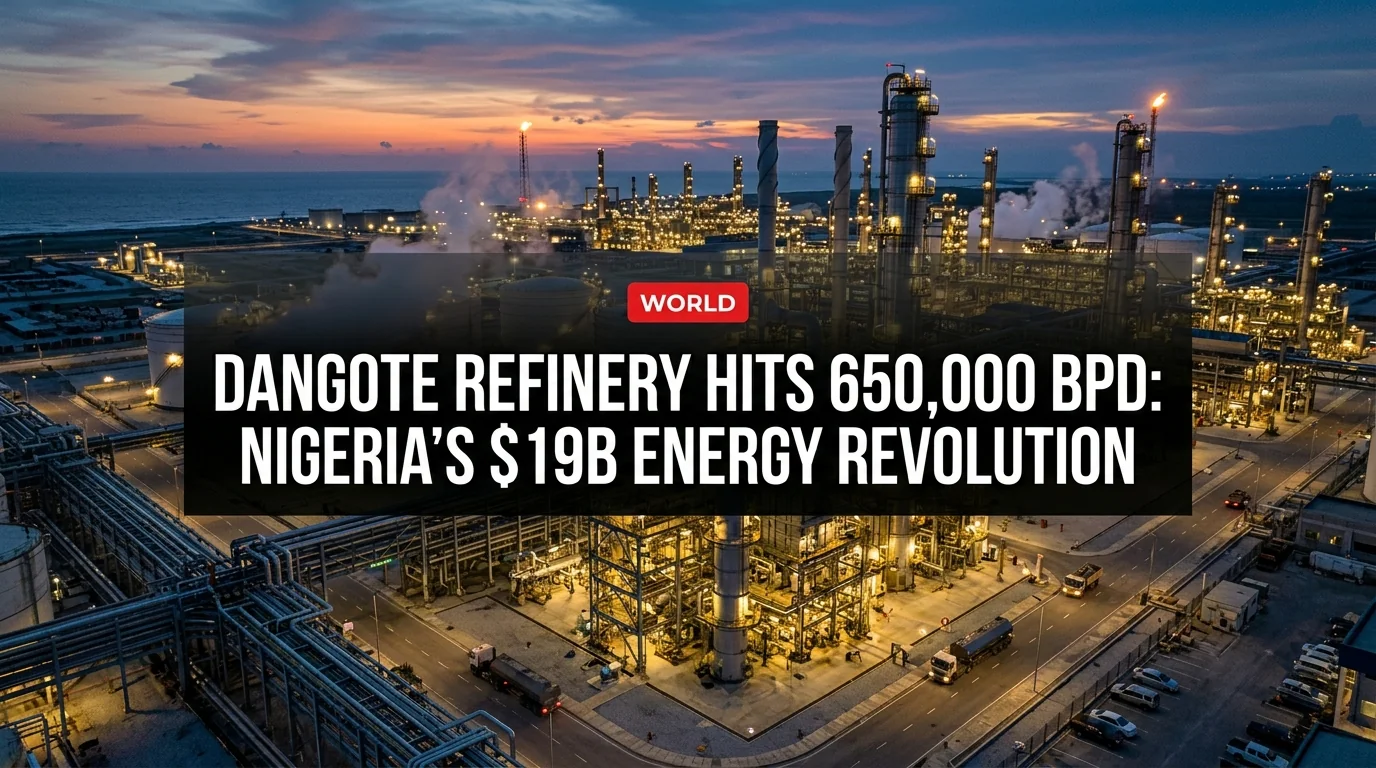
Nigeria's Dangote Petroleum Refinery has officially reached its full nameplate capacity of 650,000 barrels per day — a milestone that ends the country's 40-year dependence on imported fuel and repositions Africa's largest economy as a continental energy powerhouse.
The achievement, confirmed in February 2026, makes the Lagos-based facility the first refinery in the world to hit this output level from a single crude distillation unit. Now, as the Iran conflict disrupts Middle Eastern supply routes, African nations from South Africa to Kenya are lining up for supply contracts.
The Numbers That Matter
From Importer to Exporter: A 40-Year Reversal
For decades, Nigeria lived a paradox: Africa's largest oil producer exported crude and imported nearly all its refined fuel. Four state-owned refineries — in Port Harcourt, Warri, and Kaduna — operated at a fraction of capacity, often producing nothing at all. The country spent billions annually importing gasoline from European refineries.
That era is over.
The Dangote Refinery, spread across 6,180 acres in the Lekki Free Trade Zone outside Lagos, now supplies 92% of Nigeria's total petrol demand. In March 2026, the Nigerian Midstream and Downstream Petroleum Regulatory Authority (NMDPRA) suspended new petrol import licenses — a regulatory action that would have been unthinkable two years ago.
KEY STAT: Nigeria's refined petroleum imports fell 28.8% year-on-year in 2025, dropping from $14.06 billion to $10.00 billion. The trajectory points toward near-zero fuel imports by late 2026.
Timeline: From Announcement to Full Capacity
The 13-year journey from announcement to full capacity was marked by construction delays, financing hurdles, and political resistance from entrenched fuel import cartels. The project's cost ballooned from an initial $9 billion estimate to over $19 billion.
Africa's New Fuel Lifeline
The timing of the capacity milestone could not be more consequential. The ongoing Iran-Israel conflict has disrupted Middle Eastern fuel supply routes that historically account for roughly 75% of refined fuel imports to East and Southern Africa.
Countries across the continent are now pivoting to Dangote.
- **South Africa** is negotiating a 12-month standard supply contract
- **Ghana and Kenya** have actively sought supply agreements in 2026
- **25% of refinery output** is available for export markets
- **European refineries** that previously served West Africa are losing market share
David Bird, CEO of Dangote Petroleum Refinery, confirmed the operational readiness: "The seamless integration and strong performance of the CDU and MS Block demonstrate the plant's advanced engineering and operational resilience."
Analysts at Kpler and CITAC have noted the refinery has "disrupted global trade flows," specifically pressuring European refineries that relied on West African export markets for decades.
What the Critics Say
Not everyone is celebrating. Labor union PENGASSAN has criticized mass layoffs of construction workers as the facility transitions to steady-state operations. Some Nigerian oil marketers accuse Dangote of operating a "private monopoly" that dictates prices without real competition.
The most persistent complaint: despite local production eliminating import costs, domestic fuel prices remain at import-parity levels. Nigerian consumers expected cheaper fuel. Instead, they got reliability without the price cut.
Aliko Dangote has pushed back, framing the issue as one of supply security over pricing: "Right now it is not about pricing, it's about availability. The situation of global supply strain will continue for a while."
The Expansion: 1.4 Million BPD by 2028
Dangote is already looking beyond 650,000 BPD. A Phase 2 expansion will add a second 750,000 BPD processing line, pushing total capacity to 1.4 million barrels per day by 2028 — which would make it the largest refinery on Earth.
| Metric | Current (2026) | Phase 2 Target (2028) |
|---|---|---|
| Crude capacity | 650,000 BPD | 1,400,000 BPD |
| Polypropylene output | 1M metric tonnes/year | 1.5M metric tonnes/year |
| Projected jobs | Current workforce | +65,000 additional |
| Daily revenue potential | $150M+ | $300M+ (est.) |
| Stock listing | Private | NGX IPO planned (30% float) |
The planned listing on the Nigerian Stock Exchange by late 2026 — offering up to 30% of shares to the public — could become the largest IPO in African history.
What This Means for Global Energy
The Dangote Refinery represents more than a Nigerian success story. It is a proof of concept that large-scale industrial infrastructure can be built on the African continent, financed primarily through African institutions like Afreximbank, and operated at world-class standards.
For Europe, it means the loss of a captive fuel export market. For the Middle East, it signals reduced African dependence during a period of escalating conflict. For Africa, it offers a template — and a direct fuel supply alternative that didn't exist 18 months ago.
The refinery processed 82 million barrels of crude in 2025, with 60% purchased in naira through the landmark Naira-for-Crude initiative — a mechanism that has also helped stabilize Nigeria's volatile currency.
As construction crews break ground on Phase 2, one thing is clear: the era of Africa's fuel dependency is ending. And it's ending in Lagos.