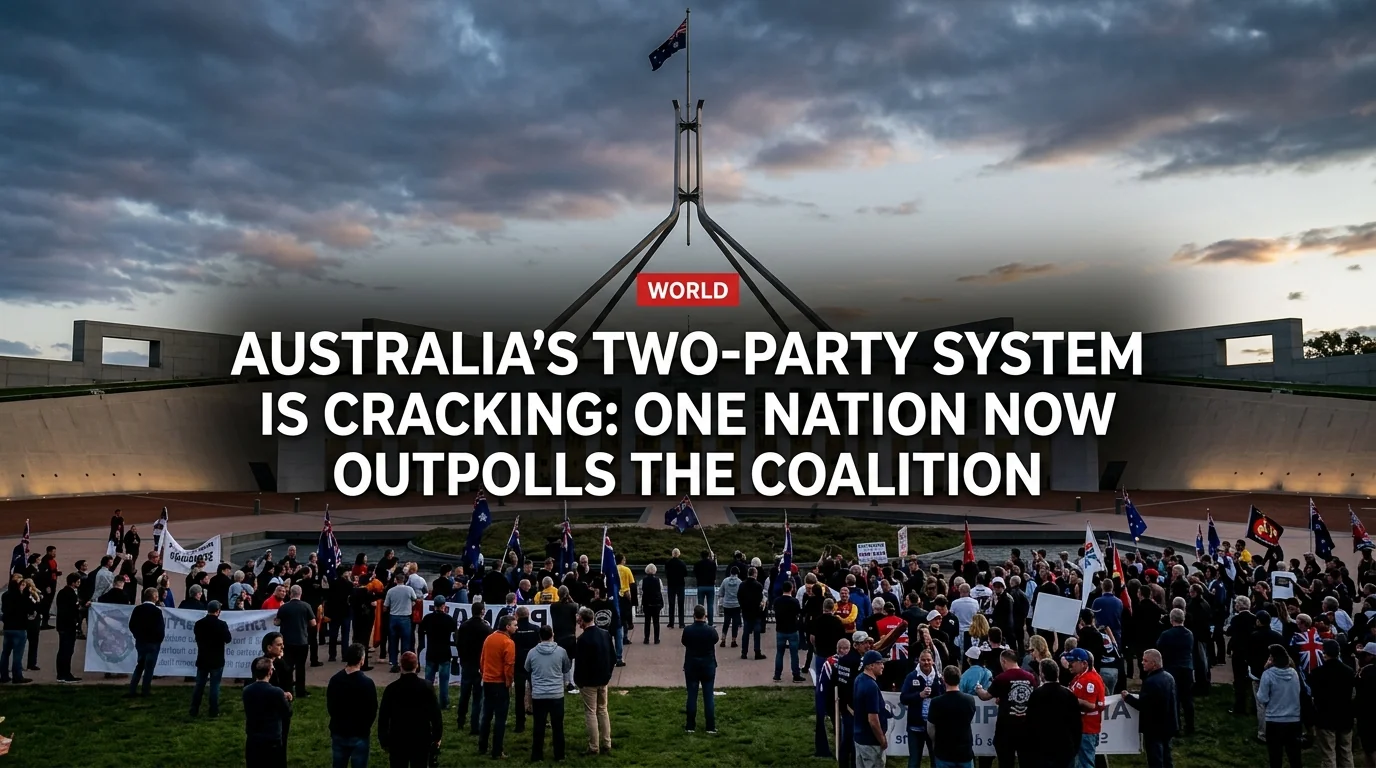
Australia's political landscape hasn't looked like this in over a century. For the first time since 1909, a minor party is consistently outpolling a major party in federal voting intention — and the tremors from Saturday's South Australian election suggest the earthquake is just getting started.
The South Australia Earthquake
On March 21, 2026, South Australians went to the polls. Labor Premier Peter Malinauskas cruised to a second term with at least 32 of 47 lower house seats. That was expected.
What wasn't expected: One Nation finished ahead of the Liberal Party in primary votes statewide.
One Nation's state leader Cory Bernardi — a former Liberal senator — won a Legislative Council seat. The party led in at least four lower house electorates: Ngadjuri, Hammond, Narungga, and Mackillop. Outside Adelaide, One Nation pulled 27% of the regional vote, outstripping every other party.
Pauline Hanson called the result "vindication." For the Liberal Party, it's an existential crisis.
Federal Polls Tell the Same Story
South Australia isn't an outlier. Federal polling shows a three-way race that would have been unthinkable two years ago.
Source: Roy Morgan survey, March 2-8, 2026
A DemosAU MRP projection from January–March 2026 estimates One Nation could win 46 to 55 federal seats at the next election — enough to become the official opposition. That's up from a projection of just 12 seats in late 2025.
KEY STAT: On a two-party-preferred basis, Labor still leads 53.5% to 46.5%. But the Coalition's primary vote collapse means One Nation is cannibalizing conservative voters at a rate that could redraw the parliamentary map.
How Did We Get Here?
The timeline reads like a political thriller.
The Barnaby Factor
Barnaby Joyce's defection from the Nationals to One Nation in December 2025 was the moment the dam broke. A former Deputy Prime Minister crossing the floor to a minor party signaled to regional voters that the old Coalition compact was dead.
Joyce now plans to run as a One Nation Senate candidate for New South Wales. His pitch is blunt: the Coalition will eventually need One Nation to form government anyway.
The Angus Taylor Reset
The Liberal Party's response was a leadership change. Angus Taylor, a harder-line conservative, toppled Sussan Ley on February 13 in a 34-17 vote. He appointed Tim Wilson as Shadow Treasurer and brought the Nationals back into the shadow cabinet after a brief January walkout.
Taylor's framing: "We must change or die. Home ownership must be the centerpiece of the Australian dream once again."
But the change hasn't stopped the bleeding. Taylor inherited a party losing voters in both directions — to One Nation on the right and to teal independents in wealthy urban seats.
- Harder conservative stance may reclaim some One Nation voters
- Housing focus addresses the single biggest voter concern
- Nationals back in shadow cabinet restores coalition unity
- Risks alienating moderate urban Liberals
- One Nation has a 3-month head start on populist messaging
- Farrer by-election in May could embarrass the new leadership
Why This Time Is Different
Australia has seen minor party surges before — the Democrats in the 1990s, the Greens in the 2010s. But analyst Antony Green has identified 25 seats where One Nation performed strongly in 2025 as key battlegrounds, primarily in rural and regional areas held by the Nationals and Liberals.
Redbridge Group Director Kos Samaras put it starkly in February: the two-party system is "under enormous stress."
The math is simple. When a minor party holds 22-24% of the primary vote nationally and concentrates that support in regional seats, they don't just win a handful of upper house positions. They start winning lower house seats. And with the MRP projection showing 46-55 potential federal seats, One Nation could leapfrog the Coalition entirely.
What Happens Next
Three dates will determine whether this is a genuine realignment or a protest-vote sugar high:
| Date | Event | Why It Matters |
|---|---|---|
| May 9, 2026 | Farrer by-election | First test of One Nation vs. Liberals in a safe conservative seat |
| July 1, 2026 | New disclosure laws | Lower donation thresholds could expose One Nation's funding sources |
| Nov 2026 | Victorian state election | One Nation polls at 26.5% — ahead of both major parties |
The Victorian numbers are staggering: One Nation at 26.5%, Labor at 25.5%, Coalition at 21.5%. If those numbers hold, Australia's second-largest state could deliver the most fragmented parliament in the country's history.
For 117 years, Australian politics ran on a simple equation: Labor vs. the Coalition. In 2026, that equation no longer balances. Whether One Nation can convert polling momentum into parliamentary seats — and whether the Coalition can stop the hemorrhage — will define Australian democracy for a generation.