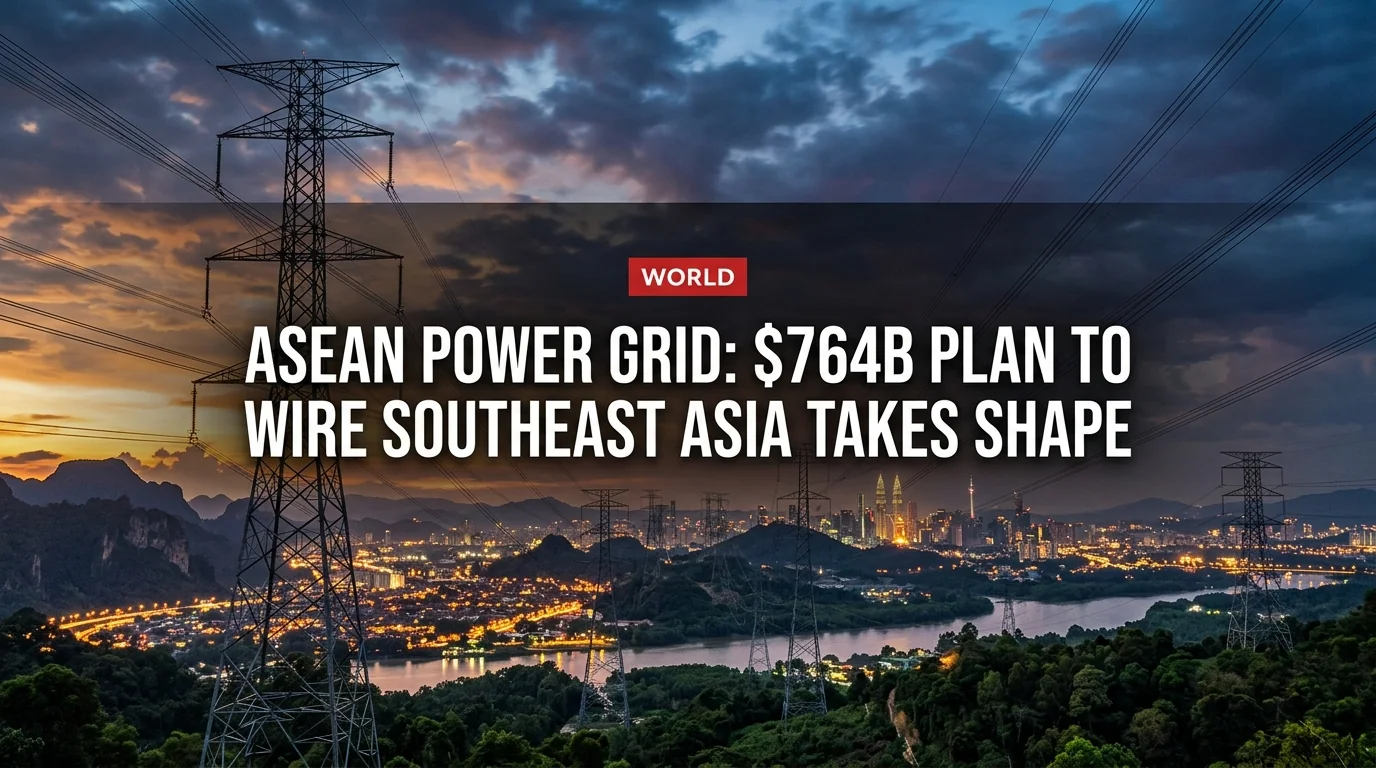
Southeast Asia is building one of the most ambitious energy infrastructure projects on Earth — and 2026 is the year it shifts from blueprints to bulldozers.
The ASEAN Power Grid (APG), a plan to interconnect the electricity networks of all ten Southeast Asian nations, has entered a decisive implementation phase. After decades of memorandums and pilot projects, the region now has a working multilateral power trading system, a new legal framework, and a financing mechanism backed by the Asian Development Bank.
The question is no longer whether it can work. It's whether 700 million people across vastly different economies can agree on how fast to build it.
From Bilateral Deals to a Regional Grid
For most of its history, cross-border electricity trade in Southeast Asia was strictly bilateral — one country selling to one neighbor. The Lao PDR-Thailand-Malaysia-Singapore Power Integration Project (LTMS-PIP) changed that.
Phase 1 proved the concept: renewable hydropower generated in Laos traveled through Thailand and Malaysia's grids to reach Singapore — a journey spanning four countries and roughly 1,800 kilometers. Over two years, the system moved 266 gigawatt-hours of clean electricity without a major disruption.
The Money Problem
The technical proof-of-concept is done. Now comes the hard part: paying for it.
The full ASEAN Power Grid vision requires an estimated $764 billion in generation and transmission investment by 2045, with at least $100 billion earmarked specifically for grid interconnections. These are numbers that dwarf any single nation's energy budget in the region.
To address this, ASEAN launched the Power Grid Financing Initiative (APGF) in October 2025, in partnership with the ADB and World Bank Group. The initiative targets three persistent barriers to private investment:
- Early-stage project preparation risk
- Long asset tenors that exceed typical commercial lending horizons
- Cross-border regulatory uncertainty that makes investors nervous
KEY STAT: Regional power integration could reduce Southeast Asia's decarbonization costs by $800 billion by 2050, according to ASEAN Centre for Energy projections.
Who's Running the Show
The project involves a web of national utilities, regulators, and multilateral bodies:
| Entity | Role | Country |
|---|---|---|
| Electricité du Laos (EdL) | Hydropower supplier | Lao PDR |
| EGAT | Grid transit (wheeling) | Thailand |
| Tenaga Nasional Berhad (TNB) | Transit + Phase 2 supplier | Malaysia |
| Energy Market Authority (EMA) | Import regulator | Singapore |
| Keppel Electric | Commercial importer | Singapore |
| ASEAN Centre for Energy (ACE) | Technical secretariat | Regional |
| HAPUA | Utility coordination body | Regional |
Malaysia's role is expanding significantly in Phase 2 — TNB is shifting from purely a transit partner to also supplying surplus renewable energy, making the grid genuinely multi-directional for the first time.
The Subsea Frontier
The next leap is underwater. Two major submarine cable projects are advancing:
- Capacity: 1.2 GW conditional approval from EMA
- Source: Offshore wind power from Vietnam
- Target operation: 2033
- Status: Feasibility evaluation signed May 2025
- Capacity: Under assessment
- Source: Indonesian renewable surplus
- Target operation: TBD
- Status: Planning phase
The Vietnam-Singapore link alone could deliver 1.2 gigawatts of offshore wind power — twelve times the current LTMS-PIP capacity. Vietnam has included the project in its national priority energy infrastructure list, targeting 3,000 MW for export to Singapore and Malaysia.
A high-voltage cable manufacturing facility in Ho Chi Minh City is scheduled to begin operations by 2030 to support these connections.
The Obstacles Nobody Wants to Talk About
For all its momentum, the APG faces stubborn political realities.
- Proven multilateral trading system (LTMS-PIP)
- New legal framework (Enhanced MoU ratified 2025)
- Dedicated financing mechanism (APGF)
- Strong ADB and World Bank backing
- 1.45 million projected green jobs
- "Energy nationalism" — countries prioritize domestic supply over exports
- Disparate voltages and frequencies across national grids
- Varying economic capacities among 10 member states
- No unified regulatory body (each country has its own rules)
- Sovereign concerns over shared critical infrastructure
"Asean's energy future depends on how quickly public-private trust is built," warned Davis Chong, CEO of Solarvest, pointing to domestic subsidies that distort regional trading economics.
Critics note that "energy nationalism" remains the biggest threat. When electricity shortages hit at home, no government wants to explain why power is flowing to a neighbor. This dynamic has delayed subsea cable projects and limited the ambition of bilateral agreements.
What 2026 Changes
The Philippines' ASEAN Chairmanship this year is focused squarely on making the Enhanced MoU operational. That means:
- Standing up dedicated Task Forces on policy, legal, and technical standards
- Developing a Submarine Power Cable Framework to create consistent rules for undersea links
- Pushing for regulatory harmonization so power can flow as freely as goods already do
The APAEC 2026–2030 plan now governs energy cooperation, shifting emphasis from planning documents to measurable implementation targets.
The Bottom Line
The ASEAN Power Grid is no longer a vision statement. It's a functioning system that has delivered clean electricity across four countries. But scaling from 200 MW to the tens of gigawatts needed for regional decarbonization requires something Southeast Asia has historically struggled with: sustained collective action across very different political systems.
The $764 billion price tag is staggering. The $800 billion in decarbonization savings if they pull it off is even more so. For 700 million Southeast Asians facing rising temperatures and rising energy demand, the math is simple — even if the politics aren't.