
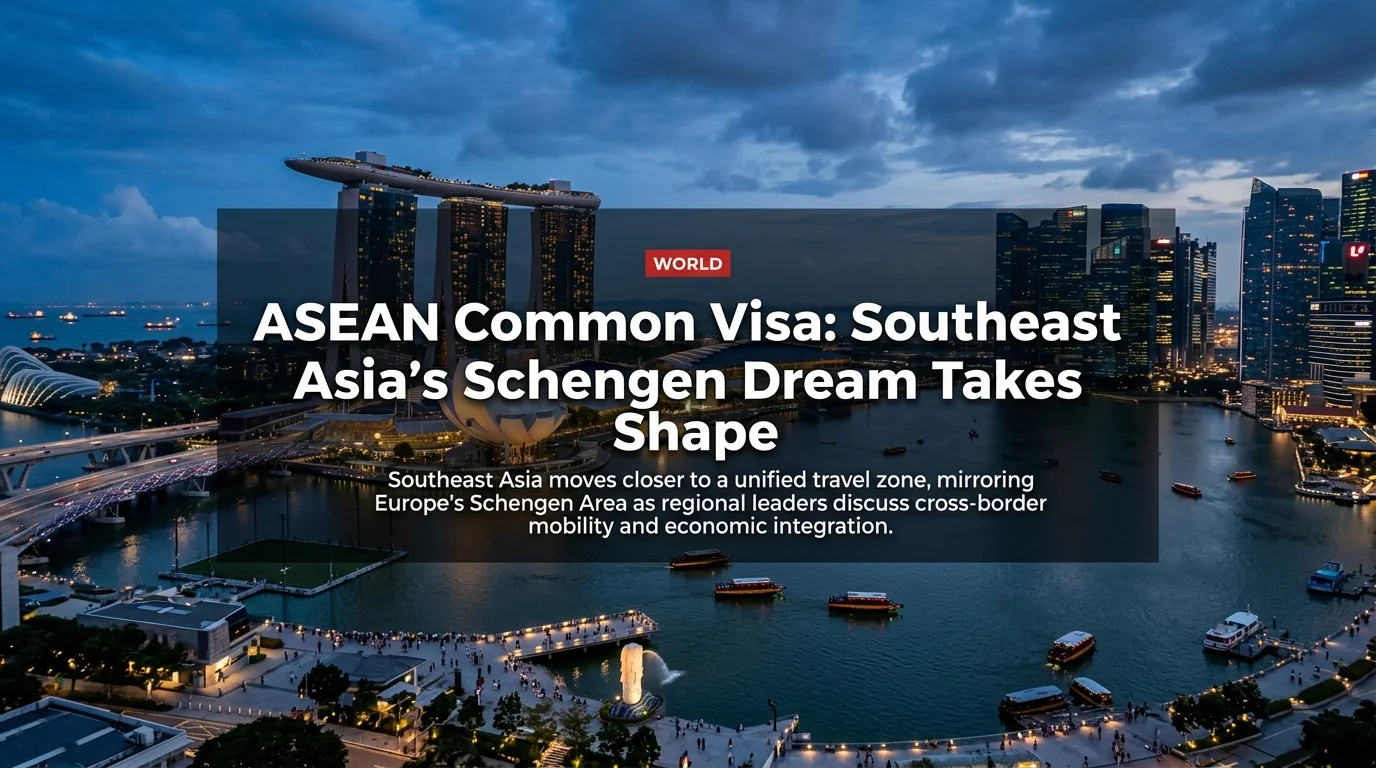
Six countries, one visa, 70 million tourists a year — Southeast Asia's most ambitious travel experiment since the creation of ASEAN itself is moving from conference-room talk to concrete digital infrastructure.
The ASEAN Common Visa (ACV), a Schengen-style unified travel document for international tourists visiting multiple Southeast Asian nations, reached a critical milestone at the January 2026 ASEAN Tourism Forum in Cebu. Tourism ministers formally elevated it to a core pillar of the ASEAN Tourism Strategic Plan 2026–2030, shifting the project from aspirational rhetoric to funded roadmap.
What the Common Visa Actually Is
The concept is straightforward: apply once, visit six (or eventually ten) countries. Instead of navigating separate visa applications for Thailand, Vietnam, Cambodia, Malaysia, Laos, and Myanmar, a tourist from India or Brazil would submit a single digital application and receive a 90-day multi-country visa.
- **Coverage:** Thailand, Cambodia, Laos, Malaysia, Myanmar, Vietnam — with Brunei, Philippines, and Singapore in expansion talks
- **Duration:** 90-day proposed validity across all participating nations
- **Application:** Single digital window, modeled on the EU's unified system
- **Target launch:** Phased pilot in late 2026, full rollout by 2028
- **Cost structure:** Thailand's 300-baht (~$9) tourism fee likely integrated into the visa price
The initiative directly mirrors Europe's Schengen Agreement, which eliminated internal border checks between 29 countries and now processes over 10 million visa applications annually.
The Economic Case
The numbers driving this initiative are hard to ignore.
The post-COVID math is brutal: Southeast Asian tourism recovered to only 84% of 2019 levels by late 2024. The region is bleeding market share to competitors who moved faster — the Middle East's tourism boom, Japan's weak-yen surge, and China's aggressive visa liberalization are all eating ASEAN's lunch.
*International tourist arrivals in 2023 (millions)*The key insight, articulated by Philippine Tourism Secretary Christina Garcia Frasco, is that Southeast Asian countries have been competing against each other when the real competition is China, India, and the Gulf states: "Collaboration is healthier than competition. Treating ASEAN as a single destination is the only way to compete with giants."
Who's Driving It — and Who's Dragging Their Feet
Thailand is the clear champion. Prime Minister Paetongtarn Shinawatra has made the ACV a centerpiece of Thailand's economic agenda, with the Tourism Authority of Thailand architecting the "Six Countries, One Destination" branding framework. Thailand's 80-million-tourist target for 2027 essentially requires the regional visa to succeed.
The Philippines, under its 2026 ASEAN Chairmanship, is expected to push for a formal "Cebu Declaration" on unified regional mobility at the 48th and 49th ASEAN Summits this year.
The Hard Problems Nobody Has Solved Yet
For all the diplomatic momentum, the ACV faces obstacles that have killed previous ASEAN integration attempts.
- Massive tourism revenue boost across all six countries
- Simplifies travel planning, attracting long-haul visitors who currently skip the region
- Creates a unified brand to compete with EU, Middle East, and East Asian tourism powerhouses
- Digital infrastructure (e-Visa portals) already exists in most countries
- No standardized immigration criteria or data-sharing protocols between members
- Security risks from uneven border enforcement — particularly concerns about Myanmar
- ASEAN's track record on multilateral implementation is poor
- Singapore, Indonesia, and Brunei — the bloc's wealthiest members — are not yet committed
- "Chinese grey money" and transnational crime cited as risks by security analysts
Professor Thitinan Pongsudhirak of Chulalongkorn University, one of the region's most respected political analysts, has been consistently skeptical: the lack of standardized immigration criteria and data-sharing protocols remains "a massive technical hurdle" that no amount of ministerial enthusiasm can bypass.
The Myanmar problem is particularly thorny. A unified visa theoretically means entry granted by Myanmar — which has looser border controls and an ongoing civil conflict — would allow access to Thailand and Malaysia. Security experts from both countries have privately flagged this as a dealbreaker without robust data-sharing.
How It Compares to Europe's Schengen
| Feature | EU Schengen | ASEAN Common Visa (Proposed) |
|---|---|---|
| Countries | 29 | 6 (expanding to 10) |
| Annual visas processed | 10M+ | TBD |
| Validity | 90 days in 180 | 90 days (proposed) |
| Shared database | SIS II (centralized) | Not yet built |
| Years from proposal to launch | 10 (1985–1995) | In progress (2024–?) |
| Border enforcement | Standardized | Varies widely |
| Digital application | VIS system | Planned single window |
The comparison is instructive but also sobering. The Schengen Agreement took a decade to implement among countries that already shared the European Economic Community's institutional infrastructure. ASEAN's institutional framework is far lighter, built on consensus and non-interference rather than binding supranational law.
What Happens Next
Three milestones will determine whether the ACV becomes reality or joins the long list of ASEAN initiatives that died in committee:
1. The Cebu Declaration (2026 ASEAN Summits): A formal political commitment would lock member states into a timeline, making it harder to quietly withdraw.
2. E-Visa portal integration (late 2026): Participating countries need to link their digital visa systems into a "single window" application. Thailand's TDAC system is the most advanced and likely template.
3. The pilot expansion: The current Thailand-Vietnam-Malaysia pilot needs to demonstrate that processing times, security screening, and revenue sharing actually work before the broader bloc will commit.
The stakes are enormous — not just $12 billion in GDP and hundreds of thousands of jobs, but ASEAN's credibility as a bloc that can deliver results, not just communiqués. If the common visa launches successfully, it becomes the template for deeper economic integration. If it stalls, it confirms the critics' view that ASEAN's consensus model cannot produce transformative policy.
Southeast Asia's Schengen moment is closer than it has ever been. Whether "closer" means two years or twenty remains the region's most consequential open question.