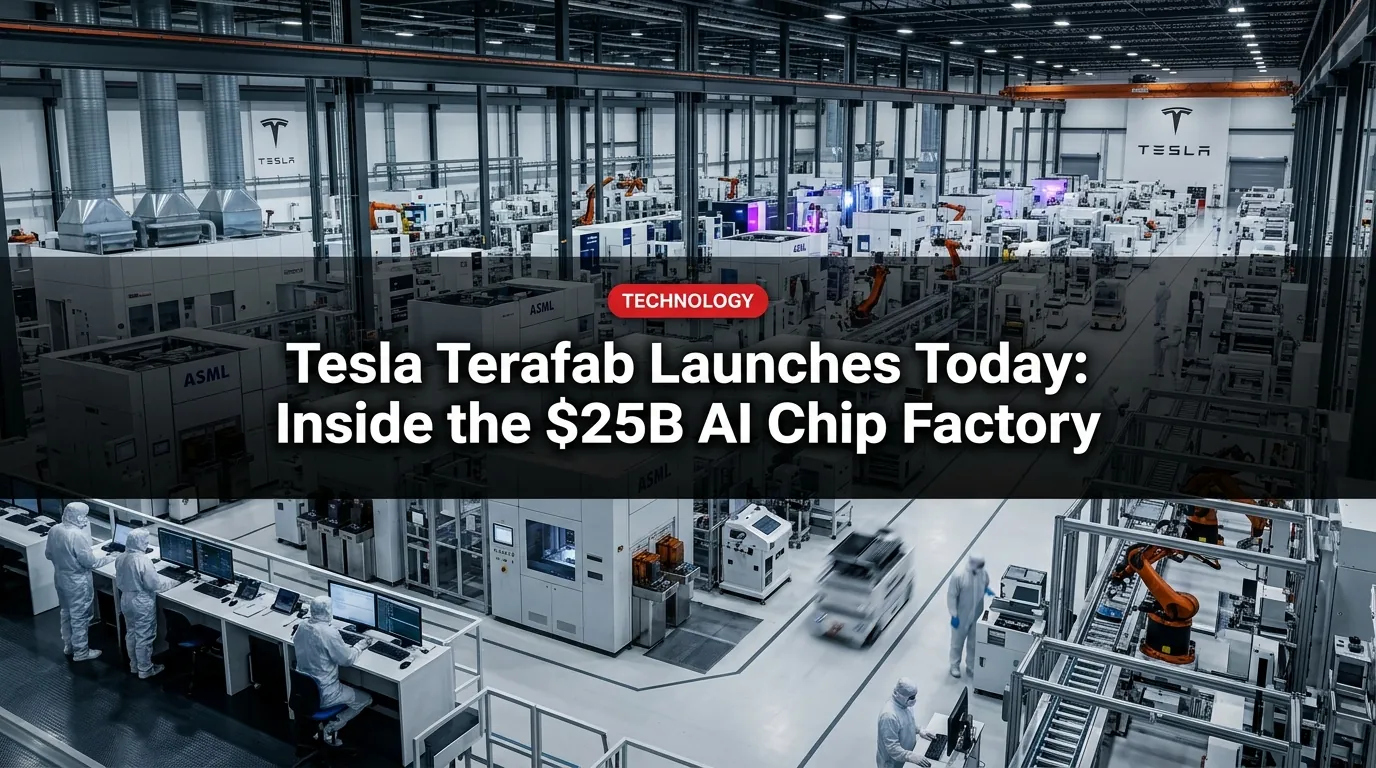
Tesla's most ambitious manufacturing gamble yet is officially underway. On March 21, 2026, the company broke ground on Terafab — a $25 billion semiconductor fabrication facility in Austin, Texas, designed to make Tesla the only automaker on Earth that designs and manufactures its own cutting-edge AI chips.
The stakes are enormous. If it works, Tesla frees itself from TSMC and Samsung, slashes chip costs for its robotaxi fleet, and sells surplus compute to competitors. If it fails, it becomes the most expensive science project in automotive history.
What Terafab Actually Is
Terafab is not a research lab. It's a full-scale semiconductor foundry targeting 2-nanometer process technology — the same bleeding-edge node that TSMC and Samsung have spent decades and hundreds of billions perfecting.
The facility will sit on Tesla's Giga Texas North Campus, where drone footage has confirmed site preparations rivaling the original Gigafactory footprint. First product off the line: the AI5 chip, which Tesla claims will deliver 50x more compute than its current AI4 while consuming just 150 watts — compared to Nvidia's H100 at 700 watts.
The AI5 Chip: Tesla vs. Nvidia
The performance claims are aggressive. Here's how Tesla's upcoming chip stacks up against the current industry standard:
| Specification | Tesla AI5 (Target) | Nvidia H100 | Tesla AI4 (Current) |
|---|---|---|---|
| Process Node | 2nm | 4nm | 5nm |
| Power Draw | 150W | 700W | ~250W |
| Compute vs. AI4 | 50x | ~15x | 1x |
| Memory Improvement | 9x over AI4 | — | Baseline |
| Manufacturing | In-house (Terafab) | TSMC | Samsung |
Why Tesla Is Building Its Own Fab
Three words: supply, cost, control.
Tesla's AI ambitions have exploded beyond what external foundries can accommodate. The company now needs chips for:
- Full Self-Driving — every Tesla on the road
- Cybercab — the autonomous robotaxi fleet launching in 2026
- Optimus — humanoid robots entering pilot production
- Dojo — Tesla's AI supercomputer for training
At Tesla's Q4 2025 earnings call in January, CFO Vaibhav Taneja confirmed that Terafab's budget is a "distinct, massive addition" to Tesla's existing capital expenditure — part of a record-breaking $20 billion+ CapEx plan for 2026.
The Skeptic's Case: Why This Might Fail
Building a cutting-edge chip fab from scratch is arguably harder than anything Tesla has attempted — including the Gigafactory, the 4680 battery cell, and Full Self-Driving combined.
- Eliminates dependency on TSMC and Samsung
- Custom chips optimized specifically for Tesla's inference workloads
- Surplus capacity can be sold to xAI, SpaceX, and external customers
- Long-term cost advantage if scale targets are hit
- Zero prior experience in semiconductor fabrication
- 4680 battery cell program missed targets by 80%+ — pattern risk
- 2nm process requires lithography expertise that takes decades to develop
- Key silicon talent (Peter Bannon, Ganesh Venkataramanan) already departed
- $25B is the *estimate* — fabs historically run over budget
Nvidia CEO Jensen Huang has reportedly cautioned that Tesla "may underestimate the decades of process expertise" required to operate a leading-edge fab. Industry analysts frequently compare Terafab to the 4680 battery cell program, which promised 100 GWh/year of production but delivered less than 20% of that target by early 2025.
The Timeline: From Groundbreaking to Gigascale
That final target — 1 million wafer starts per month — would represent roughly 70% of TSMC's entire current global output. It's a number so large that most semiconductor analysts have simply refused to model it.
The Ripple Effects
Terafab isn't just a Tesla story. If the project reaches even half its stated targets, the ripple effects hit multiple industries:
Commercial real estate investors are already seeing 15–25% rent premiums in Austin as the project drives demand for workforce housing, logistics facilities, and supporting infrastructure. TSMC and Samsung, meanwhile, face the prospect of losing one of their largest AI chip customers.
The Bottom Line
Terafab is either Tesla's masterstroke or its most spectacular overreach. The company is attempting something no automaker — and very few companies of any kind — has ever done: build a world-class semiconductor foundry from zero.
The $25 billion question isn't whether Tesla can break ground. That happened today. It's whether the company can do what only TSMC, Samsung, and Intel have managed in the last 40 years — and do it faster.
Musk has promised live drone footage of construction on X, inviting the world to watch in real time. For the first time in semiconductor history, a fab build will be a spectator sport.
KEY STAT: Tesla's Terafab targets 200 billion chips per year — more than Apple, Qualcomm, and AMD's combined annual orders from TSMC.