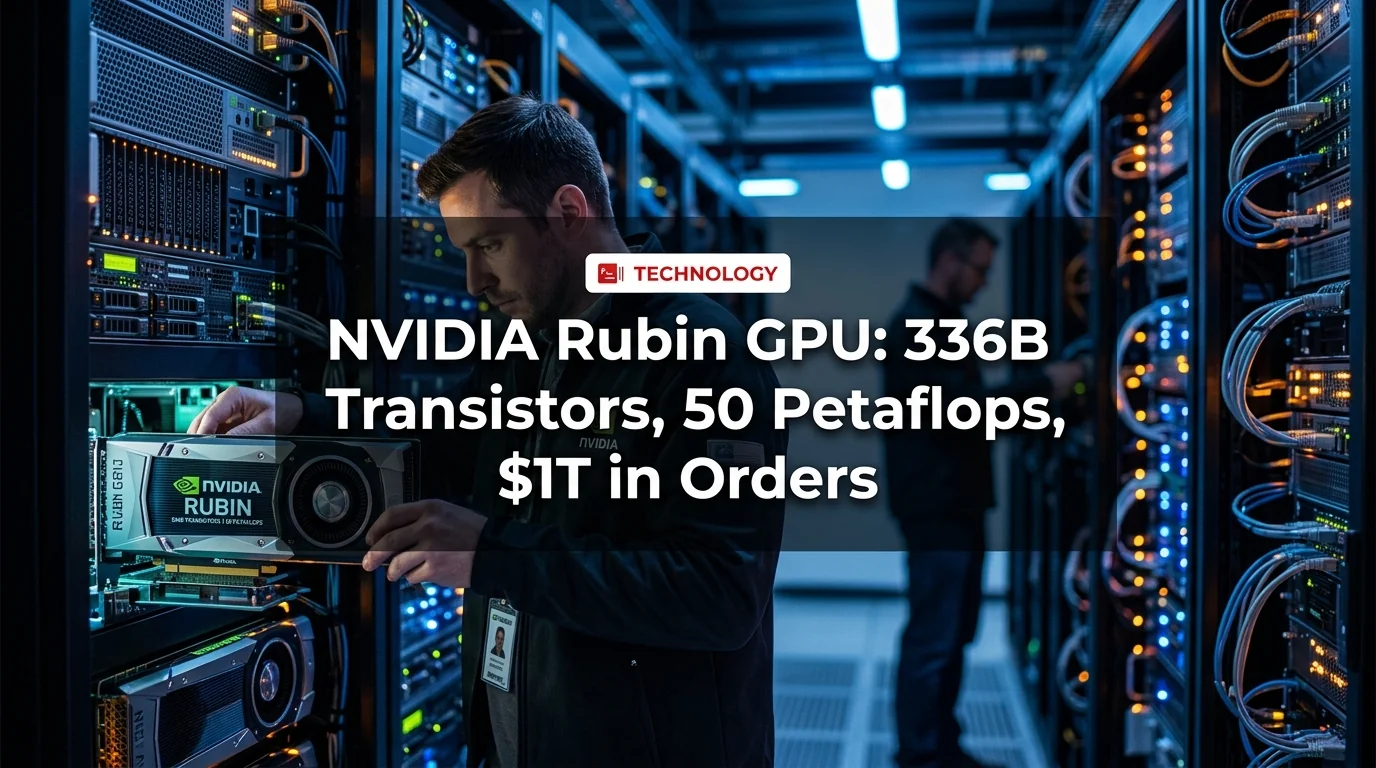
NVIDIA has officially launched the Rubin architecture at GTC 2026 — the most powerful AI chip platform ever built. With 336 billion transistors, 50 petaflops of compute per GPU, and $1 trillion in combined orders, Rubin isn't just an upgrade. It's a generational leap designed to power the transition from AI training to AI reasoning.
Here's everything you need to know.
- **336 billion** transistors per GPU (dual-die design)
- **50 petaflops** of FP4 compute — 5x over Blackwell
- **TSMC 3nm** (N3P) process node
- **HBM4 memory** with 22 TB/s bandwidth
- **10x cheaper** inference tokens vs. Blackwell
- Ships **H2 2026** to major cloud providers
Why Rubin Matters Now
Jensen Huang put it bluntly at GTC 2026: "AI now has to think. In order to think, it has to inference. The inflection point of inference has arrived."
The AI industry has shifted. Training massive models is table stakes. The bottleneck now is inference — running those models at scale, in real time, affordably. Rubin was built specifically for this moment.
The numbers back it up: NVIDIA projects $215 billion in FY2026 revenue, fueled by a $1 trillion combined order pipeline for Blackwell and Rubin systems through 2027.
The Six-Chip Platform
Rubin isn't a standalone GPU. It's a tightly integrated six-chip ecosystem where every component was designed to work together:
| Component | Function | Key Spec |
|---|---|---|
| Rubin GPU | AI training & inference engine | 50 petaflops FP4, 336B transistors |
| Vera CPU | Custom data center processor | 88 Olympus Arm cores, 1.2 TB/s memory |
| NVLink 6 Switch | GPU-to-GPU interconnect | 3.6 TB/s bidirectional bandwidth |
| ConnectX-9 SuperNIC | Network interface | 1,600 GB/s throughput |
| BlueField-4 DPU | Data processing & security | Hardware-accelerated storage |
| Spectrum-6 Switch | Ethernet switching | 102.4 Tb/s with co-packaged optics |
The Vera CPU deserves special attention. It's NVIDIA's first custom data center processor — 88 "Olympus" Arm-based cores with Armv9.2 compatibility, purpose-built for agentic AI workloads. This is NVIDIA saying it no longer needs Intel or AMD for the CPU side of its AI systems.
Rubin vs. Blackwell vs. Hopper
Three generations, three different eras of AI:
| Spec | Hopper (2022) | Blackwell (2024) | Rubin (2026) |
|---|---|---|---|
| Process Node | TSMC 4nm | TSMC 4nm | TSMC 3nm (N3P) |
| FP4 Compute | N/A | ~20 petaflops | 50 petaflops |
| Memory | HBM3 (3.35 TB/s) | HBM3e (8 TB/s) | HBM4 (22 TB/s) |
| Transistors | 80B | 208B | 336B |
| NVLink Speed | 900 GB/s | 1,800 GB/s | 3,600 GB/s |
| Primary Use | Training | Training + inference | Inference-first |
KEY STAT: Rubin delivers 35x higher throughput per megawatt when paired with Groq 3 LPUs — a direct answer to the power consumption crisis plaguing AI data centers.
The Groq Integration
One of the most surprising moves: NVIDIA integrated Groq's SRAM-based Language Processing Unit technology into the Rubin platform following a $20 billion acquisition. The Groq 3 LPU handles the "decode phase" of AI inference — the part where models generate tokens one at a time.
This solves what engineers call the memory wall. Traditional GPUs bottleneck on memory bandwidth during sequential token generation. Groq's SRAM-based approach eliminates that bottleneck, enabling real-time responses from trillion-parameter models.
Samsung manufactures the Groq 3 LPU, while SK Hynix and Samsung supply the HBM4 memory. TSMC handles the GPU fabrication using its most advanced 3nm process and CoWoS packaging.
The Supply Chain Power Play
NVIDIA isn't just building better chips — it's locking down the manufacturing pipeline. According to SemiAnalysis, NVIDIA has booked 50% of the world's advanced packaging capacity at TSMC. That's a defensive moat: even if AMD or custom silicon competitors design competitive chips, they can't get them built at scale.
Analyst Daniel Ives called the $1 trillion pipeline evidence of demand "coming from every direction," with inference now the dominant cost driver. But not everyone is bullish — Ray Dalio has warned of an "AI bubble" at 80% euphoria, pointing to the unprecedented debt hyperscalers are accumulating.
What Ships When
The Vera Rubin NVL72 — the first full rack-scale system — integrates 72 Rubin GPUs and 36 Vera CPUs. Scale that up to the Vera Rubin POD, and you're looking at 1,152 GPUs across 40 racks delivering 60 exaflops of compute.
The Bigger Picture
NVIDIA has shifted from a two-year release cycle to an annual "rhythm." Rubin in 2026, Rubin Ultra in 2027, Feynman in 2028. Each generation roughly doubles performance. The company is treating GPU architectures like iPhone releases — constant, predictable, and each one making the last look obsolete.
The naming convention tells the story: Hopper (computing pioneer), Blackwell (statistician), Rubin (dark matter discoverer), Feynman (quantum physics legend). NVIDIA sees itself not just building chips, but building the infrastructure for a new kind of intelligence.
Whether the $1 trillion in orders represents genuine sustained demand or peak-cycle euphoria remains the central question for investors. But for the AI industry, Rubin's message is clear: the era of inference has arrived, and NVIDIA built the hardware for it.
First reported at GTC 2026, San Jose. NVIDIA expects Vera Rubin NVL72 systems to reach Tier 1 cloud providers in the second half of 2026.