
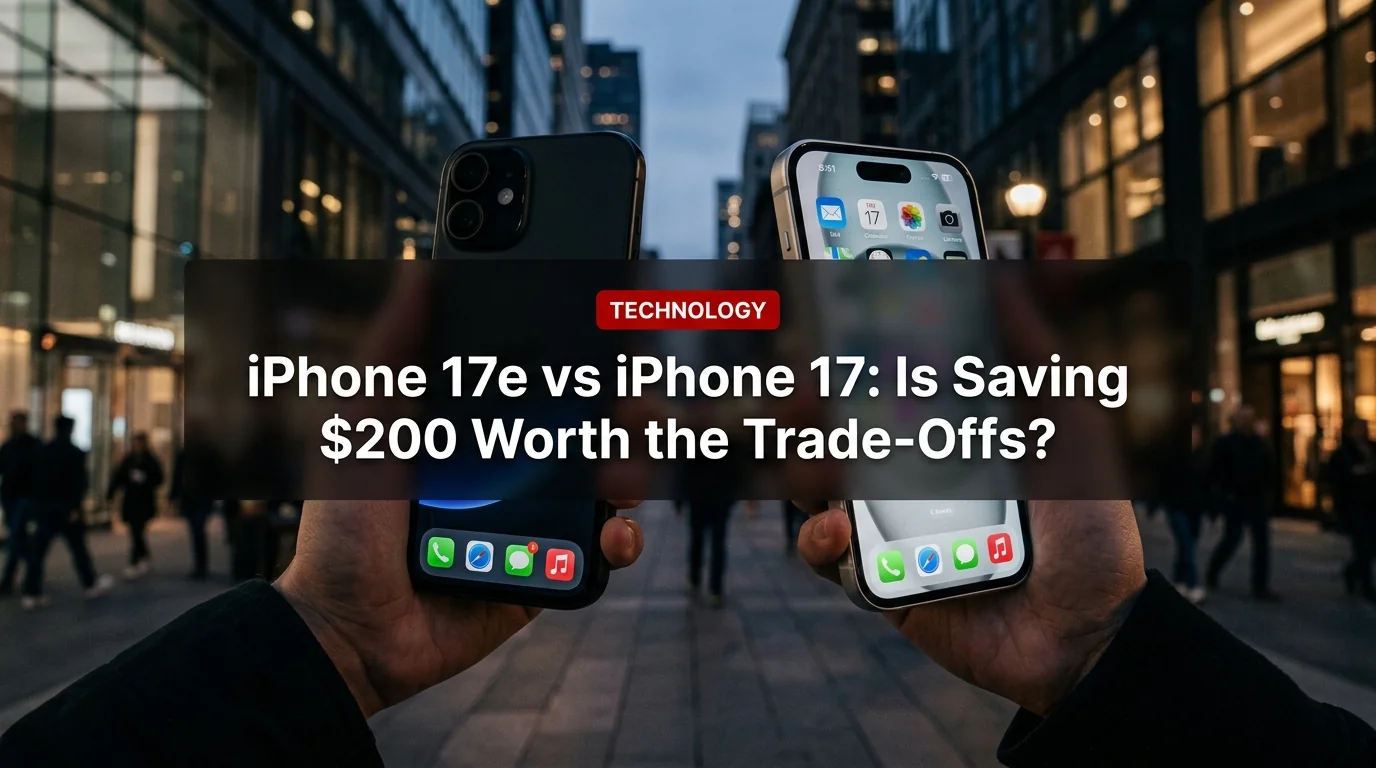
Apple's newest budget contender, the iPhone 17e, landed on March 11 at $599 — a full $200 less than the standard iPhone 17. Both phones run the same A19 chip and start at 256GB of storage, which raises an obvious question: what exactly are you giving up?
We dug into the specs, tested the trade-offs, and broke down every difference that actually matters.
The Price Gap at a Glance
Both models doubled their base storage to 256GB this generation — a welcome change that eliminates the old storage tax Apple used to impose on budget buyers.
Spec-by-Spec Breakdown
| Feature | iPhone 17e | iPhone 17 |
|---|---|---|
| Price | $599 | $799 |
| Display | 6.1" OLED, 60Hz | 6.3" OLED, 120Hz ProMotion |
| Design | Notch | Dynamic Island |
| Chip | A19 | A19 |
| Storage | 256GB | 256GB / 512GB |
| Rear Camera | 48MP single lens | 48MP + 48MP dual lens |
| Front Camera | 12MP | 18MP Center Stage |
| MagSafe | Yes (15W) | Yes |
| Wi-Fi | Wi-Fi 6 | Wi-Fi 7 |
| 5G Modem | C1X (no mmWave) | Apple networking chip |
| Always-On Display | No | Yes |
| Ceramic Shield 2 | Yes | Yes |
Where the iPhone 17e Wins
- Same A19 chip means identical app performance and Apple Intelligence support
- MagSafe finally comes to the budget line — 15W wireless charging and full accessory ecosystem
- 256GB base storage matches the flagship, double the iPhone 16e's 128GB
- C1X modem delivers 2x faster cellular speeds than the iPhone 16e's C1
- $599 is the lowest price for an A19-powered iPhone
The biggest story here is the A19 chip. Previous budget iPhones shipped with year-old silicon, but the 17e gets the same processor as its expensive sibling. That means full Apple Intelligence support — on-device Siri, writing tools, image generation, and notification summaries all run identically on both phones.
MagSafe compatibility is another genuine win. The iPhone 16e lacked it, forcing budget buyers into slower Qi charging and missing out on Apple's expanding accessory ecosystem. That's fixed now.
Where the iPhone 17 Pulls Ahead
The $200 premium buys three things that matter and a few that might not.
Display: 120Hz Changes Everything
- iPhone 17's 120Hz ProMotion makes scrolling, animations, and gaming visibly smoother
- Always-On Display shows time, widgets, and notifications without waking the screen
- Dynamic Island integrates live activities seamlessly into the UI
- iPhone 17e's 60Hz is noticeably less fluid once you've used 120Hz
- Notch design feels dated next to the Dynamic Island
- No Always-On Display means reaching for your phone more often
If you've never used a 120Hz phone, you won't miss it. If you have, the 17e's 60Hz panel will feel like stepping back in time. This is the single biggest experiential difference between the two phones.
Camera: One Lens vs Two
The iPhone 17e's 48MP Fusion camera takes genuinely good photos. It handles next-generation portraits and delivers optical-quality 2x telephoto through sensor cropping. Both phones shoot 4K Dolby Vision at 60fps.
But the iPhone 17 adds a second 48MP lens — an ultrawide — plus an upgraded 18MP front camera with Center Stage tracking. For anyone who shoots group photos, landscapes, or frequent video calls, the dual-lens system is a tangible upgrade.
- 48MP Fusion (single lens)
- Optical-quality 2x telephoto
- 12MP front camera
- 4K Dolby Vision @ 60fps
- 48MP + 48MP dual lens
- Dedicated ultrawide
- 18MP Center Stage front camera
- 4K Dolby Vision @ 60fps
Connectivity: Wi-Fi 7 and Beyond
The iPhone 17 supports Wi-Fi 7, which delivers faster speeds and lower latency on compatible routers. The 17e is stuck on Wi-Fi 6. For most home networks today, this won't matter. In two years, it might.
The 17e also lacks an Ultra Wideband chip, meaning no Precision Finding for AirTags or other UWB devices. And its C1X modem, while faster than last year's C1, doesn't support mmWave 5G — relevant mainly in dense urban areas with mmWave coverage.
Who Should Buy Which?
*iPhone 17e scores (out of 100, relative to iPhone 17)*Buy the iPhone 17e ($599) if:
- You're upgrading from an iPhone 14 or older and want a massive leap without spending $800
- Raw processing power matters more than display smoothness
- You take photos but don't need an ultrawide lens
- You want MagSafe without the flagship price
- Budget is a real factor in your decision
Buy the iPhone 17 ($799) if:
- You've used 120Hz and can't go back to 60Hz
- You shoot a lot of video or take group photos regularly
- Wi-Fi 7 future-proofing matters to you
- You use AirTags with Precision Finding
- The $200 difference doesn't meaningfully impact your finances
The Verdict
With the A19 chip, 256GB storage, MagSafe, and a capable 48MP camera, the iPhone 17e covers about 85% of what the standard iPhone 17 offers for 75% of the price. The missing 15% — the 120Hz display, dual cameras, Wi-Fi 7 — is real, but whether it's worth $200 depends entirely on your priorities.
For most people upgrading from an iPhone 15 or older, the 17e is the smarter buy. The money you save could go toward AirPods, a MagSafe charger, or simply staying in your pocket.
For the latest deals and carrier promotions, check Apple's trade-in estimator — the math might surprise you.