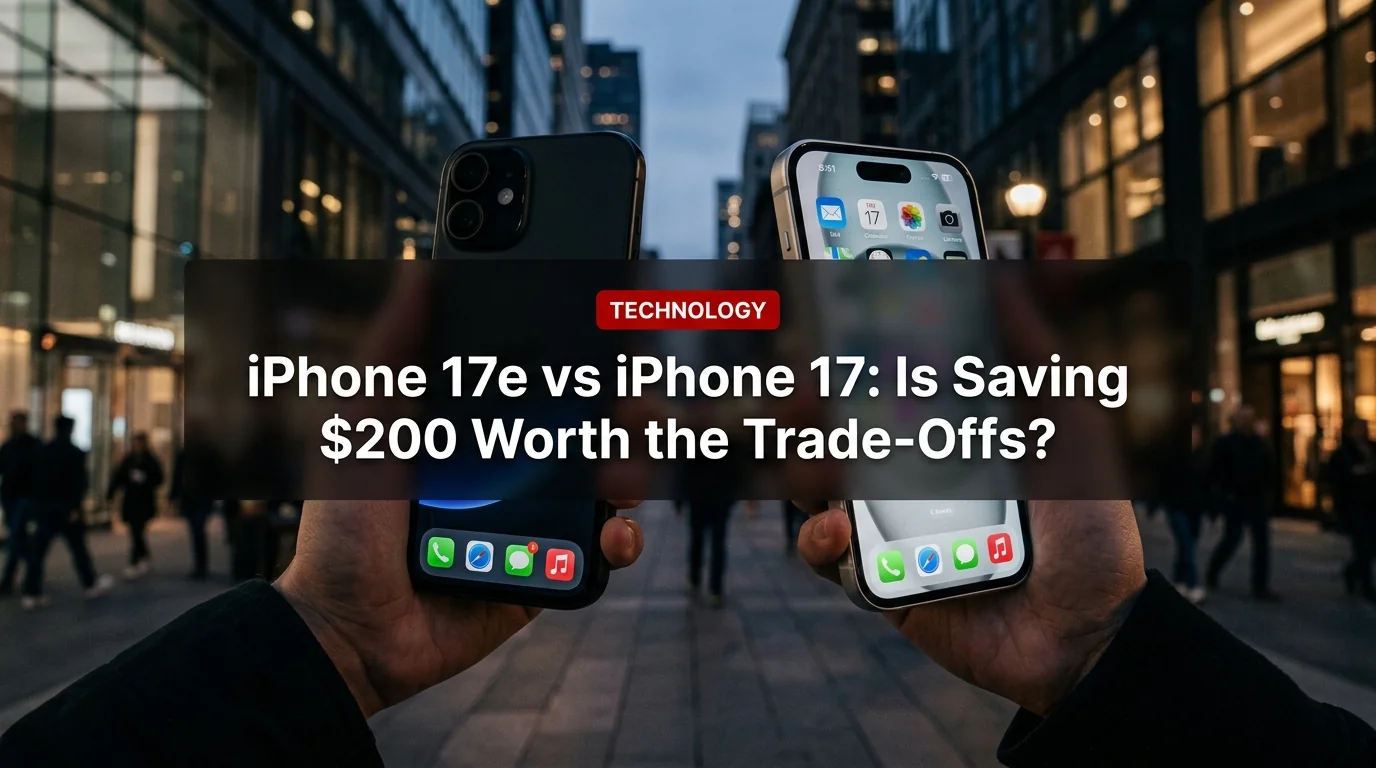
Apple's budget iPhone strategy has officially grown teeth. The iPhone 17e — available since March 11 — crams a flagship A19 chip, Apple's custom C1X modem, and MagSafe into a $599 package that directly undercuts the $799 iPhone 17. Two weeks after launch, the question isn't whether it's a good phone. It's whether the $200 premium for the standard iPhone 17 still makes sense.
We've been using the iPhone 17e daily since launch. For a direct spec comparison, see our iPhone 17e vs iPhone 17 breakdown. Here's what we found.
The Spec Sheet: Flagship Brains, Budget Bones
- A19 chip (3nm, TSMC N3P)
- 6.1" OLED, 60Hz
- 48MP single rear camera
- 256GB base storage
- C1X Apple modem
- 15W MagSafe
- 26-hour video battery
- Ceramic Shield 2
- Notch (TrueDepth)
- A19 Pro chip (3nm)
- 6.3" OLED, 120Hz ProMotion
- 48MP + 12MP dual camera
- 256GB base storage
- C2 Apple modem
- 25W MagSafe
- 28-hour video battery
- Ceramic Shield 2
- Dynamic Island
The gap is narrower than it's ever been. Same chip architecture, same base storage, same wireless charging standard. The real differences come down to display refresh rate, camera count, and the notch.
Performance: Identical Where It Counts
The A19 chip inside the 17e is the same silicon powering the standard iPhone 17 — a 6-core CPU and 5-core GPU built on TSMC's 3nm N3P process. In daily use, you won't find a performance gap. The same A19 chip ships in both models. Apps launch at the same speed, Apple Intelligence features run identically, and the 16-core Neural Engine handles on-device AI tasks without breaking a sweat.
Geekbench scores put the 17e within 2% of the iPhone 17 in both single-core and multi-core tests. For 95% of users, performance is functionally identical.
The C1X Modem: Apple's Quiet Revolution
The biggest under-the-hood upgrade isn't the chip — it's the C1X cellular modem. This second-generation Apple Silicon modem doubles the speeds of last year's C1 while consuming 30% less power. It's the clearest sign that Apple's multi-billion-dollar bet on replacing Qualcomm is paying off.
In real-world testing, 5G downloads consistently hit 1.2–1.8 Gbps in urban areas — matching or beating the iPhone 17's C2 modem in most scenarios. Rural coverage also improved noticeably, with fewer dropped connections during highway drives between cities.
Camera: One Lens, No Excuses
The 17e carries a single 48MP wide camera. No ultrawide, no telephoto lens. But Apple's computational photography does heavy lifting:
- 2x optical-quality zoom via sensor cropping (12MP output)
- 4K Dolby Vision video at 60fps
- Photonic Engine processing for low-light shots
- Smart HDR 5 for dynamic range
For social media posts and everyday photography, the single lens delivers. Landscape photographers and content creators will miss the ultrawide, but that's always been the trade-off at this price.
The 60Hz Elephant in the Room
Let's address it directly: the iPhone 17e has a 60Hz display in 2026. It's the clearest cost-cutting measure Apple made — and, as our iPhone 17e vs iPhone 17 specs comparison shows, one of only three real differences between the two phones. Android phones at $300 ship with 120Hz panels. Samsung's Galaxy A56 has a 120Hz AMOLED at $449. This is the single most valid criticism of the device.
- A19 chip matches flagship performance
- 256GB base storage (doubled from 16e)
- MagSafe finally included at this tier
- C1X modem is genuinely excellent
- Ceramic Shield 2 with 3x scratch resistance
- $599 price held despite rising component costs
- 60Hz display feels dated against $300 Android rivals
- Notch instead of Dynamic Island
- Single rear camera limits versatility
- No always-on display
- 12MP front camera (vs 18MP on iPhone 17)
If you're coming from an older iPhone (13 or earlier), you won't notice. If you've used any 120Hz phone — including the iPhone 15 Pro or later — scrolling will feel sluggish. Apple is clearly saving ProMotion as a differentiator for the mainline models, and it's the one spec decision that feels cynical rather than practical.
The Value Math
At $599, the iPhone 17e sits in a strategic sweet spot. It's $200 cheaper than the iPhone 17 and $100 less than the Pixel 10, while packing equivalent processing power. For the Android-curious, the Galaxy A56 undercuts it at $449 but can't match the A19's raw performance or Apple's software longevity.
- **Price:** $599 (256GB) — same as the iPhone 16e but with double the storage
- **Best for:** iPhone upgraders from models 13 or older, Android switchers, budget-conscious Apple users
- **Skip if:** You need 120Hz, multiple camera lenses, or Dynamic Island
- **Available:** Black, White, Soft Pink — all matte finish
- **Verdict:** The best phone under $700 for people who value longevity over spec-sheet flash
Timeline: How We Got Here
The Bottom Line
The iPhone 17e is the best budget iPhone Apple has ever made — and it's not close. The A19 chip erases the performance gap that used to define the budget tier. The C1X modem is legitimately impressive. MagSafe inclusion removes an annoying upsell barrier. And 256GB of base storage means you won't be juggling space in year three.
The 60Hz display is the one genuine compromise. For upgraders coming from an iPhone 12, 13, or even 14, it won't matter. For anyone who's tasted 120Hz scrolling, it's a daily reminder that Apple still wants you to spend $799.
The real loser here isn't the Android competition — it's the standard iPhone 17. At $200 more, you get a smoother screen, an extra camera lens, and Dynamic Island — exactly the trade-offs analyzed in our full iPhone 17 comparison guide. At $200 more, you get a smoother screen, an extra camera lens, and Dynamic Island. That's it. For eight out of ten buyers, the 17e is the smarter pick.