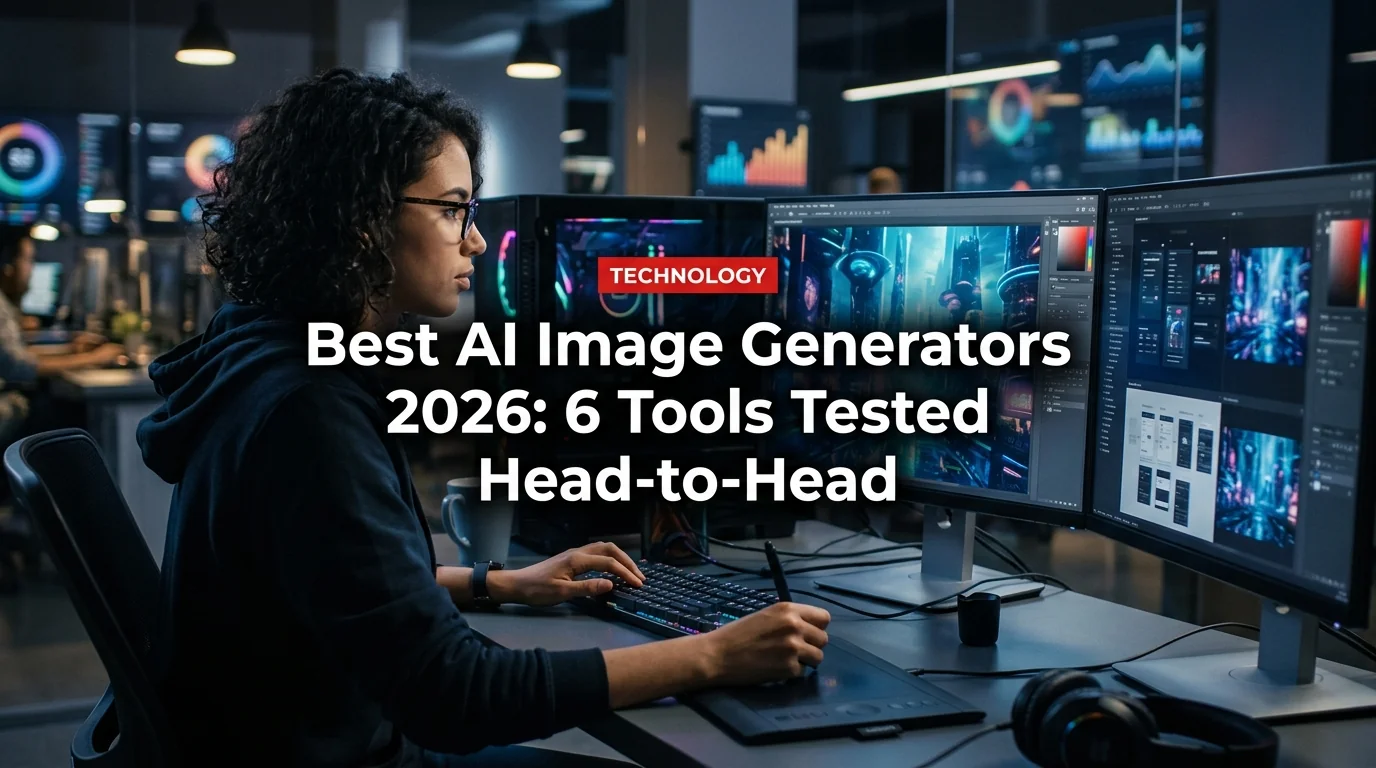
The AI image generation market is projected to hit $484 million in 2026 — and the tools available today would have been science fiction two years ago. We tested the six leading generators across photorealism, text rendering, speed, and pricing to find out which ones are actually worth your money.
The 2026 Landscape Has Fundamentally Changed
Forget everything you knew about AI image generators in 2024. The entire architecture has shifted. Models no longer just "diffuse" noise into images — they reason about scenes before rendering a single pixel. ByteDance's Seedream 5.0 uses Chain of Thought visual reasoning. OpenAI rebuilt DALL-E from the ground up as GPT Image 1.5, embedding generation directly into its multimodal reasoning engine.
The result: hands finally look right, text actually renders correctly, and physics makes sense. We've crossed the uncanny valley.
Head-to-Head: The Complete Comparison
| Feature | GPT Image 1.5 | Midjourney v8 | Stable Diffusion 4 | FLUX 2 | Nano Banana Pro | Adobe Firefly 5 |
|---|---|---|---|---|---|---|
| ELO Score | 1,264 | ~1,200 | ~1,150 | ~1,180 | 1,235 | ~1,100 |
| Max Resolution | 2K | 4K | 4K (Ultra) | 4MP native | 2K | 2K |
| Text Accuracy | 85%+ | 70% | 75% | 82% | 78% | 80% |
| Hand Accuracy | 92% | 90% | 88% | 91% | 93% | 85% |
| Speed | ~6 sec | ~3 sec | ~8 sec | ~4.5 sec | ~5 sec | ~7 sec |
| Open Source | No | No | Yes | Partial | No | No |
| Local Use | No | No | Yes | Yes (Klein) | No | No |
| Commercial Safe | Yes | Yes | License req. | License req. | Yes | Industry standard |
The Top 3, Ranked
1. GPT Image 1.5 — Best Overall
OpenAI's complete rebuild of DALL-E isn't just an upgrade — it's a different product. By embedding image generation directly into GPT-4o's reasoning engine, it understands what you want before it renders. Complex scenes with multiple subjects, specific spatial arrangements, and accurate text? It nails them consistently.
- Highest benchmark score ever recorded (1,264 ELO)
- Best text rendering accuracy in the industry
- Conversational refinement through ChatGPT — describe changes in plain English
- Included in the $20/month Plus plan
- No local or offline option
- Limited fine-tuning capabilities
- Strict content policies block certain creative use cases
- 2K max resolution trails competitors
Price: Included in ChatGPT Plus ($20/month) or $0.035/image via API.
2. Midjourney v8 — Best for Creative Work
The March 17 alpha release of v8 renders 4-5x faster than v7 while pushing into native 4K territory. Midjourney's signature strength — that unmistakable aesthetic quality — hasn't been diluted by the speed gains. For mood boards, concept art, and visual storytelling, nothing else comes close.
Price: $10-$60/month depending on plan. No free tier.
3. FLUX 2 — Best for Photorealism
Black Forest Labs (valued at $3.25 billion) built FLUX 2 for one purpose: making images that look like photographs. Multi-reference consistency lets you feed up to 10 reference images, maintaining identity across generations. Product photographers and e-commerce teams are switching in droves.
Price: FLUX Dev is free and open-weight. FLUX 2 Pro starts at $0.04/image via API.
The Specialist Picks
- Free and open source
- Full local control — runs on RTX 3090
- New Diffusion Transformer (DiT) architecture
- Massive community ecosystem of LoRAs and extensions
- Requires technical setup
- Industry standard for IP-safe commercial content
- Now hosts 30+ models (Kling, Runway, Google Veo)
- Custom Models for brand-consistent generation
- Integrated into Creative Cloud workflow
- Premium pricing, less creative freedom
Pricing Breakdown
Prices in USD. Per-image API costs shown as cents; subscription plans shown as monthly rate.
The Legal Landscape Is Shifting
Two major rulings are reshaping how these tools operate. On March 4, 2026, the U.S. Supreme Court declined to hear the Thaler v. Perlmutter case, confirming that purely AI-generated images cannot receive copyright protection. Two weeks later, a Munich court reached the same conclusion for AI-generated logos.
Meanwhile, the EU Parliament's March 10 resolution proposes a flat-rate licensing fee of 5-7% of global turnover for AI companies to compensate original creators.
- AI-generated images cannot be copyrighted in the US or EU
- EU proposes 5-7% revenue fee on AI companies for creator compensation
- Adobe Firefly remains the safest choice for commercial use — trained exclusively on licensed content
- Models offering "Custom Models" training (Adobe, Stability) let artists protect and monetize their own style
What's Coming Next
The line between image and video generation is dissolving. Kling 2.5 Turbo and Sora 2 can animate any generated still into 1080p cinematic motion in seconds. By mid-2026, expect "generate an image" and "generate a video" to be the same button.
Local generation is also surging back. FLUX 2 Klein runs on a standard RTX 3090, ending total reliance on cloud APIs. Stability AI's SD4 is free for personal use. The era of paying per pixel is ending for anyone willing to invest in hardware.
The Bottom Line
If you want one tool that does everything well: GPT Image 1.5. If you're a creative professional: Midjourney v8. If you need photorealistic product shots: FLUX 2. If you want total control and zero cost: Stable Diffusion 4. If you're an enterprise worried about IP: Adobe Firefly 5.
The best strategy in 2026? Use at least two. Each generator has a sweet spot, and the professionals getting the best results are the ones mixing tools — Midjourney for creative exploration, FLUX for final production renders, and GPT Image for anything requiring accurate text.
KEY STAT: The AI image generation market is growing at 17.4% CAGR, projected to reach $1.75 billion by 2034. These tools aren't a fad — they're the new Photoshop.