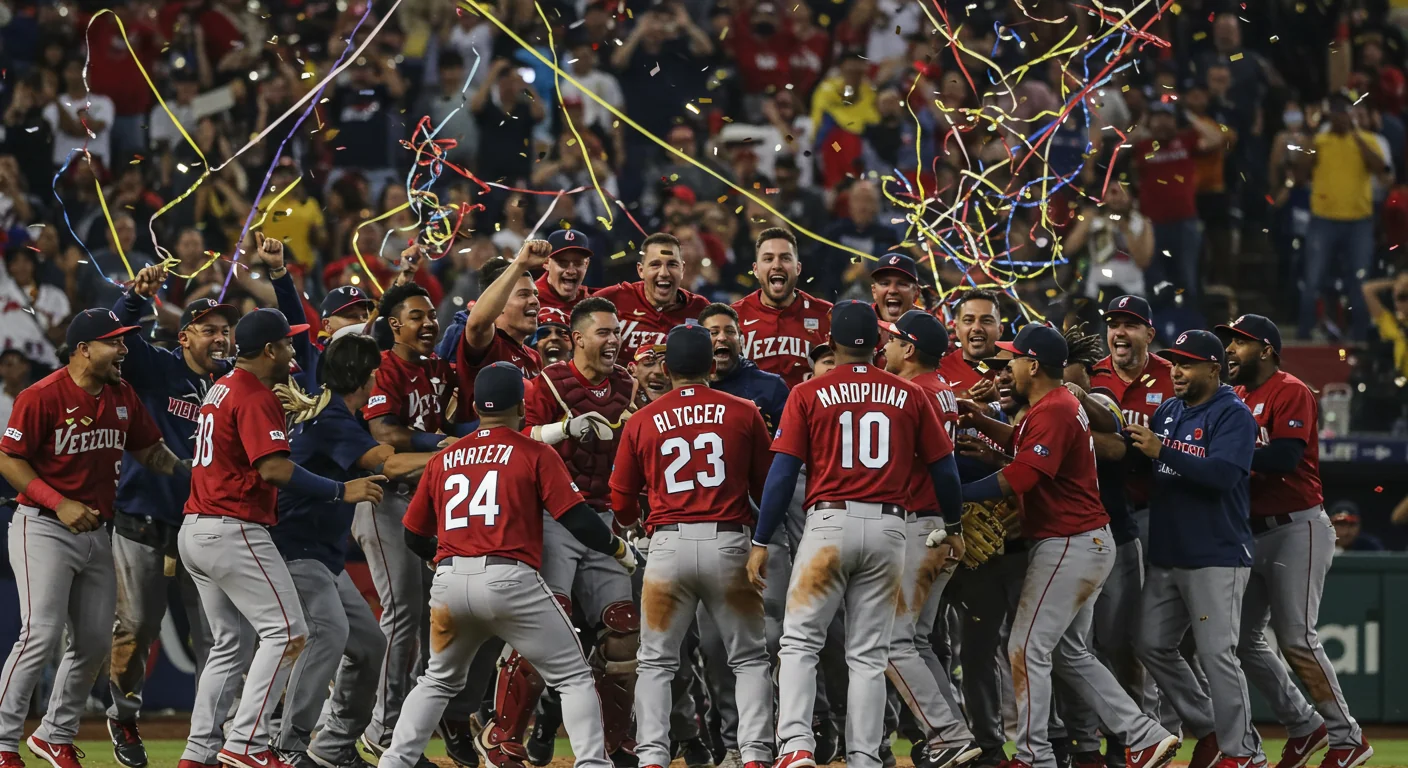
Venezuela stunned the United States 3-2 at loanDepot Park on March 17, claiming the country's first World Baseball Classic title in the tournament's 20-year history. Eugenio Suarez laced a go-ahead RBI double in the ninth inning, silencing a capacity Miami crowd that had erupted moments earlier when Bryce Harper launched a game-tying solo home run off the upper deck facade.
The sixth edition of the WBC drew 1,619,839 fans across four host cities, a 24 percent jump from 2023, and delivered the kind of drama that MLB Commissioner Rob Manfred has spent years hoping the tournament would produce.
Nine Innings That Rewrote Venezuelan Baseball
Venezuela entered the final as underdogs. Their quarterfinal upset of defending champion Japan, an 8-5 dismantling in Miami on March 14, ended Japan's streak of reaching every semifinal since the tournament's inception in 2006. But beating the host Americans in their own ballpark carried different weight.
For seven innings the game was a pitchers' duel. Venezuela scratched across two runs on sacrifice flies and groundouts, the kind of small-ball execution that defined their tournament identity. The Americans, managed by Mark DeRosa, struggled to string hits together against a Venezuelan bullpen that had allowed just four earned runs in three elimination games.
Then Harper connected in the eighth. The ball traveled 421 feet. The stadium shook. Social media declared the comeback underway.
KEY STAT: Harper's home run was the hardest-hit ball of the entire tournament at 114.7 mph exit velocity.
It lasted one half-inning. Suarez, who had been hitless in his previous eight at-bats, drove a first-pitch slider into the right-center gap. The Venezuelan dugout emptied onto the top step. Closer Luis Rengifo retired the side in order in the bottom of the ninth. Venezuela's players piled onto each other near the mound while Miguel Cabrera, serving as hitting coach in what he called his final act in professional baseball, wept in the dugout.
The Numbers Behind the Spectacle
The 2026 WBC shattered every benchmark the tournament had set.
FOX Sports broadcast all 47 games in the United States, with the semifinal between the Americans and the Dominican Republic averaging 7.37 million viewers on FS1 and FOX Deportes, the most-watched WBC game in history until the final surpassed it. Netflix paid a reported sum exceeding $100 million for exclusive rights in Japan, a deal that reflected the tournament's growing commercial footprint in Asia.
The financial returns extended beyond broadcast revenue. San Juan, which hosted 10 pool-play games at Hiram Bithorn Stadium, projected $43.8 million in total economic impact. Puerto Rico's government estimated a $29 million return on a $5 million public investment.
Italy's Espresso-Fueled Run and Other Surprises
Venezuela's title was the headline, but Italy's semifinal appearance may prove more consequential for the sport's global trajectory. Managed by Francisco Cervelli, the Italian squad brought a dugout espresso machine, an underdog mentality, and Vinnie Pasquantino, who became the first player in WBC history to hit three home runs in a single game during a pool-play demolition of Mexico.
Italy's run to the final four validated years of European baseball development investment. The performance will factor into discussions about expanding the tournament's footprint beyond its traditional strongholds in the Americas and East Asia.
- Venezuela's first WBC title in six editions
- Japan failed to reach the semifinals for the first time
- Italy made its first semifinal appearance
- Tournament served as a 2028 LA Olympics qualifier
Japan's early exit was equally significant. Shohei Ohtani delivered highlight-reel moments, including a grand slam against Chinese Taipei, but Venezuela's quarterfinal ambush exposed defensive vulnerabilities that Japan's pitching staff could not overcome. It marked the first time Japan failed to reach the semifinals, ending a run that had included two championships and three runner-up finishes.
DeRosa Under Fire, Manfred Looking Ahead
The loss triggered immediate scrutiny of DeRosa's management. Critics questioned why high-leverage reliever Mason Miller was unavailable in the ninth inning after Harper's home run had shifted momentum. DeRosa declined to detail his bullpen decisions in the postgame press conference, saying only that his pitching staff had given the team a chance to win.
The criticism highlighted a persistent tension in the WBC: American teams frequently field rosters heavy on star position players but lack the cohesive pitching strategy that smaller nations build through months of preparation. One columnist contrasted the Venezuelan dugout's drums-and-dancing energy with what he described as American players who looked like "toy soldiers."
Manfred, however, framed the tournament's success in broader terms. "I didn't think it was going to get this big this fast, but it is a real jewel," he said. "A big part of the growth of the game going forward."
What Comes Next for International Baseball
The 2026 WBC's immediate legacy is already being written. Venezuela and the Dominican Republic have secured berths in the 2028 Los Angeles Olympic baseball tournament as the top two finishers from the Americas, excluding host nation USA.
Manfred indicated that MLB is seriously considering moving the next WBC, tentatively scheduled for 2029 or 2030, to midseason around the All-Star break. The shift would address longstanding concerns from teams about pitcher injuries during spring training, a complaint that has dampened roster participation since the tournament's founding.
The timing of that decision intersects with labor negotiations. The current collective bargaining agreement between MLB and the players' association expires December 1, 2026. Tony Clark, the MLBPA's executive director, has signaled that the WBC's commercial success will become a leverage point in talks about how international revenue is shared.
For Venezuela, the policy debates can wait. In Caracas, Maracaibo, and Valencia, the celebrations that began on March 17 have not stopped. The country that produced Miguel Cabrera, Felix Hernandez, and Jose Altuve now holds the trophy that had eluded Latin American baseball's most passionate fan base for two decades. Suarez's ninth-inning double will be replayed on Venezuelan television for years.
The WBC set out to prove that baseball could generate the same multinational fervor as the FIFA World Cup. After Miami, that argument no longer requires qualifiers.