The European Super League — football's most ambitious and divisive breakaway project — is officially dead. Real Madrid, the last club standing, reached a reconciliation deal with UEFA on February 11, 2026, ending a five-year war that reshaped European football governance forever.
Here's what happened, why it mattered, and what comes next.
The Final Score
What Just Happened
On February 7, 2026, FC Barcelona formally withdrew from the Super League Company. Four days later, Real Madrid president Florentino Pérez — the project's architect from day one — announced an "agreement of principles" with UEFA. The €4.5 billion damage claim was dropped. The legal battles were over.
The Unify League, as it was rebranded in December 2024, never played a single match.
The Full Timeline
The Key Players
| Name | Role | Side |
|---|---|---|
| Florentino Pérez | Real Madrid president, chief architect | Super League |
| Joan Laporta | Barcelona president, key backer (until Feb 2026) | Super League |
| Bernd Reichart | CEO, A22 Sports Management | Super League |
| Aleksander Čeferin | UEFA president | Opposition |
| Javier Tebas | La Liga president | Opposition |
| Fan groups (England, Germany) | Organized protests, "Earn It" campaigns | Opposition |
Why It Failed — Three Times
The Super League died not once, but three times. Each death was different.
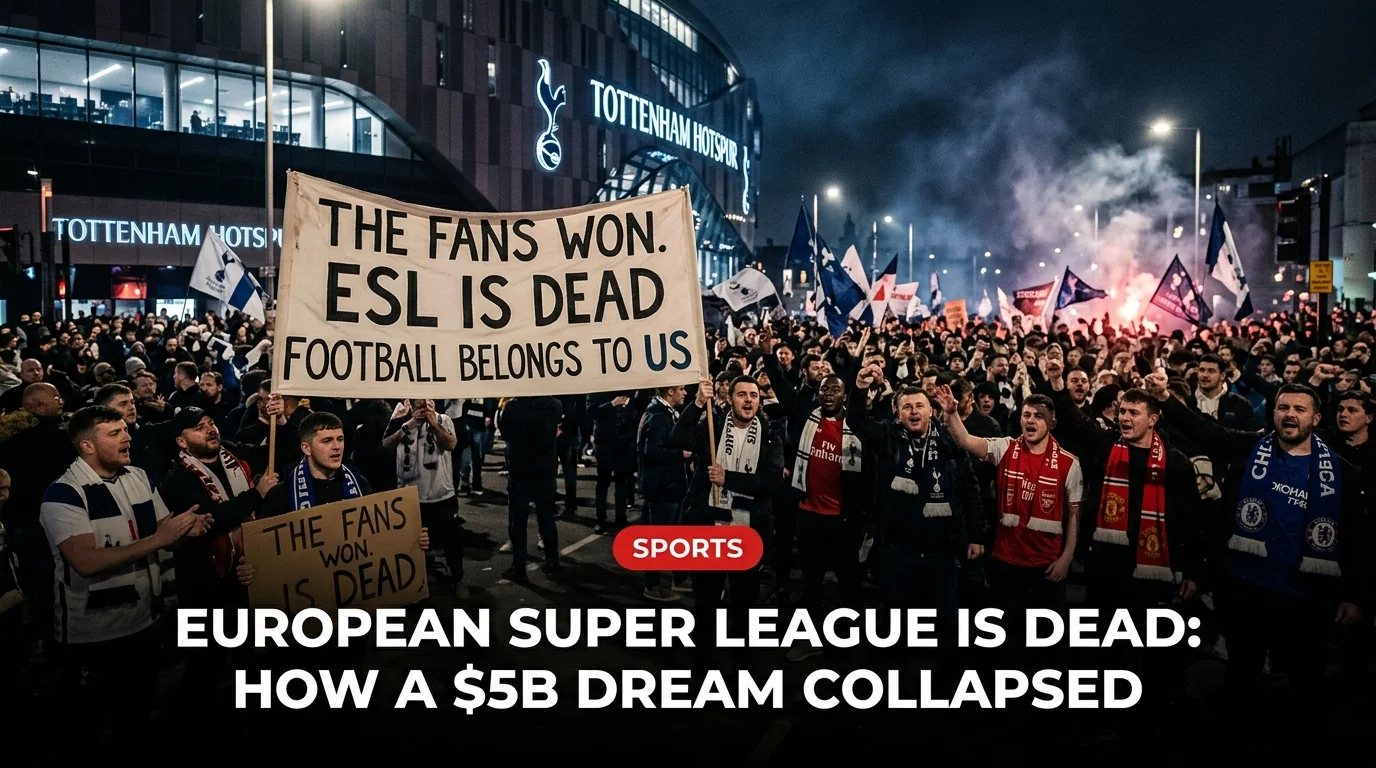
Death #1 (April 2021): Fan revolt. The original 12-club announcement lasted 48 hours. English fans organized protests within hours. Politicians condemned it across Europe. Nine of the 12 founding clubs withdrew before the weekend was over.
Death #2 (2024–2025): No one showed up. The Unify League rebrand tried to fix the original sin — the closed-shop format — by proposing merit-based qualification for 96 clubs. But no club outside Barcelona and Real Madrid committed. A22's finances cratered. Revenue dropped 78% in a single year.
Death #3 (February 2026): The money ran out. With A22 in technical bankruptcy and Barcelona gone, Pérez chose pragmatism over principle. The reconciliation deal reportedly gives Real Madrid a seat at the table for UEFA's future governance reforms.
KEY STAT: A22's revenue collapsed 78% in one year — from €3.3M in 2023 to just €720K in 2024 — while operating costs ballooned to €6 million.
What the Super League Got Right (and Wrong)
- **Right:** Identified real problems — UEFA's revenue distribution is lopsided, and elite clubs face genuine financial pressure (Barcelona held €1.2B in debt).
- **Right:** The ECJ ruling proved UEFA's monopoly was legally indefensible.
- **Wrong:** Never solved the trust problem. No club beyond the Real Madrid-Barcelona axis committed.
- **Wrong:** The "for the fans" messaging rang hollow when fans were the loudest opposition.
- **Wrong:** A22's finances made the project look unserious — you can't build a multi-billion-dollar league on €720K in revenue.
The Winners and Losers
| Winners | Losers | |
|---|---|---|
| Clubs | UEFA loyalists who kept their CL spots | Real Madrid, Barcelona (5 years of distraction) |
| Organizations | UEFA (monopoly challenged but intact) | A22 Sports (faces likely liquidation) |
| Fans | Supporter groups who killed it twice | — |
| Money | UEFA's €5.1B 2026/27 cycle | La Liga (would have lost 55% of value per KPMG) |
What Happens Now
The Super League is dead, but the problems it tried to solve aren't. UEFA has responded with three moves:
- Expanded Champions League: The "Swiss Model" format with 36 teams launched in 2024, offering more matches and revenue.
- Revenue sharing: UEFA projects €5.1 billion for the 2026/27 cycle, with 97% redistributed into the football pyramid.
- Governance reform: Real Madrid and Barcelona are expected to rejoin UEFA's executive committees as part of the reconciliation deal.
A22 Sports Management, the company that spent five years and millions of euros trying to break UEFA's grip, faces likely liquidation or a pivot to streaming technology.
The lesson? In football, the fans still have veto power. The Super League had the courts, the money, and the legal arguments. It never had the people.
This article draws on reporting from The Guardian, AP News, Sports Business Journal, SportsPro Media, and official statements from UEFA and A22 Sports Management.