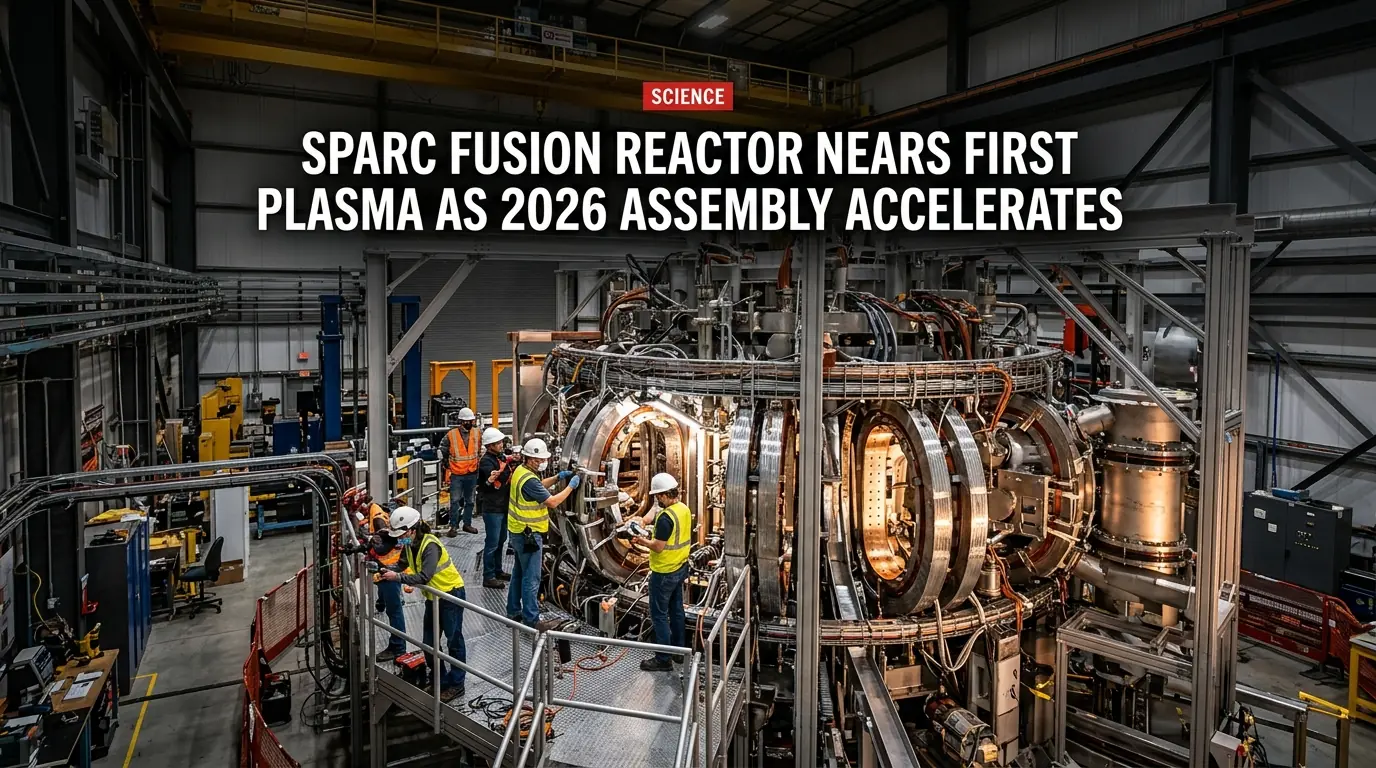
Commonwealth Fusion Systems is assembling the most ambitious private fusion machine ever built. The SPARC reactor in Devens, Massachusetts — roughly 70% complete — is on track for first plasma by late 2026 and net energy gain by early 2027.
If it works, it will be the first privately funded device to produce more energy from fusion than it consumes. That milestone, measured as Q > 1, has eluded physicists for seven decades.
Why SPARC Changes the Fusion Equation
For decades, the path to fusion ran through massive, government-funded megaprojects. ITER, the international flagship reactor in southern France, weighs 23,000 tonnes, spans 180 hectares, and has ballooned to an estimated $45–65 billion. First plasma is now pushed to 2033 at the earliest.
SPARC takes the opposite approach. By using high-temperature superconducting (HTS) magnets made from YBCO tape, the reactor generates magnetic fields of 20 Tesla — nearly double ITER's maximum. Stronger fields mean the plasma can be confined in a much smaller space.
The result: a device roughly 1/60th the volume of ITER that aims to match its performance.
- Size: ~3m diameter tokamak
- Volume: ~60x smaller than ITER
- Cost: ~$3 billion total program
- Magnetic field: 20 Tesla (at coil)
- First plasma: Late 2026
- Net energy target: Early 2027
- Funding: Private ($3B raised)
- Size: 24m tall, 30m wide
- Volume: 830 cubic meters
- Cost: $45–65 billion estimated
- Magnetic field: 12 Tesla max
- First plasma: 2033–2034 (revised)
- Net energy target: 2039 (D-T ops)
- Funding: 35 nations, public
The Magnet Breakthrough That Made It Possible
The turning point came on September 5, 2021, when CFS successfully tested a full-scale HTS magnet at 20 Tesla — the strongest fusion magnet ever built. That single demonstration validated the core physics behind SPARC and unlocked $1.8 billion in Series B funding, the largest investment round in fusion history.
The magnets use yttrium barium copper oxide (YBCO) tape that becomes superconducting at relatively high temperatures, eliminating the need for the extreme cooling systems that make conventional superconducting magnets so expensive and complex.
Assembly Timeline: What's Happening Now
The first toroidal field magnet was installed in January 2026. CFS plans to have all 18 in place by end of summer, followed by final assembly, vacuum testing, and cooldown procedures before the first plasma attempt.
The Money Behind the Machine
CFS has raised nearly $3 billion through private investment, making it the best-funded fusion startup in the world.
*Funding rounds in millions of dollars*Strategic backers include Italian energy giant Eni, which committed over $1 billion for future power from the planned ARC commercial plant. Google signed an agreement to purchase 200 MW from ARC. NVIDIA and Siemens built a digital twin of SPARC using AI simulation to optimize reactor operations before first plasma.
The Skeptics Have a Point
Not everyone is convinced SPARC will deliver on schedule — or at all.
- HTS magnet technology already proven at full scale
- Compact design dramatically reduces cost and build time
- $3B in private funding signals serious investor confidence
- NRC developing streamlined fusion regulatory framework by Oct 2026
- Digital twin collaboration with Google, NVIDIA may accelerate commissioning
- Intense neutron bombardment may damage internal walls and shorten machine lifespan
- Jump from SPARC demo to commercial ARC plant involves unproven engineering
- "Demountable" magnet joints — a key ARC feature — have never been tested at scale
- 10-second pulse operation is far from continuous power generation
- 70 years of fusion promises have taught the field to be cautious
Prof. Hartmut Zohm of the Max Planck Institute acknowledges the physics is "sound" but cautions that the engineering leap from SPARC to the commercial ARC plant — planned for Chesterfield County, Virginia — remains significant.
What Comes After SPARC
SPARC is a demonstration device. It won't generate electricity for the grid. That job falls to ARC (Affordable Robust Compact), the planned commercial follow-on reactor already being sited in Virginia.
The U.S. Nuclear Regulatory Commission is finalizing a new regulatory framework, expected by October 2026, that would treat fusion devices more like particle accelerators than fission reactors. That distinction could dramatically speed licensing for ARC and other commercial fusion plants.
If SPARC achieves net energy in 2027 and the regulatory path clears, CFS aims to deliver grid-scale fusion power from ARC by the early 2030s. The company has already secured power purchase commitments from Google and Eni.
The Bottom Line
Fusion has been "30 years away" for 70 years. CFS is betting that HTS magnets change that math permanently. With SPARC 70% built, 18 magnets going in this summer, and $3 billion in the bank, the next 12 months will determine whether fusion finally crosses from physics experiment to industrial reality.