SpaceX has formally abandoned its target of sending an uncrewed Starship to Mars during the late 2026 launch window, redirecting the vehicle's development toward meeting NASA's Artemis lunar landing schedule. The decision, confirmed in internal documents first reported in February, marks the first time the company has publicly deprioritized its founding mission to reach the Red Planet.
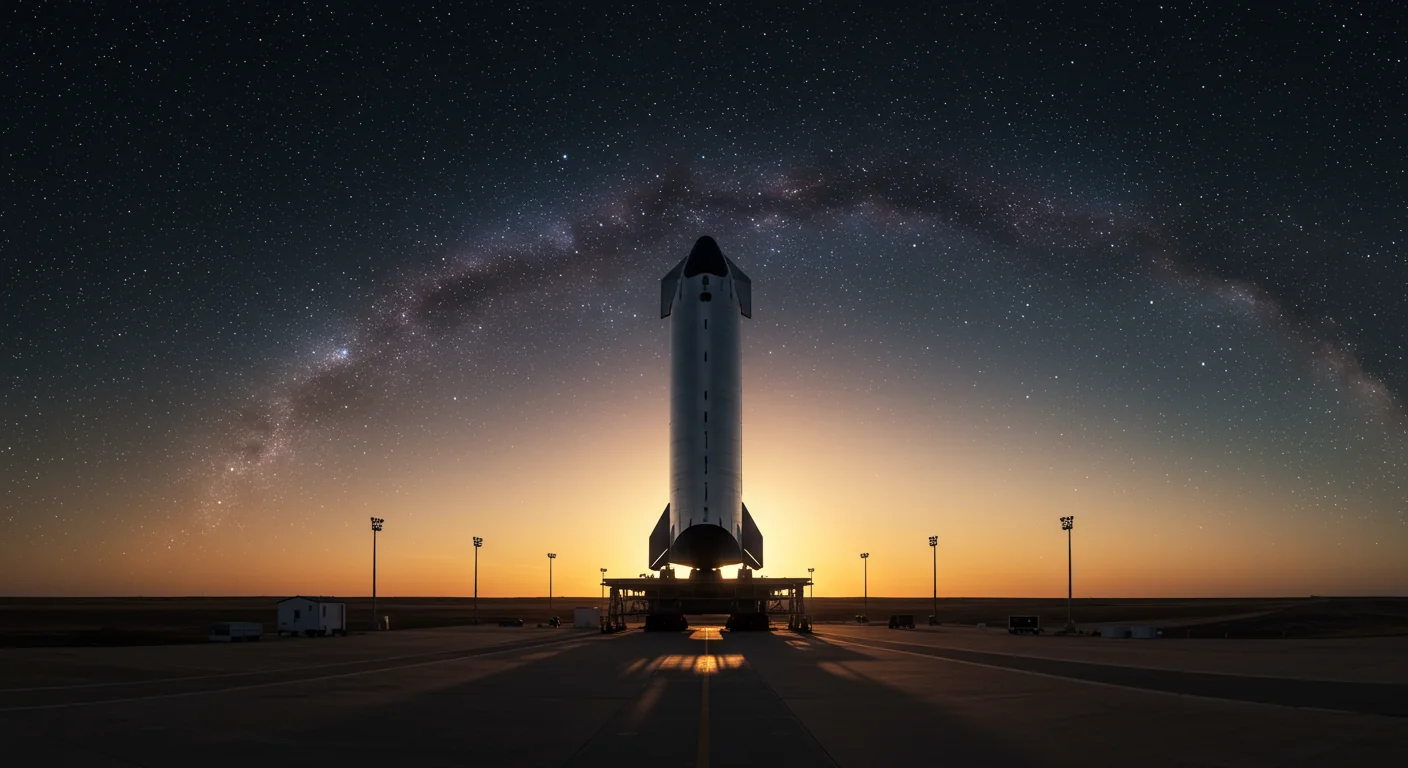
The postponement pushes the earliest Mars attempt to the 2028-2029 transfer window, a 26-month delay dictated by orbital mechanics. But just one day before this report, SpaceX demonstrated it is not standing still: on March 18, the company completed a successful static fire of its Starship Version 3 rocket on the newly constructed Launch Pad 2 at Starbase, Texas.
Why SpaceX Chose the Moon Over Mars
The calculus was straightforward. NASA's Human Landing System contract, worth more than $4 billion, requires SpaceX to deliver a crewed lunar lander variant of Starship for the Artemis III mission, currently targeted for 2028. The agency's Office of Inspector General warned in a March 2026 report that Starship development delays already threaten that timeline.
Elon Musk framed the decision as strategic rather than defeatist. "The Moon is faster... we can iterate much faster on building a self-growing city compared to Mars," he said, suggesting lunar operations would serve as a proving ground for the technologies needed on Mars, particularly life support, habitat construction, and in-situ resource utilization.
- SpaceX shelved the 2026 Mars window in February
- Next opportunity: late 2028 to early 2029
- Artemis III lunar landing now drives the Starship schedule
- NASA HLS contract exceeds $4 billion
The financial incentive is hard to ignore. SpaceX's valuation reached $1.25 trillion in February following its acquisition of xAI, but the Artemis contract represents guaranteed government revenue at a moment when the company is burning through an estimated $5 billion to $10 billion in Starship R&D costs.
The V3 Static Fire and What It Proves
The March 18 static fire of Booster 19, the first Starship Version 3 hardware, validated several critical upgrades. The V3 stack stands 124.4 meters tall and generates 15.7 million pounds of thrust from its Raptor 3 engines, enough to lift between 100 and 150 metric tonnes to low Earth orbit in fully reusable configuration.
The inaugural V3 flight, designated Flight 12, is expected in April 2026. A full-scale orbital refueling demonstration, the single most critical technology for both lunar and Mars missions, should follow by mid-year. SpaceX must prove it can transfer propellant between two Starships in orbit before either destination becomes viable for heavy payloads.
Phil Smith, a space industry analyst at BryceTech, called orbital refueling "a significant but not insurmountable challenge." The greater concern among independent engineers is the heat shield. Mars entry speeds of 7.5 kilometers per second generate temperatures exceeding 1,400 degrees Celsius, roughly double what Starship encounters returning from Earth orbit. Whether the thermal protection system can survive multiple such entries without replacement remains an open question.
The Road to Mars Still Runs Through Boca Chica
SpaceX's preferred Mars landing site is Arcadia Planitia, a broad, flat region with abundant shallow water ice and low elevation that provides more atmosphere for deceleration during descent. The company aims for a landing ellipse of less than 200 meters using Terrain-Relative Navigation, the same technology NASA's Perseverance rover used to touch down in Jezero Crater in 2021.
But reaching Arcadia Planitia requires solving problems that do not exist on the Moon. Starship must carry enough propellant to perform supersonic retro-propulsion in Mars's thin atmosphere, a maneuver never attempted at this scale. The vehicle must also land autonomously with a communication delay of up to 24 minutes, meaning no real-time human intervention is possible.
Musk's updated timeline envisions an uncrewed fleet of up to 20 Starships launching toward Mars during the 2028-2029 window, with the first human mission following in 2031 to 2033. Tesla's Optimus humanoid robots would serve as the advance workforce, assembling habitats and processing resources before crew arrival.
BOTTOM LINE: SpaceX is not abandoning Mars. It is sequencing the problem differently, using the Moon as a $4 billion dress rehearsal.
What Stands Between Starship and the Red Planet
Steven Berg, an assistant professor of aerospace engineering at Rutgers University, has been among the most vocal skeptics of SpaceX's orbital refueling timeline. His concern is not whether refueling is possible but whether SpaceX can achieve the launch cadence required. A single Mars mission may require 10 to 15 refueling flights in rapid succession, demanding a turnaround time measured in days rather than weeks.
The FAA adds another variable. Four open environmental review issues delayed Starship launches in late 2025, and each new pad and flight profile requires separate licensing. SpaceX's relationship with federal regulators has improved under the current administration but remains a potential bottleneck.
Then there is the question no one at SpaceX answers directly: what happens to a Starship that lands on Mars? Unlike lunar missions, there is no near-term plan to return the vehicle. The first Mars Starships will be one-way cargo carriers, their stainless steel hulls repurposed as shelters or storage. Return flights require manufacturing propellant from Martian water ice and atmospheric carbon dioxide, a process called in-situ resource utilization that has been demonstrated only at laboratory scale.
For now, the path to Mars runs through the Moon, through orbital fuel depots, through regulatory approvals, and through heat shield materials that do not yet exist in flight-proven form. SpaceX has never lacked ambition. The 2026 postponement is an admission that ambition alone cannot bend orbital mechanics or compress engineering timelines. What it can do, and what the V3 static fire demonstrated, is keep building while the planets slowly align.