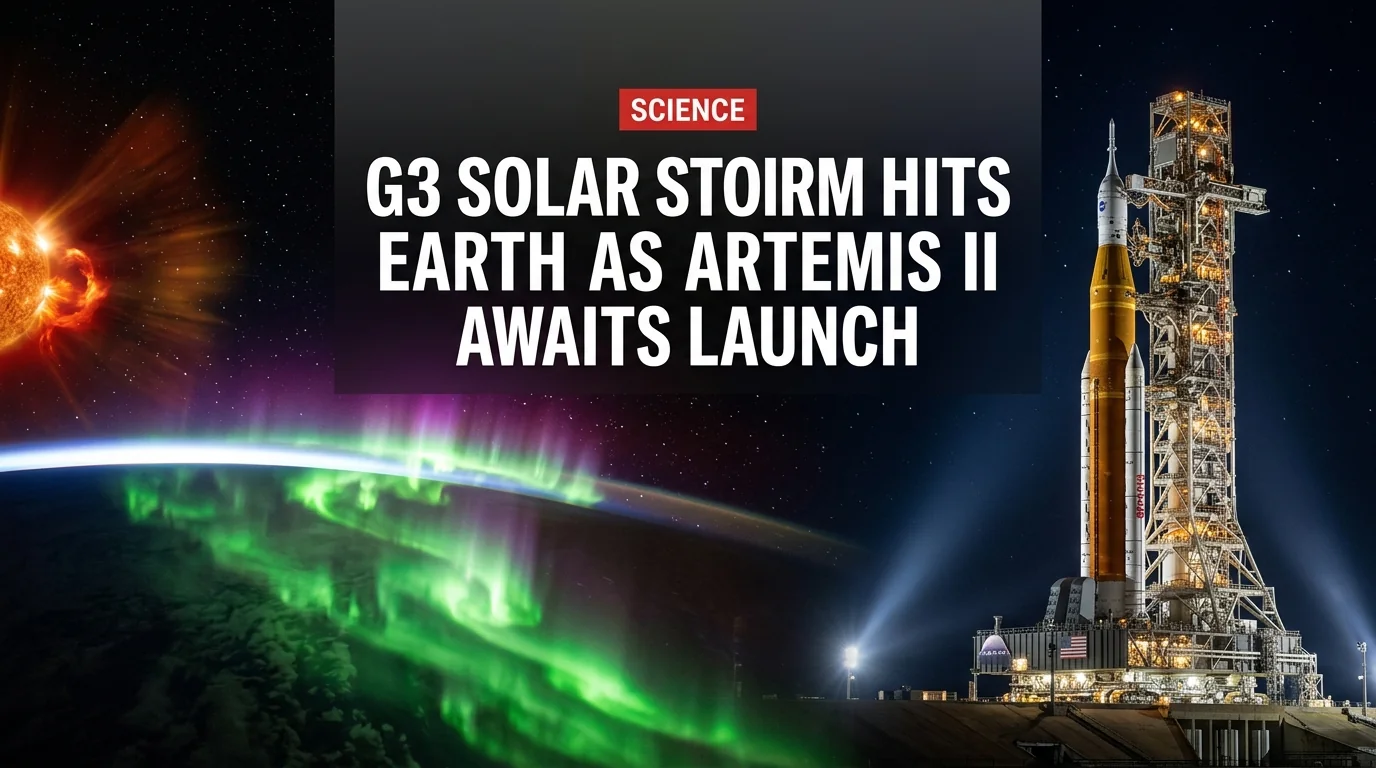
A powerful G3 geomagnetic storm is slamming into Earth's magnetic field this weekend, lighting up skies across 18 U.S. states with auroras — and raising fresh questions about whether NASA should press ahead with its Artemis II Moon mission, now just 10 days from launch.
The storm, triggered by multiple coronal mass ejections from Active Region AR4392, pushed the planetary Kp index to 7.0 on March 21. NOAA's Space Weather Prediction Center confirmed G3 (Strong) conditions at 23:28 UTC on March 20 and again at 01:54 UTC on March 21, with watches extending through March 22.
What's Happening Right Now
Four separate CMEs launched from the Sun between March 16 and 18 are arriving in waves. The first hit Earth's magnetosphere late on March 19, and the final pulse is expected to sweep through by Saturday evening. A fast-moving coronal hole high-speed stream is compounding the effect.
- **Storm level:** G3 (Strong) — third-highest on NOAA's 5-point scale
- **Kp index peak:** 7.0 (March 21)
- **Source:** Active Region AR4392 (M2.7 flare on March 16)
- **Duration:** March 19–22, tapering to G1 by Sunday
- **Equinox boost:** Spring equinox on March 20 doubled storm coupling efficiency
The timing is no coincidence. The spring and fall equinoxes create a geometric alignment between Earth's magnetic field and the solar wind that dramatically increases the chance of strong geomagnetic activity — a phenomenon scientists call the Russell-McPherron effect.
Auroras Stretch Deep Into the US
The storm has pushed aurora displays far south of their usual Arctic home. Observers in Wyoming, Colorado, Oregon, and Arizona reported vivid green and purple curtains overnight, with the Kp-7 conditions theoretically making the northern lights visible as far south as Illinois.
*Aurora visibility probability by latitude during Kp-7 conditions*Photographers have flooded social media with shots from locations that rarely see the phenomenon. March 2026 is shaping up to be the best month for northern lights viewing in nearly a decade, according to Live Science.
The Artemis II Problem
Just 330 miles away from Kennedy Space Center's aurora-lit skies, the Space Launch System rocket carrying the Orion capsule rolled out to Launch Pad 39B on March 19 — the same day the first CME arrived.
Artemis II will send four astronauts — Reid Wiseman, Victor Glover, Christina Koch, and Jeremy Hansen — on a 10-day loop around the Moon. Unlike astronauts on the International Space Station, who orbit within Earth's protective magnetosphere, the Artemis II crew will be fully exposed to whatever the Sun throws at them.
- Solar maximum reduces galactic cosmic ray exposure (paradox effect)
- Orion has six onboard radiation sensors and alarm systems
- NASA's Moon to Mars Space Weather Office provides 24/7 monitoring
- Crew trained to build improvised storm shelters inside the capsule
- A single strong solar energetic particle event could deliver dangerous radiation doses
- January's S4 radiation storm was the worst in 23 years
- No way to return quickly once past the Moon
- Solar declining phase often produces the most powerful individual flares
Dr. Victor Velasco Herrera at Mexico's UNAM has publicly urged NASA to delay: "Given how active the Sun is right now, our forecasts suggest that delaying the launch until the end of 2026 may be a much safer decision."
NASA has not wavered. The agency says its real-time monitoring network — spanning sun-orbiting satellites, ground stations, and even the Perseverance rover on Mars — gives mission controllers enough warning to protect the crew.
2026: A Year of Escalating Solar Violence
This weekend's G3 storm is just the latest in a series of increasingly aggressive solar events since the solar maximum was officially declared in October 2024.
The January event was particularly alarming. While initial forecasts from SpaceWeatherLive predicted G5 conditions, the storm peaked at G4 — narrowly avoiding the extreme category because the interplanetary magnetic field maintained a northward orientation. Had it flipped south, the story would have been very different.
What a Real G5 Would Cost
The current G3 storm causes manageable disruptions: voltage fluctuations in power grids, intermittent GPS errors, and degraded high-frequency radio for a day or two. A G5 would be catastrophic.
A Cambridge University and British Antarctic Survey study calculated that an extreme G5 event could knock out power for millions across the northeastern United States and northern Europe simultaneously. The last time that happened — the 2003 Halloween Storms — Sweden lost power for an hour and South Africa's grid suffered transformer damage that took months to repair.
What Happens Next
NOAA expects storm conditions to taper to G1 (Minor) by Sunday, March 22. But the Sun isn't done. Activity is forecast to remain elevated through mid-2026, and solar physicists warn that the declining phase of a solar cycle historically produces the most violent individual flares.
For aurora chasers, the next few nights still offer excellent viewing opportunities across northern states. For NASA, the clock is ticking toward April 1 with the Sun showing no signs of calming down.
The flight readiness review is expected this week. Four astronauts are in quarantine. And 93 million miles away, AR4392 is still crackling with energy.