An unseen world five times the mass of Earth may be lurking at the frozen edge of our solar system — and the most powerful survey telescope ever built is about to look for it.
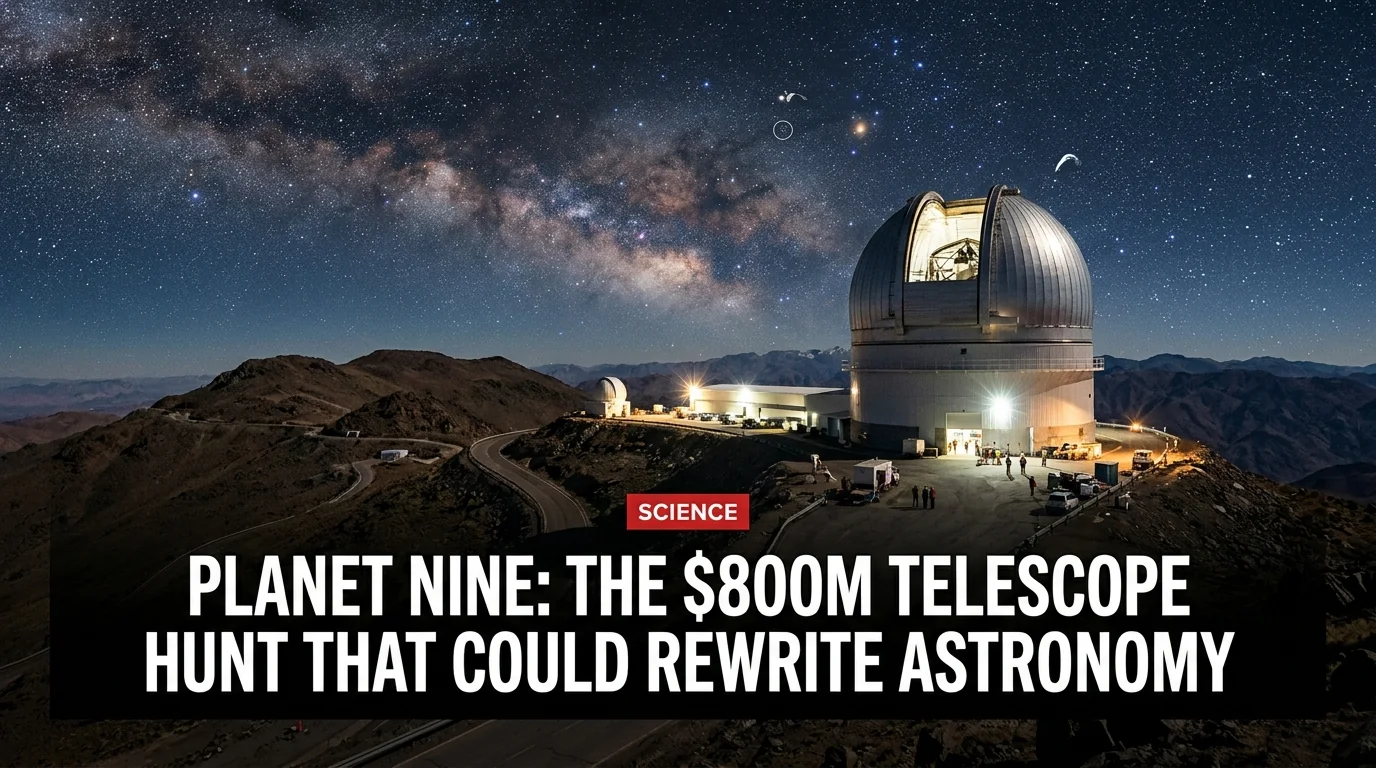
The Vera C. Rubin Observatory in Chile has entered its final commissioning phase in March 2026, with its ten-year Legacy Survey of Space and Time (LSST) set to begin later this year. Finding Planet Nine is one of its headline missions. If the planet exists within the predicted search zone, astronomers expect a definitive answer by late 2027.
Why Scientists Think Planet Nine Exists
The case for Planet Nine rests on a statistical anomaly that refuses to go away. In 2014, astronomers Chad Trujillo and Scott Sheppard noticed something strange: a cluster of extreme trans-Neptunian objects (ETNOs) — icy bodies beyond Neptune — were all tilted and aligned in a way that the known planets couldn't explain.
In January 2016, Caltech's Konstantin Batygin and Michael Brown built the mathematical case. Their models showed that a single massive, distant planet could herd these objects into their observed orbits. The probability of the alignment happening by chance?
KEY STAT: Less than 0.007% — roughly 1 in 14,000 odds that the orbital clustering is coincidence.
Not everyone is convinced. Astronomer Samantha Lawler of the University of Regina argues that "selection bias" — the tendency to find objects only where we look — creates an illusion of clustering. The debate has raged for a decade. Rubin's all-sky survey should settle it.
What Planet Nine Would Look Like
This isn't a gas giant like Jupiter. Think of a super-Earth or mini-Neptune — a world between Earth and Neptune in size, on a wildly elongated orbit that keeps it billions of miles from the Sun. At that distance, it reflects almost no light, which is why decades of searching have come up empty.
The Hunt So Far: A Timeline
The May 2025 breakthrough deserves attention. Researchers Terry Long Phan and Tomotsugu Goto at National Tsing Hua University in Taiwan found a heat signature by cross-referencing infrared data from two space telescopes taken 23 years apart. The signal appeared to move in a way consistent with a distant, slow-orbiting planet. It's now being verified with the James Webb Space Telescope.
The Telescope Built to Find It
The Vera C. Rubin Observatory is not just another telescope — it's a survey machine.
| Feature | Specification |
|---|---|
| Location | Cerro Pachón, Chile (2,682m elevation) |
| Camera | 3.2 gigapixels (largest digital camera ever built) |
| Sky coverage | Entire visible southern hemisphere every 3–4 nights |
| Total cost | ~$800 million (NSF, DOE, private funding) |
| Annual operating cost | $70–72 million per year |
| Primary mission | Legacy Survey of Space and Time (LSST), 10 years |
| Developer | SLAC National Accelerator Laboratory (camera) |
Michael Brown himself has said: "If you were to hand me a billion dollars to build a telescope to find Planet Nine, I would give it back because the Vera Rubin Observatory is absolutely perfect."
The strategy is straightforward. By photographing the entire sky repeatedly, any faint, slow-moving object will reveal itself through its gradual shift against the background stars. Planet Nine, at magnitude 21–22, sits comfortably within Rubin's detection range.
The Wild Card: Could It Be a Black Hole?
In one of the more provocative theories, physicists Jakub Scholtz and James Unwin have suggested that "Planet Nine" might not be a planet at all — but a primordial black hole roughly the size of a grapefruit.
A black hole of 5–6 Earth masses would produce the same gravitational effects on ETNOs. It would also explain why no telescope has spotted it in visible or infrared light — black holes don't reflect or radiate in ways conventional planet searches would detect.
If true, it would be the first primordial black hole ever discovered, opening an entirely new chapter in astrophysics.
What Discovery Would Mean
- Planet Nine would be only the **third planet discovered since antiquity** (after Uranus in 1781 and Neptune in 1846)
- It would prove the solar system extends **far beyond** current models
- It would validate the "Nice model" of planetary migration, which predicts a fifth giant planet was ejected during early formation
- Michael Brown — who led the effort to demote Pluto — would become the discoverer of its replacement
That last point carries a certain poetic justice. Brown, who earned the nickname "Pluto Killer" after his work led to Pluto's 2006 reclassification as a dwarf planet, has spent the past decade trying to find a world that would genuinely earn the title of ninth planet.
The Bottom Line
After a decade of mathematical models, archival searches, and heated academic debate, the Planet Nine question is entering its final act. The Vera C. Rubin Observatory has the sensitivity, the sky coverage, and the observing cadence to deliver a verdict.
By late 2027, we'll either know that a hidden super-Earth has been orbiting our Sun for 4.5 billion years undetected — or that one of astronomy's most compelling hypotheses was a statistical mirage all along.
Either outcome reshapes our understanding of the solar system. The telescope is ready. The coordinates are set. Now we wait.