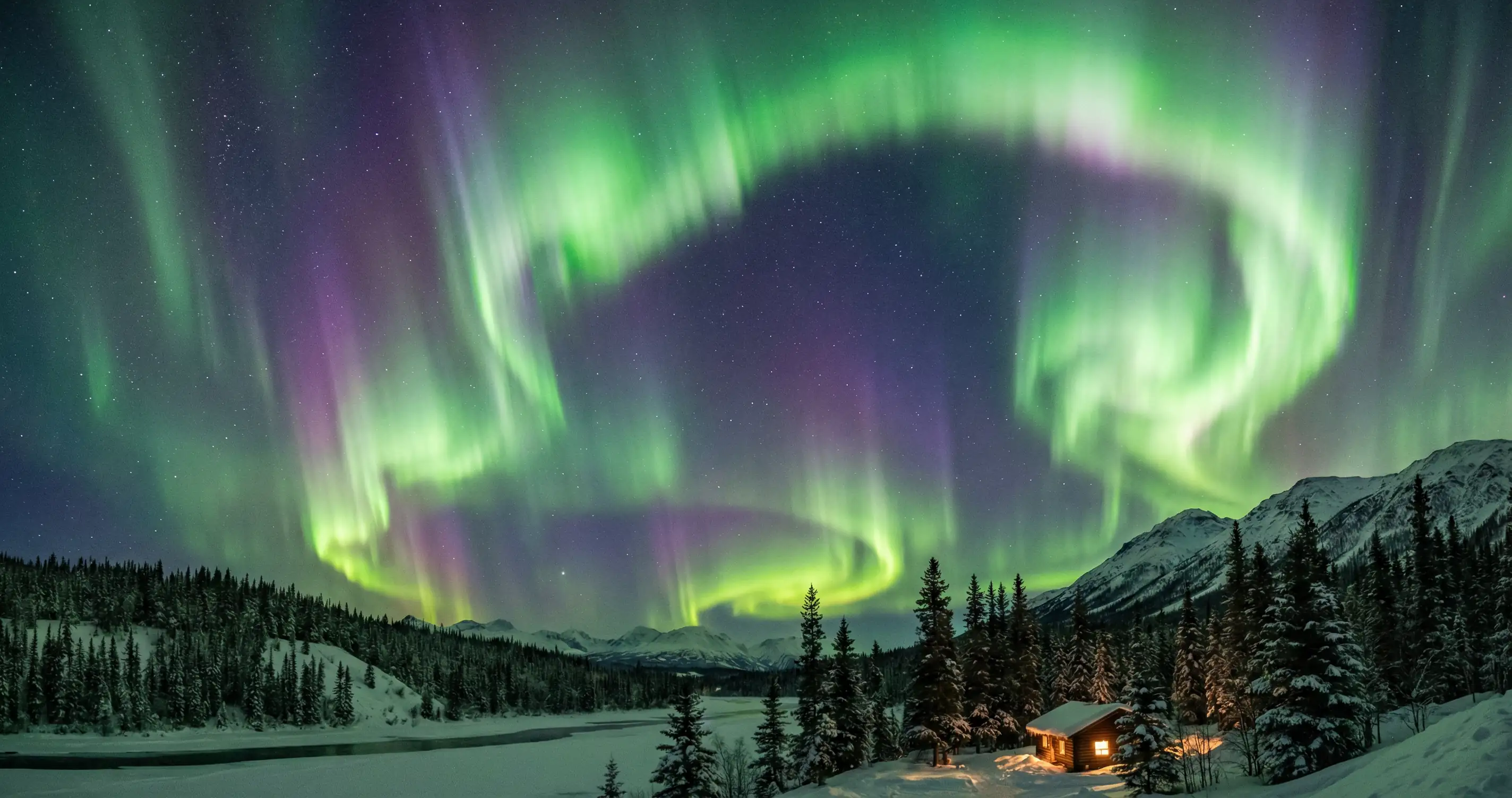
The northern lights are forecast to peak in 2026 as solar activity stays strong. The best months to see the aurora borealis are late September through March, with December through February offering the most reliable conditions: long darkness and often clearer skies. For timing, aim for local midnight, roughly 10 p.m. to 4 a.m., when the auroral oval is usually most overhead.
Geomagnetic activity also tends to spike around the equinoxes (March 20 and September 23). For the darkest skies, plan for a new moon or crescent phase; a full moon can wash out fainter displays. A geomagnetic storm watch with a Kp index of 4 or higher increases the chance of visible aurora, including at lower latitudes.
Best Places in North America
In the U.S. and Canada, the best odds are at high latitudes. Fairbanks, Alaska (around 65°N), is one of the world's top destinations for aurora viewing, with clear, dark skies and frequent activity. Yellowknife, Canada (about 62°N), is another. During strong geomagnetic storms (Kp 5 or above), the aurora can push south into the northern tier of the continental U.S., so viewers in Minnesota, North Dakota, Montana, and northern New England sometimes see displays.
Best Places in Europe
Northern Scandinavia leads in Europe. Norway, Sweden, and Finland, especially above the Arctic Circle, offer excellent viewing. Iceland is also a major aurora destination, with a good balance of accessibility and dark skies. As in North America, stormy periods can push the aurora farther south across Scotland and northern Europe.
Viewing Tips
The aurora typically appears between 65° and 75° magnetic latitude. To maximize your chances, choose a spot with minimal light pollution, check the weather for clear skies, and use a Kp forecast to target nights with higher activity. Dress for cold; prime viewing is in winter, often in sub-freezing temperatures. Allow your eyes 15–20 minutes to adapt to the dark.
What's Next
Solar cycle conditions will stay favorable for the next few years. Apps and sites like Space.com and Aurora Map offer 2026-specific guides and short-term forecasts. Planning a trip around a new moon and a period of elevated Kp will give you the best shot at a memorable display.