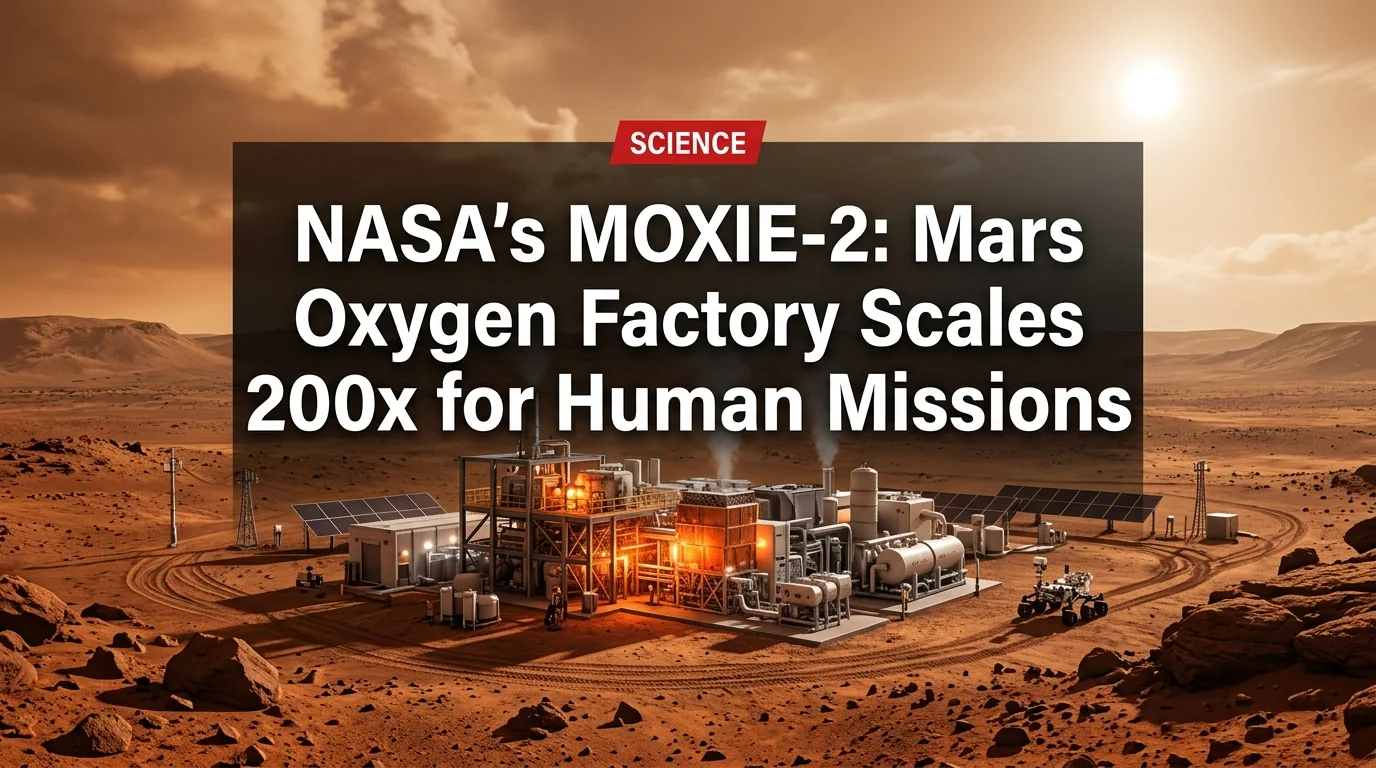
NASA's next Mars machine won't carry a drill or a camera. It will carry a factory — one designed to turn the thin Martian atmosphere into 30 metric tons of breathable oxygen and rocket fuel, enough to launch astronauts back to Earth.
The agency's Mars Oxygen and Methane System (MOMS), widely known as MOXIE-2, represents a 200-fold scale-up from the toaster-sized experiment that first proved the concept aboard the Perseverance rover in 2021. On March 17, 2026, NASA formally integrated the industrial-scale system into its Moon-to-Mars Architecture, marking a shift from demonstration to deployment.
From 122 Grams to 30 Metric Tons
The original MOXIE ran 16 times between April 2021 and August 2023, extracting a total of 122 grams of oxygen from Martian CO₂ — roughly what a person breathes in three hours. It was a proof of concept, nothing more.
MOXIE-2 operates on an entirely different scale.
::stats
- 200x — Production increase over original MOXIE
- 1–3 kg/hr — Sustained oxygen output rate
- 30 tons — Total oxygen target over 14–18 months
- 99.6% — Purity grade (propellant-qualified)
- $17M — Initial 2026 scale-up contract ::
"We've moved from a toaster-sized experiment to a factory-scale reality," said Dr. Michael Hecht, the principal investigator who led MOXIE at MIT's Haystack Observatory. "The technology is surprisingly robust against Mars' dust and thermal cycling."
How It Works: Breathing CO₂, Exhaling O₂
Mars' atmosphere is 95% carbon dioxide. MOXIE-2 uses solid oxide electrolysis (SOXE) to split CO₂ molecules at roughly 800°C, separating the carbon from the oxygen. A scroll compressor first intakes and pressurizes the thin Martian air — atmospheric pressure on Mars is less than 1% of Earth's — before feeding it into electrolysis stacks built by Utah-based OxEon Energy.
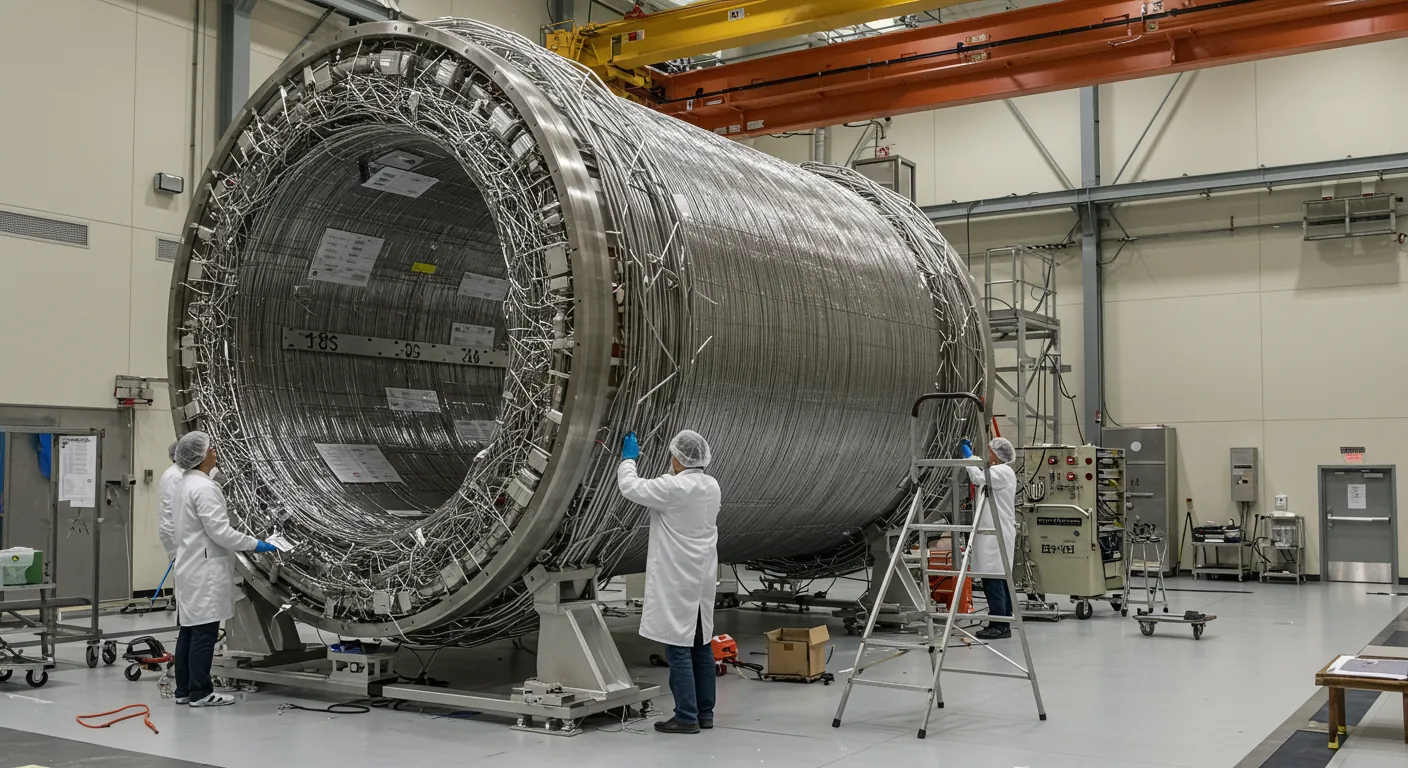
The upgraded system uses mission-scale SOXE stacks with a five-fold increase in cell area and 6.5 times more cells per stack, making each unit 33 times the capacity of the original. Six stacks working together can produce the full 30-ton target within a 19-month operational window.
MOXIE vs. MOXIE-2: The Numbers
| Specification | MOXIE (2021) | MOXIE-2 / MOMS (2026) |
|---|---|---|
| Oxygen output | 6–12 g/hr | 1,000–3,000 g/hr |
| Total production | 122 g (lifetime) | 30,000,000 g (30 tons) |
| Power draw | ~300 W | 20–30 kW |
| System mass | 15 kg | ~1,000 kg |
| Purity | 98%+ | 99.6%+ |
| R&D investment | ~$55M (total) | $17M (initial scale-up) |
The Economics of Breathing on Mars
Every kilogram launched from Earth to Mars costs approximately $1 million. The 30 tons of oxygen MOXIE-2 produces on-site would cost $30 billion to ship from Earth — assuming you could even fit it on existing rockets.
KEY STAT: By manufacturing oxygen on Mars instead of shipping it, NASA eliminates hundreds of tons of launch mass and saves billions in mission costs.
This is the core promise of In-Situ Resource Utilization (ISRU): stop carrying everything from home. The oxygen MOXIE-2 produces serves two purposes — life support for crew habitats and oxidizer for the Mars Ascent Vehicle (MAV) that brings astronauts home.
Who's Building It
The project spans NASA's Jet Propulsion Laboratory, MIT, and a network of specialized contractors:
::keyfacts
- MIT Haystack Observatory — Lead research institution; developed the SOXE technology and system controls
- OxEon Energy (Utah) — Industrial contractor; designs and manufactures the ruggedized electrolysis stacks
- Air Squared — Provides scroll compressor technology for CO₂ intake
- Plansee HPM & Global Tungsten — Manufacture chromium-based interconnectors for electrolysis cells
- NASA STMD — Funding and mission management through the Space Technology Mission Directorate ::
Jessica Elwell, OxEon Energy's COO, called the scale-up "a pivotal moment for both space and Earth," noting the same electrolysis technology can produce clean fuel terrestrially.
The Timeline to Mars
::timeline
- April 2021 — First oxygen produced on Mars (5.4 grams via MOXIE)
- August 2023 — MOXIE completes 16th and final run; 122 grams total
- Late 2024 — NASA awards OxEon Energy SBIR Phase II contract for scale-up
- July 2025 — MOMS breadboard demonstrates integrated O₂ and methane production in simulated Mars environment
- March 2026 — NASA integrates MOXIE-2 into Moon-to-Mars Architecture
- 2026–2027 — Full terrestrial qualification testing
- 2028 — Integration with nuclear fission power source (20–30 kW Kilopower reactor)
- Late 2020s — Pre-deploy cargo mission lands MOXIE-2 on Mars to fill MAV tanks before crew launch ::
The Skeptics Have a Point
Not everyone is celebrating without caveats. Some researchers have flagged that NASA's intermittent funding between 2023 and 2025 nearly stalled momentum on the industrial scale-up. The gap between MOXIE's final run and the MOMS contract left critical engineering talent dispersed.
There's also the power question. MOXIE-2 needs 20–30 kilowatts of continuous power — roughly what 20 American homes consume. On Mars, that means a nuclear fission reactor, likely a variant of NASA's Kilopower system. That reactor doesn't exist in flight-ready form yet.
What This Means for the Mars Timeline
MOXIE-2 isn't just a science experiment. It's infrastructure. Without on-site oxygen production, a crewed Mars mission requires either dramatically more launch mass or a one-way ticket. The MOMS system is what makes a round trip economically and physically feasible.
NASA Deputy Administrator Pam Melroy and STMD Associate Administrator Jim Reuter have positioned the system as the "industrial heart" of the Mars campaign. "We aren't just visiting," Reuter said. "We are establishing a presence by living off the land."
The factory that breathes Mars' air so humans can too — that's MOXIE-2. And as of this month, it's officially on the mission manifest.