K2-18b Biosignature Was a False Alarm: What Went Wrong
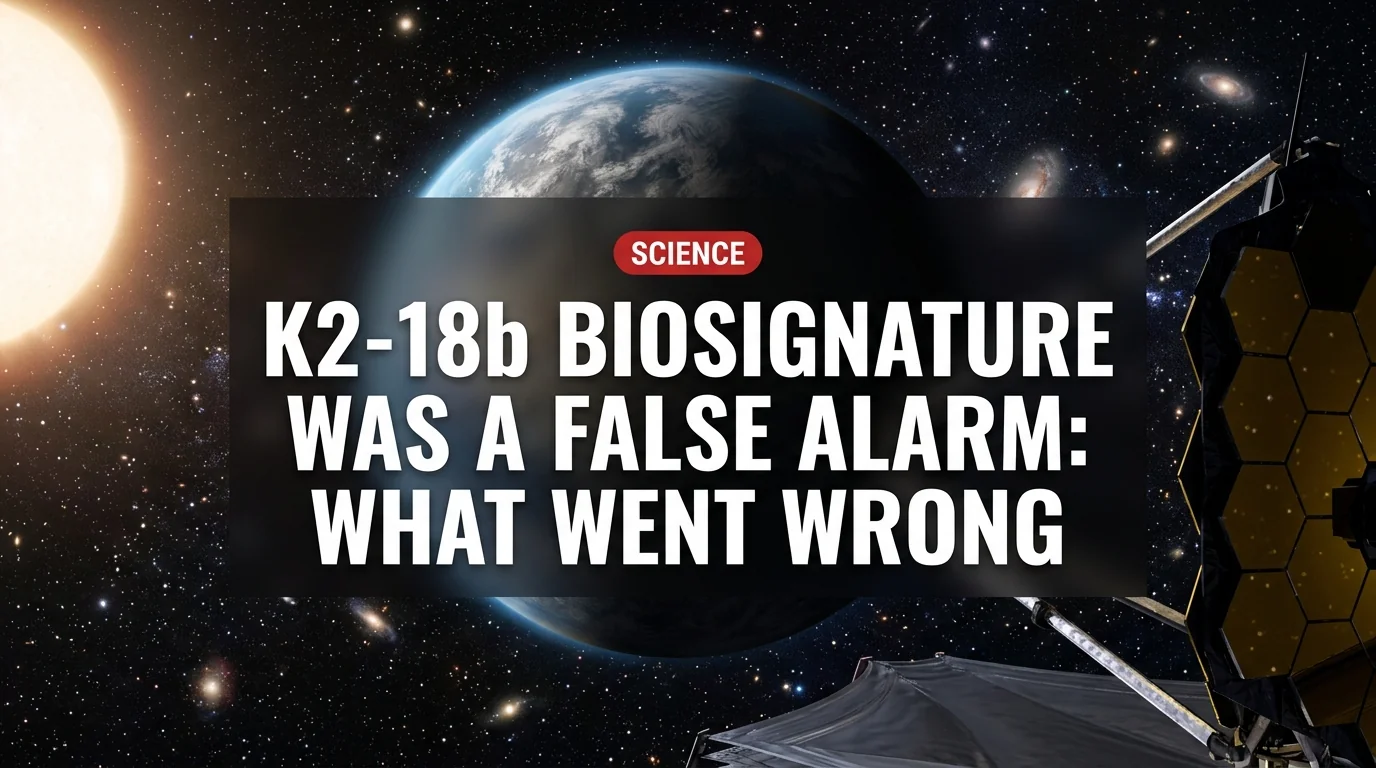
The most exciting claim in modern astrobiology — that the James Webb Space Telescope detected signs of life on a distant exoplanet — has collapsed under scrutiny. A January 2026 paper from Arizona State University concludes that the dimethyl sulfide (DMS) signal on K2-18b was never what it appeared to be.
The finding doesn't just close a chapter. It exposes how hype, statistical shortcuts, and media pressure can distort the scientific process.
The Signal That Launched a Thousand Headlines
In September 2023, Cambridge astrophysicist Nikku Madhusudhan announced that JWST had detected methane, carbon dioxide, and — tantalizingly — a hint of DMS in the atmosphere of K2-18b, a "Hycean" world 124 light-years away in the constellation Leo.
On Earth, DMS is produced almost exclusively by marine phytoplankton. Finding it on an exoplanet with a possible ocean was electrifying.
- **K2-18b** is 8.6× Earth's mass, 2.6× Earth's radius
- Orbits its red dwarf star every **33 days** in the habitable zone
- Classified as a **Hycean world** — hydrogen atmosphere over a liquid ocean
- Located **124 light-years** from Earth in constellation Leo
The Numbers Never Added Up
From the start, the statistical evidence was fragile. Here's how the confidence levels evolved — and eroded:
The gold standard for scientific discovery is 5 sigma — a 1-in-3.5-million chance of error. The K2-18b DMS signal never exceeded 3 sigma, which translates to a 1-in-370 chance of being random noise. In particle physics, that wouldn't even earn a press release.
59 Molecules, One Spectral Bump
The killing blow came from Luis Welbanks and his team at Arizona State University. Their January 2026 preprint showed that the infrared "fingerprint" attributed to DMS could be produced by at least 59 other compounds, including propyne (CH₃C≡CH) — a simple hydrocarbon with no biological significance.
The problem is fundamental to exoplanet spectroscopy: JWST captures light filtered through a planet's atmosphere during transit. At the resolution available, many molecules produce overlapping absorption features. Without higher-resolution instruments, separating DMS from propyne — or dozens of other candidates — is statistically impossible.
KEY STAT: The DMS concentration estimated on K2-18b was 10,000× higher than on Earth — itself a red flag that the signal might not be biological in origin.
The Skeptics Were Right All Along
Not everyone bought the hype. The scientific pushback was swift and came from multiple directions:
| Researcher | Institution | Finding | Date |
|---|---|---|---|
| Jake Taylor | Oxford | Data lacks precision for DMS detection | Mid-2025 |
| Renyu Hu | NASA JPL | Abiotic photochemistry can explain the signal | July 2025 |
| Rafael Luque | U. of Chicago | No strong statistical evidence for DMS | Late 2025 |
| Luis Welbanks | Arizona State | 59 molecules produce identical spectral features | Jan 2026 |
NASA's official position remained cautious throughout: "Detection of a single potential biosignature would not constitute discovery of life."
The Cambridge team, to their credit, always described the detection as "tentative." But that qualifier rarely survived the journey from paper to headline.
What K2-18b Actually Taught Us
The episode isn't a failure of science — it's science working exactly as designed. A bold claim was made, tested independently, and found insufficient. That process took roughly two years, which is fast by astronomical standards.
But it exposed three structural problems:
1. The Hycean hypothesis may be flawed. K2-18b was the poster child for a new class of habitable worlds — hydrogen-atmosphere ocean planets. If DMS detection is unreliable on the best candidate, the entire framework needs recalibration.
2. JWST's spectral resolution has limits. The telescope is extraordinary, but it was designed as a general-purpose observatory, not a dedicated biosignature hunter. Confirming alien biochemistry will likely require the Habitable Worlds Observatory, planned for the 2040s.
3. The hype cycle is dangerous. When "hints of life" become headlines before reaching statistical significance, public trust in science erodes with each retraction.
What Comes Next
The search isn't over. Researchers estimate 16 to 24 additional hours of JWST observation could settle the DMS question definitively. Meanwhile, related sulfur-chemistry research on other exoplanets — like L 98-59 d — continues to expand our understanding of atmospheric chemistry beyond Earth.
The real biosignature discovery, when it comes, will need to clear a much higher bar. K2-18b set the precedent: extraordinary claims in astrobiology now require extraordinary evidence, not just extraordinary telescopes.
K2-18b remains one of the most studied exoplanets in history. Its atmosphere confirmed methane and CO₂ — a genuinely significant finding. The biosignature claim, however, has joined the long list of promising signals that didn't survive peer review.